
OTD in early British television: 11 May 1938
The 150th original OTD post in this series.
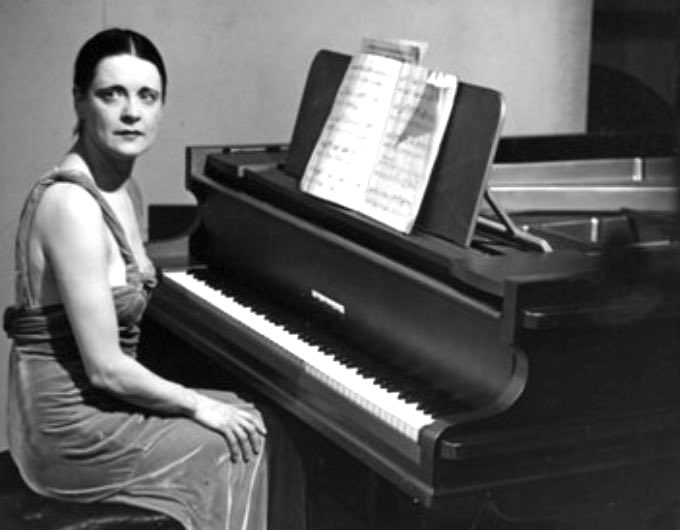
John Wyver writes: Monday 2 May 1938 (I know, I know) saw pianist Harriet Cohen together with the a modestly enhanced BBC Television Orchestra give a studio concert at Alexandra Palace of music by Thomas Arne and Bach. The image above is of her on this occasion.
The producer of this half-hour presentation was Dallas Bower, but it’s less the broadcast that I want to focus on and more a fascinating Listener column that it prompted – and that was published on Wednesday 11 May. The writer of ‘Music to look at’, which was a careful close-reading of the broadcast, was the ever-so-slightly mysterious ‘G.G.W.’, who was still contributing reviews alongside regular filings by Grace Wyndham Goldie.
On this occasion, ‘G.G.W.’ paid scrupulous attention to the camera angles:
A.P. have at their disposal a number of ways of presenting the pianist on the screen. On this occasion they played safe and showed Miss Cohen much as we should have seen her ifwc had been attending a concert hall. Thal is to say, we saw a side view of piano and pianist, with the right hand near the camera, the left receding into the distance.
No one who has heard her play will need telling that Miss Harriet Cohen was worth listening to. But presented thus on a television screen it may perhaps be asked whether the visual side of the programme added materially to the enjoyment of the sound.
What we could see was this: the treble end of the key board and part of the piano: Miss Cohen in profile, and her right arm from shoulder to hand. We could see and admire the flexibility of her right wrist (the left, doubtless equally flexible, was seldom visible); and occasionally we saw something of the fingering of her right hand.
Now was that all we could justifiably expect? Might it not be said that within the small space of our screen we should have preferred a close-up view looking down on the pianist’s hands – the sort of view the pianist herself sees if she looks down while she is playing?
To arrange it presents technical difficulties, but it is not beyond the ingenuity of A.P. and has already been done with interesting results. Of course the programme would begin with the conventional side view of piano and player just to show that there was no deception and that it really was Miss Cohen’s hands we were about to watch.
No one would want the camera to switch about from keyboard to player and back again during the actual performance. We get quite enough of that sort of camera work in the cinema, and with serious music it would be only an irritating distraction from the sound.
But once the pianist begins to play it is her hands that matter, and it is her hands we want to see. Against this it might be argued that the very movement of the fingers on the screen is to many a distraction from the music, and that while it would interest some who are concerned with the technique of playing, there are other viewers who would be better served with a less unconventional treatment.
‘G.G.W.’ suggests that something similarly imaginative might also be tried with other instruments, before making an especdially radical suggestion.
There is one other consideration for the producer, for what it is worth : and that is the enthusiast who goes to a concert armed with the score. Here is a clear case of a person who wants to listen to music and watch. not the players, but the printed notes.
Some day it might be effective – it would certainly be interesting – if the camera could be trained on to a specially prepared score and move from line to line as the work proceeds.
I believe it would take nearly three decades before producer Barrie Gavin experimented with just such a technique in a collaboration with Pierre Boulez.
Leave a Reply