
The Ring on my sofa
John Wyver writes: I spent Sunday afternoon at home with Wotan, Fricka and friends. Not in person, obvs, but nearly as good as, thanks to the live stream from Paris of Das Rheingold. Opéra national de Paris is giving two cycles of Richard Wagner’s tetralogy this autumn, and one of those is available on the company’s platform, both live and then in a 30-day catch-up pattern.
The online offer is sensationally good value, with a €9.99 monthly subscription tab that is cancellable at any time, and even a free 7-day trial, which if you are on the ball, allows you to see all four operas. The next live performance, conducted as is the full cycle is by Pablo Heras-Casado, is Die Walküre at 5pm on Tuesday; the conclusion, Götterdämmerung, is on Sunday.
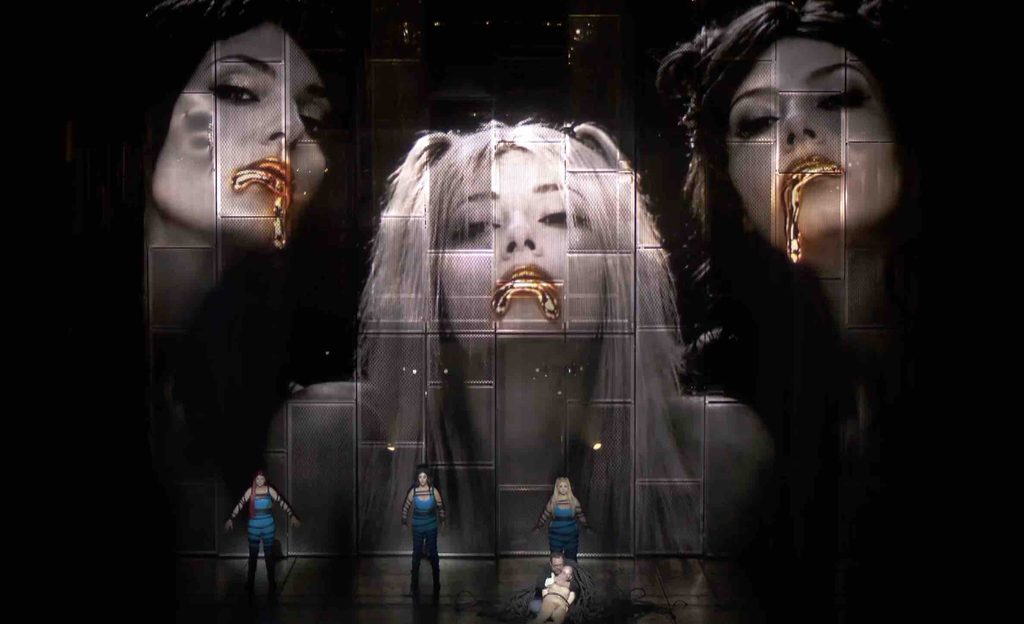
The stage director is Calixto Bieito, the radical Spanish director whose work invariably attracts the label ‘controversial’. You can get a good idea of his contemporary, tech-obsessed approach from this 2025 review (with a different cast). Bieito sets the action in front of a towering wall of metal panels in which are set doors and other apertures. The staging before this is comparatively simple, so that the Rhinemaidens simply stand in a line as they tempt Alberich (above). Only in the final moments does the wall open up, spectacularly, with the bridge that allows Wotan and Fricka to cross into the new edifice of Valhalla (below).
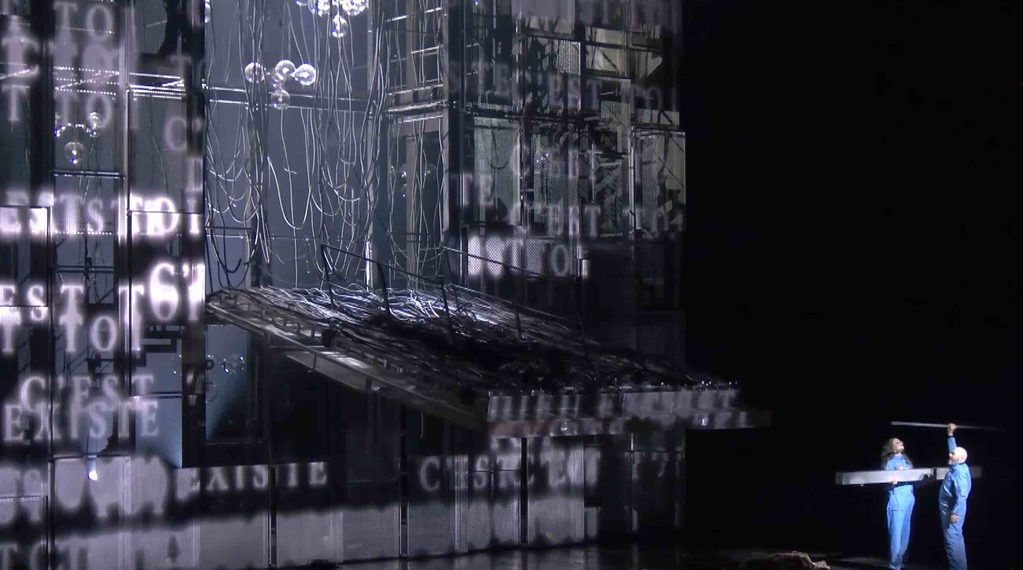
The dominant feature of the production, however, are the projections onto the metal grille. Even on my modestly-sized flat screen television, I thought these were sensational. Digital environments, flickering patterns of data, avatars and human faces, conjure up a virtual universe that dwarfs the singers in a space of the electronic sublime. I was captivated, and the exemplary English subtitles were very helpful too.
The screen translation, achieved I believe by an in-house team, was clear and straightforward, shot in a mix of medium shots and wides, mostly from the front but with occasional use of angled cameras. The shots capture the action and the spectacle most effectively, but the screen language is entirely conventional: no close-ups, no superimpositions or cross-fades, and certainly no inserts, split-screens or the like.
My first Ring was also on screen, more than forty years ago, when BBC2 showed Patrice Chéreau’s 1976 “centenary” production, conducted by Pierre Boulez. This was screened as ten episodes – Das Rheingold and then single acts of the other three – on consecutive Saturday evenings. Brian Large had recorded this at Bayreuth, without a theatre audience, in 1979 and 1980. The images were not HD but the grammar of the translation to the screen was directly comparable.
This sense that screen adaptation from the theatre has not progressed in nearly half a century continues to surprise me. The screen language of almost every other television form — think sports and news — becomes ever richer, more complex and more mediated, while performance remains pretty much the same as it ever was. Apparent transparency from the stage remains the rule.
Leave a Reply