
The Sunday dozen
John Wyver writes: In this week’s choice of links that have interested and engaged me across the past week I have resolutely set my face against explicit engagements with the hideous politics of the world, although of course they have crept back in in cultural forms. I hope you find something that is useful or diverting.
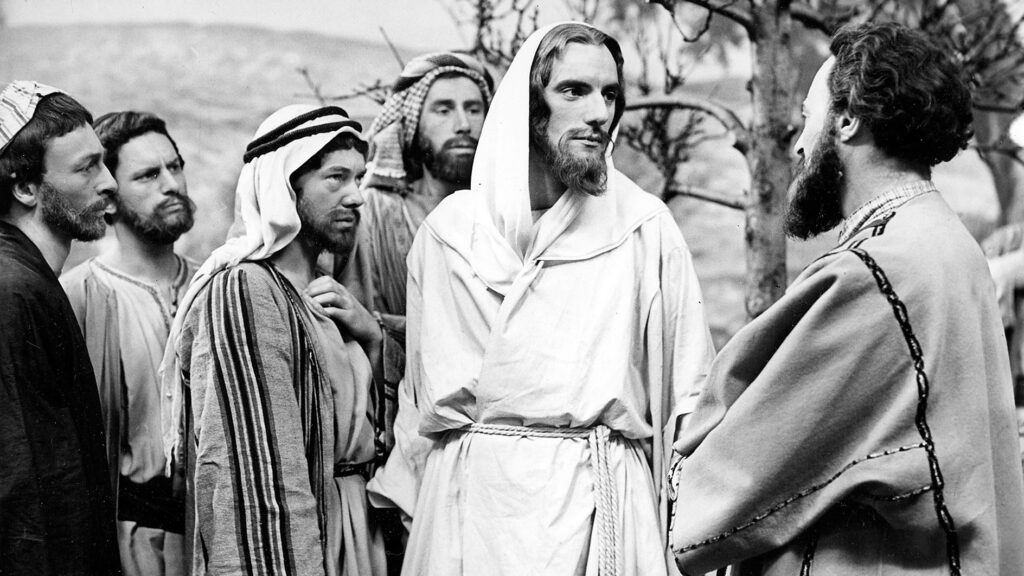
• Depicting Jesus: an absolutely fascinating History of the BBC web essay by Paul Hayes about the children’s serial Jesus of Nazareth broadcast 70 years ago; the header image shows Hugh Dickson as Nathaniel Bartholomew, Philip Guard as Philip, Michael Bryant as John, Richard Grant as James, Tom Fleming as Jesus and Anthony Jacobs as Judas in a scene from episode five, Jesus the King.
• Domestic thrillers aren’t just a trend. They’re the defining metaphor of our time: Judy Berman for Time is really very good on the contemporary domestic thriller, ‘a niche that has come to dominate every form of narrative entertainment by, for, and about women’ with ‘broad resonance in a paranoid society in the throes of what the journalist Jeff Sharlet calls a “slow civil war.“‘
• Snow White and the Seven Dwarfs: for ReverseShot, Dan Schindel on Disney’s revolutionary multi-plance camera.
• Deep faking Orson Welles’ mangled masterpiece: Michael Shulman for The New Yorker [£; limited free access] with an amazing tale about The Magnificent Ambersons, re-animating dead actors, and AI (and I know I’m featuring several New Yorker pieces this week, but each one more than deserves its place); and in case you need reminding, here’s an original trailer:
• “Man of Principle”: Agnieszka Holland remembers Andrzej Wajda: a reflection by the fellow filmmaker Holland tied to the current BFI Southbank season of the great Polish director’s key works.
• The ‘little scorpion’ of the French Riviera: we stayed in the Mediterranean town of Menton last summer and saw the closed Jean Cocteau museum, so this thorough New York Times piece by Zachary Small, with a wealth of illustrations by Théo Giacometti, was of particular interest.
• ‘She worked like a maniac’ … meet the design genius who could even make roadworks look good: so good to be reminded by Catherine Slessor for the Guardian of the wonderful work of graphic designer Margaret Calvert, who inspiringly remains active as she turns 90.
• In Our Time – Henry IV Part One: a confident outing in the new run with Misha Glenny chairing a discussion of Shakespeare’s lesser-known history play, with Emma Smith, Professor of Shakespeare Studies at Hertford College, University of Oxford, Lucy Munro Professor of Shakespeare and Early Modern Literature at Kings College London, and Laurence Publicover, Associate Professor in the Department of English at the University of Bristol.
• Fanfiction’s total cultural victory: terrific by Eli Cuginin for Defector:
Fanworks and fan cultures are, frankly, wondrous: engaged, constructive, tuition-free writing communities for writers at all levels! Massive archives that include works of serious ingenuity, talent, and feeling! Fortresses’ worth of gay erotica! Fanfiction helped teach me, as an adolescent, how to write; it helped me learn how to articulate desire. Trouble has always lain, however, within the hunger to turn fanfiction into published fiction, and in how fanfiction’s fantasies are repackaged for mass appeal.
• Robinson Crusoe counsels against solitude and Solitude has many faces: two very fine, complementary articles, the first longer and more academic, by Barbara Taylor for History Workshop Journal about Daniel Defoe and loneliness.
• On Broadway: four musicals and me: I really enjoyed Kevin Champoux’s diaristic reflections for The Paris Review about watching four recent musicals:
What keeps me interested in Broadway musicals is not just the possibility that one might lapse into an unexpected moment of transcendence but that they so frequently do not even approach it. It is an art form condemned to failure because it runs along the live wire of sentimentality, because it cannot hide behind a fog of interpretation.
• Bruce Springsteen’s Streets of Minneapolis: how digital circulation boosts the impact of a protest song: Adam Behr for The Conversation; see also What do we want from a protest song?, by Mitch Therieau for The New Yorker [£; limited free access].
• Liberalism’s pianist: a remarkable and clear-eyed assessment of Igor Levit by Nathan Shields for The New York Review, with a broad look across the classical music world today, its politics and avoidance thereof:
Not only does Levit invoke onstage a cultural authority that classical music no longer has; his offstage rhetoric is also part of an old argument about how that authority was lost.
• Morton Feldman’s music of stillness: I’m currently listening to the the wonderfil Another Timbre six-CD set of Feldman’s Trios: Works for flute, piano and percussion, performed by GBSR Duo and Taylor MacLennan, and Alex Ross’ deeply informed essay for The New Yorker is the perfect complement…
• And finally: here’s the very fine 4 minute 20 second trailer for the box-set.
Leave a Reply