
The Sunday dozen
John Wyver writes: I have started a nearly month-long holiday in France, and after three days’ driving have arrived at the small town of Simiane-la-Rotonde in the Luberon. Which is glorious, and which I will send an occasional update from over the coming days, while also continuing to make the final preparations for The Cultures of Early Television conference in early July, registration for which is open here.
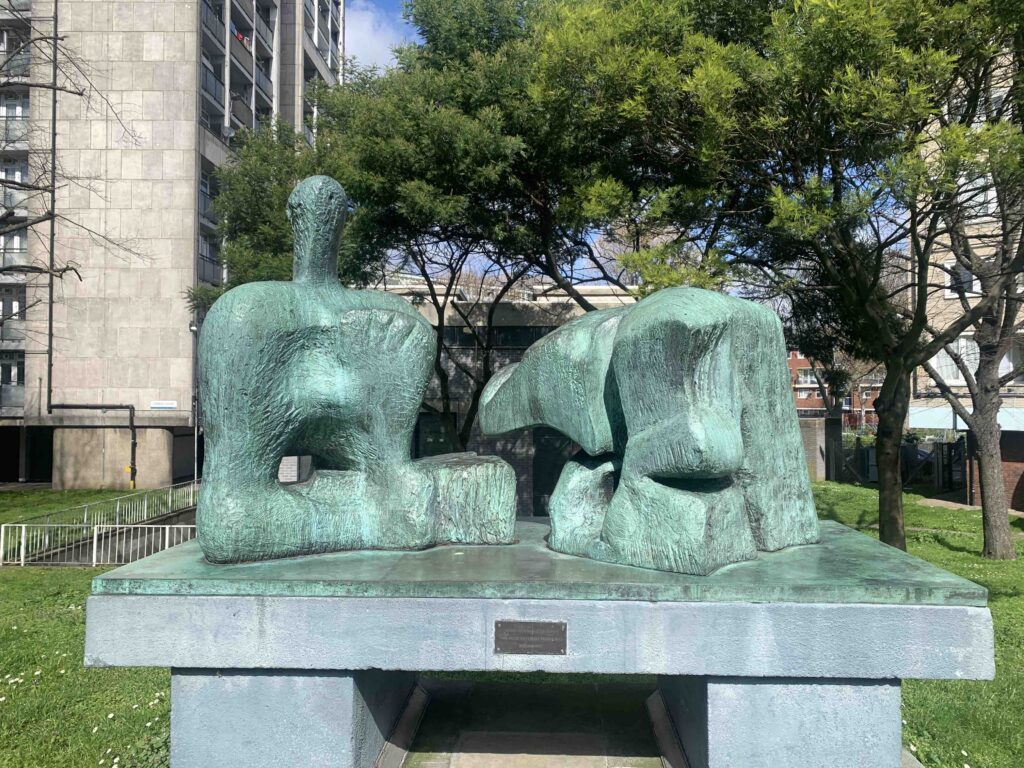
Posts will continue but with slightly dodgy connectivity they may be a little late, like this week’s miscellany of articles and audio that have engaged me over the past week. And the link to this week’s header image, which is my photo of Henry Moore’s Two-Piece Reclining Figure No. 3, sited at the Brandon Estate in Lambeth, is the second of the Municipal Dreams blog posts highlighted below.
• Nine Days in May: an excellent History of the BBC contribution by David Hendy about the pre-Corporation Company during the General Strike that began on 2 May 1926. As he writes,
The public wanted up-to-date information on a rapidly changing crisis, and with newspaper printing at a standstill the BBC was in a unique position to fill the void. Yet, the BBC’s role in the Strike was to prove highly contentious, and proved to be the first major flashpoint between broadcasters and the Government over questions of impartiality and independence.
See, or rather hear, also Archive on 4: Voices of the General Strike, now on BBC Sounds.
• Senses of Cinema 117: the latest issue of the fully open online magazine is as essential as ever, with – amongst much else – a wide-ranging collection of articles about the tensions associated with contemporary film festivals.
• All the President’s Men is 50 years old. A former Post staffer tells us why that matters: terrific from Ann Hornaday for LA Times.
• A constellation of different animals: do read Luke Dunne in LA Review of Books on the German filmmaker, writer, and theorist Alexander Kluge, who died recently at the age of 94:
Kluge’s films and fiction alike are often playful, flamboyant, sentimental (though rarely saccharine), and frequently very funny. That none of this comes at the expense of intellectual or moral seriousness, that Kluge refused to acknowledge this trade-off in the first place, is part of his charm. War and capital-H History, yes, but also angels, opera, and slapstick. For Kluge, there simply was no either-or—only both-and would ever do.
• The LCC and the arts I: The open-air sculpture exhibitions, and The LCC and the arts II: the ‘Patronage of the Arts’ scheme: two absolutely exceptional Municipal Dreams blog posts, the second of which is about the LCC’s art for schools and public places project that was inaugurated in 1956, and which gifted among many other pieces the great Henry Moore pictured above.
• The audacity of art at the Obama Presidential Center: a delightful New York Times article [gift link] by Robin Pogrebin, with visuals by Kevin Serna, about the visual art commissions for the new Barack Obama presidential library, which opens officially in Chicago in June; works by Richard Hunt, Julie Mehretu, Idris Khan, Njideka Akunyili Crosby, Rashid Johnson, and Martin Puryear are among those featured.
• Walt Disney visited a Ford factory in 1948. What he witnessed there laid the groundwork for what would become Disneyland: courtesy of Smithsonian Magazine, Roland Betancourt presents an extract from his new study Disneyland and the Rise of Automation: How Technology Created the Happiest Place on Earth.
• Dancing about architecture: for Urban Omnibus, writer and dancer Maxwell Neely-Cohen speaks with Rennie McDougall about her book Nonstop Bodies: How Dance Made New York City and the links between dance the urban environment.
• The Habsburg International: Hari Kunzru’s brief blurb for this rich Do Not Research essay runs as follows:
I wrote about Stefan Zweig and the surprising afterlife of the Habsburg Empire. Nostalgia for a multilingual, multicultural space in which trade flowed freely, drove everything from the foundation of the UN to the free market theories of Neoliberalism.
• How close reading took over the internet via The Devil Wears Prada’s cerulean monologue: I don’t quite buy Kate Travers’ argument for The Conversation but I enjoyed reading and thinking about it.
• A day in Canterbury: a lovely illustrated ramble with Luke McKernan through a city I know nearly as well as him:
Canterbury is a time machine. One senses each and every age simultaneously, in its variety, its unevenness, its untidiness. An olde Citie, somewhat decayed, yet beautiful to behold, so the sixteenth-century writer and city resident John Lyly described it. It has always been what it is.
• Richard Dawkins and the Claude delusion: as Matthew Sheffield writes, most entertainingly, for Flux, ‘the author of The God Delusion is now suffering from a Claude delusion’.
• Easy to join, easy to leave: William Davies with an exceptionally interesting review of Anton Jäger’s new Hyperpolitics: Extreme Politicisation Without Political Consequences for LRB [£; limited free access]:
The politics that is currently encouraged and exploited by the contemporary radical and far right is born of the confluence of an imagined community (both good and bad), represented and disseminated on video-sharing platforms, and the reality of a depleted community that is visible to many people in their day-to-day lives.
• And finally…: I’m in France, which is enough of a reason to share Edith Piaf singing ‘La vie en rose’, on French television on 4 March 1954.
Leave a Reply