
75: Towards a New (Coventry) Cathedral
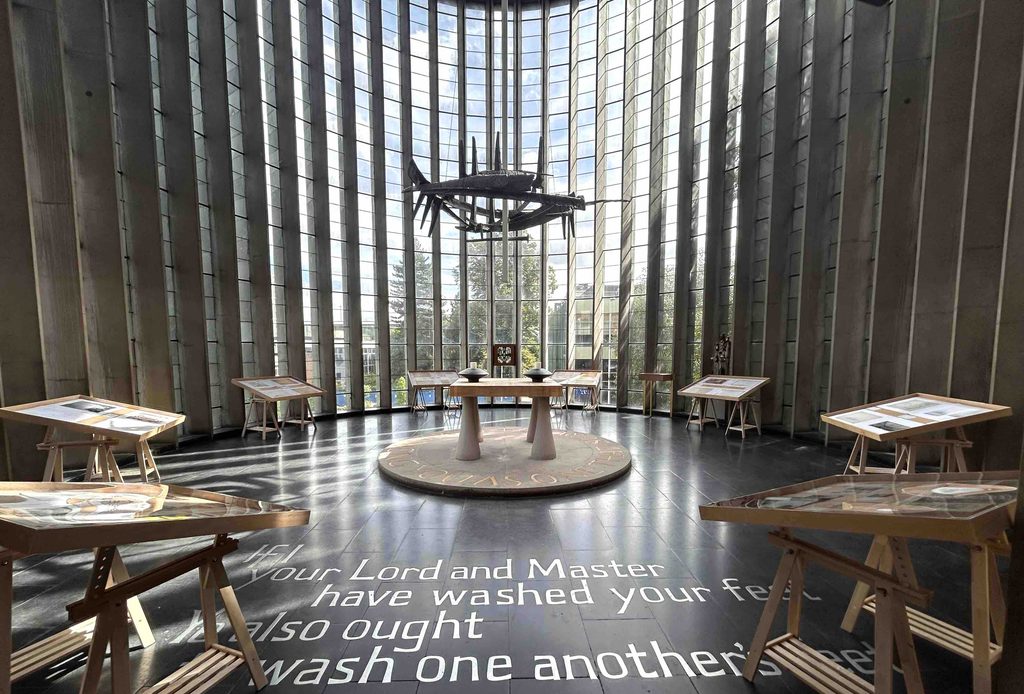
John Wyver writes: To Coventry, to the city’s great and glorious cathedral, and most particularly to the exhibition 75: Towards a New Cathedral (until 21 September), mounted there in the Chapel of Christ the Servant (above). I visited with my friend and colleague Helen Wheatley, who was the consultant on my BBC Four documentary Coventry Cathedral: Building for a New Britain (the link is to the film on Youtube, as here):
When Helen and I, along with our collaborators Todd MacDonald, who filmed and edited, and Ian Cross, who created the very special graphic design, were working on the film in 2021 , I was frustrated by how few traces I could find of the 200-plus entries to the 1950-51 competition to design a rebuilt cathedral after wartime bombing. Basil Spence, of course, won that competition, and now this compact and rich exhibition surfaces a number of those other plans. Helen and I found it fascinating.
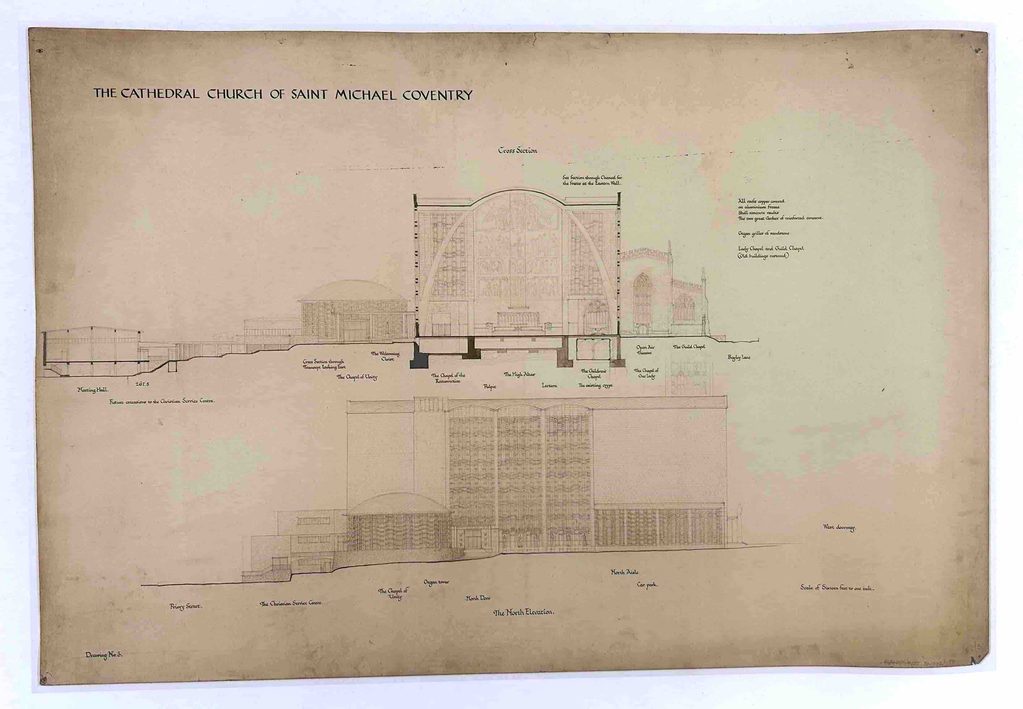
On display are plans and elevations from the proposals by a dozen architects, mostly now largely forgotten to history. Frank Scarlett put forward a huge hall with an arched roof across the nave ‘framing an immense glazed east wall behind the sanctuary’; see below, and apologies for my poor iPhone images throughout (and there’s no catalogue).
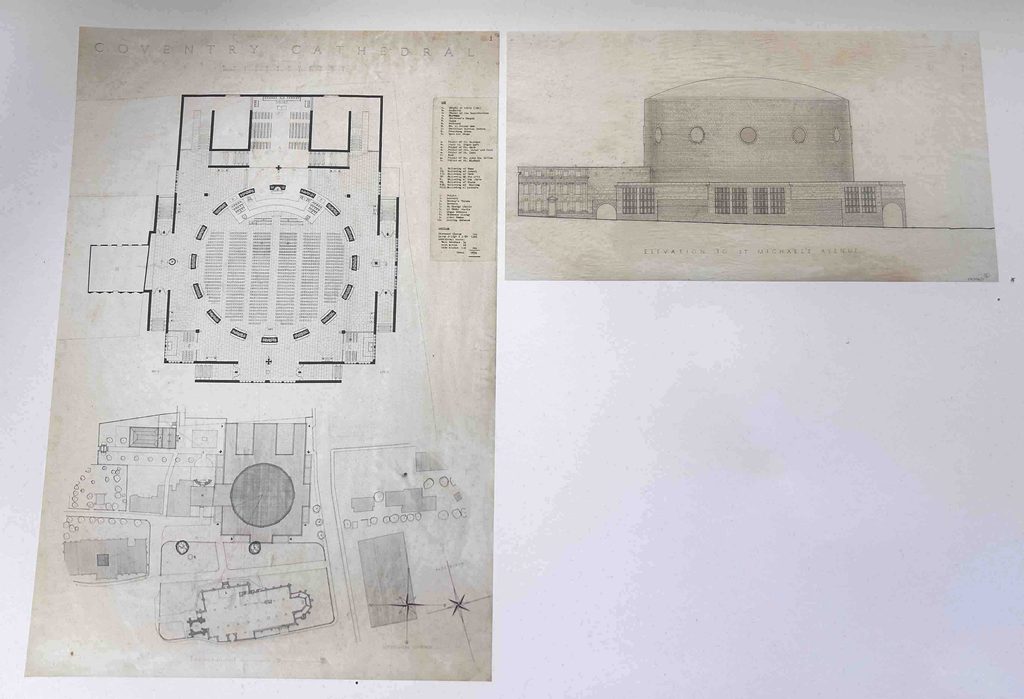
Donald Hanks McMorran offered what the label describes ‘a circular worship space… enclosed within a vast drum-like volume and shallow dome’ (below)
Resembling an ancient mausoleum moreso than a cathedral, the scheme anticipated debates on congregational participation whilst presenting the cathedral as a timeless civic monument rather than an emblem of post-war reconstruction.
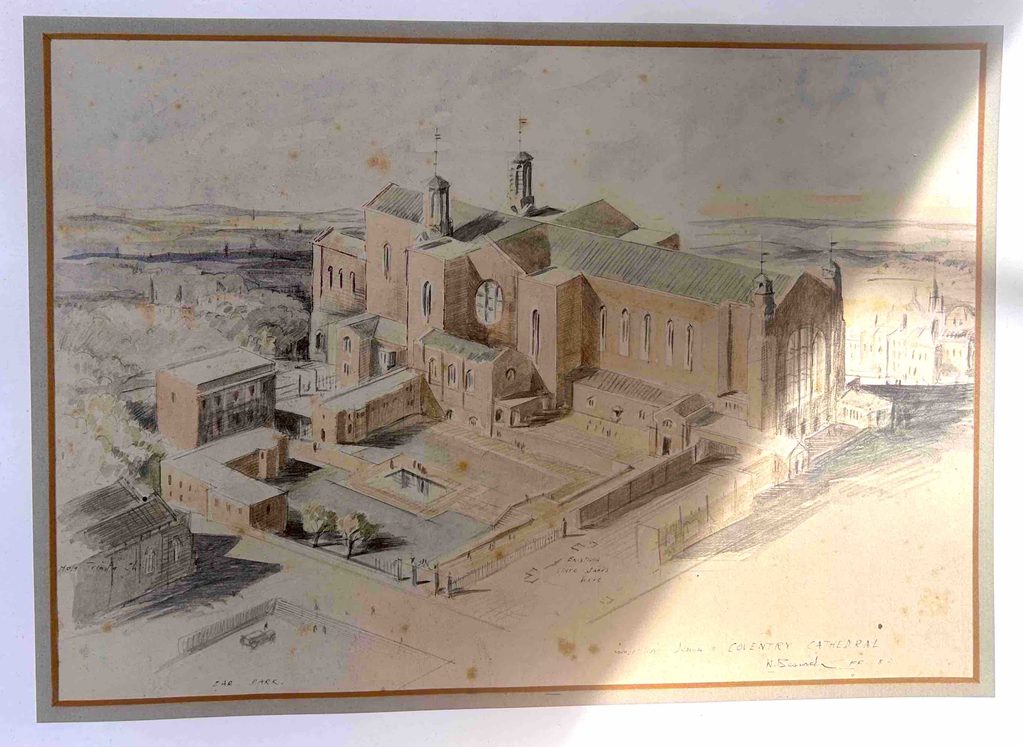
Rather less felicitous, at least to my eyes, is William Beswick’s suggestion, which resembles nothing so much as a Victorian workhouse. This is a rare perspective drawing among the proposals, since apparently architects were discouraged from submitting in this form.
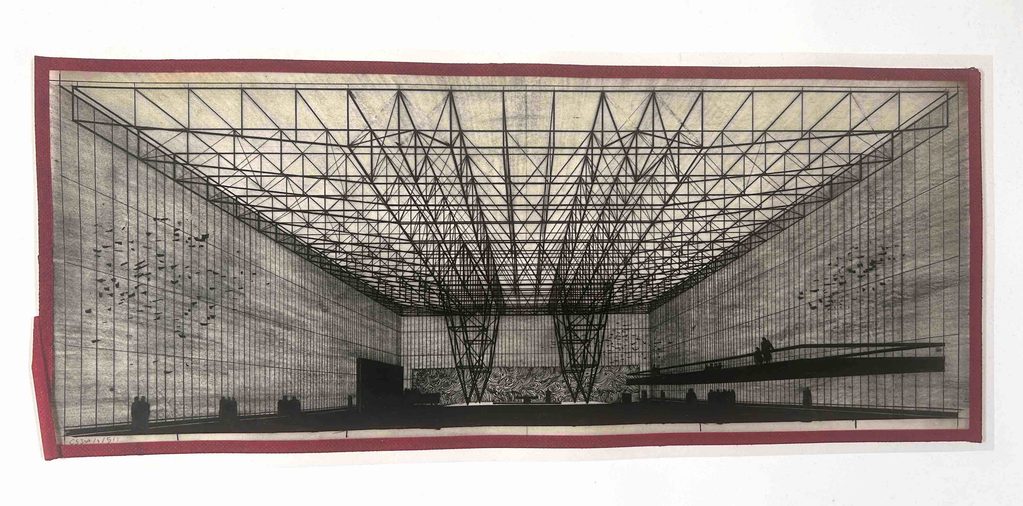
The two most radical proposals came from architects who would emerge as central figures in post-war modernism. Colin St John Wilson, later to wage what he would call a ’30-year war’ along with M.J. Long to build the British Library, collaborated with Peter Carter in 1951 and drew on Coventry’s manufacturing heritage to imagine a factory-like interior, which the label details in this way:
Colin St John Wilson’s proposal exemplified the analytical approach of a younger post-war generation, rejecting the picturesque sensibility associated with The Architectural Review. Retaining most of the ruins except the apse, Wilson imposed a rigorous geometric order on the site. His interior perspective shows four giant steel pylons rising from an elevated altar platform conceived as a symbolic ‘rock’, supporting a cantilevered roof and aluminium louvres within a glazed enclosure. The scheme gave the cathedral an industrial character, deriving monumentality from geometry, construction, and the altar’s central liturgical significance, rather than from processional drama or memorial associations.
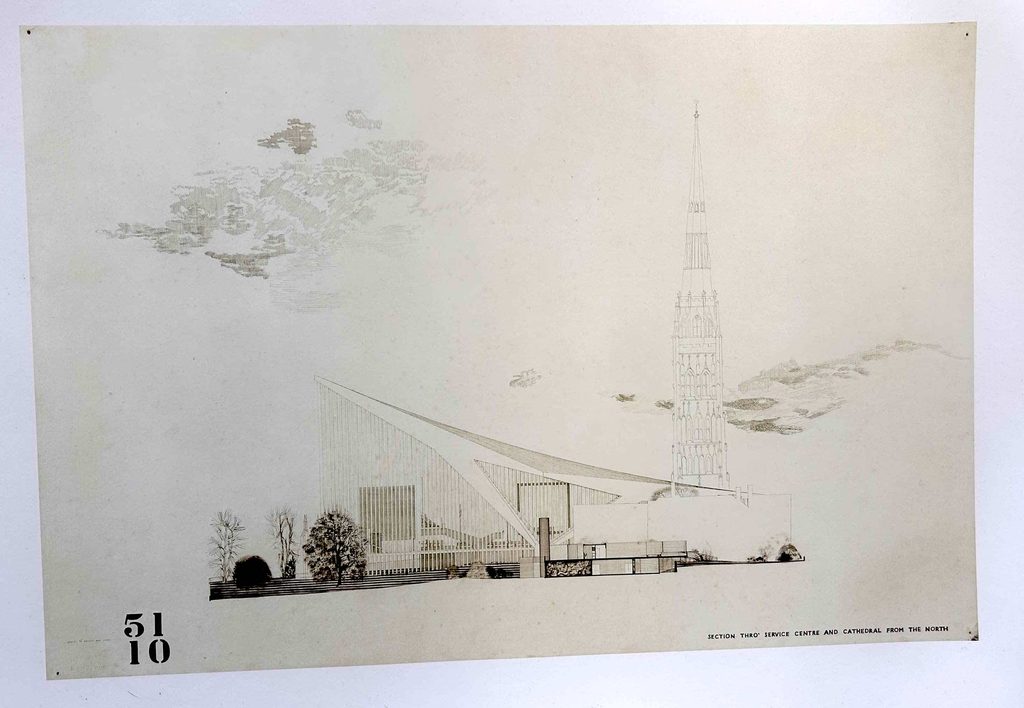
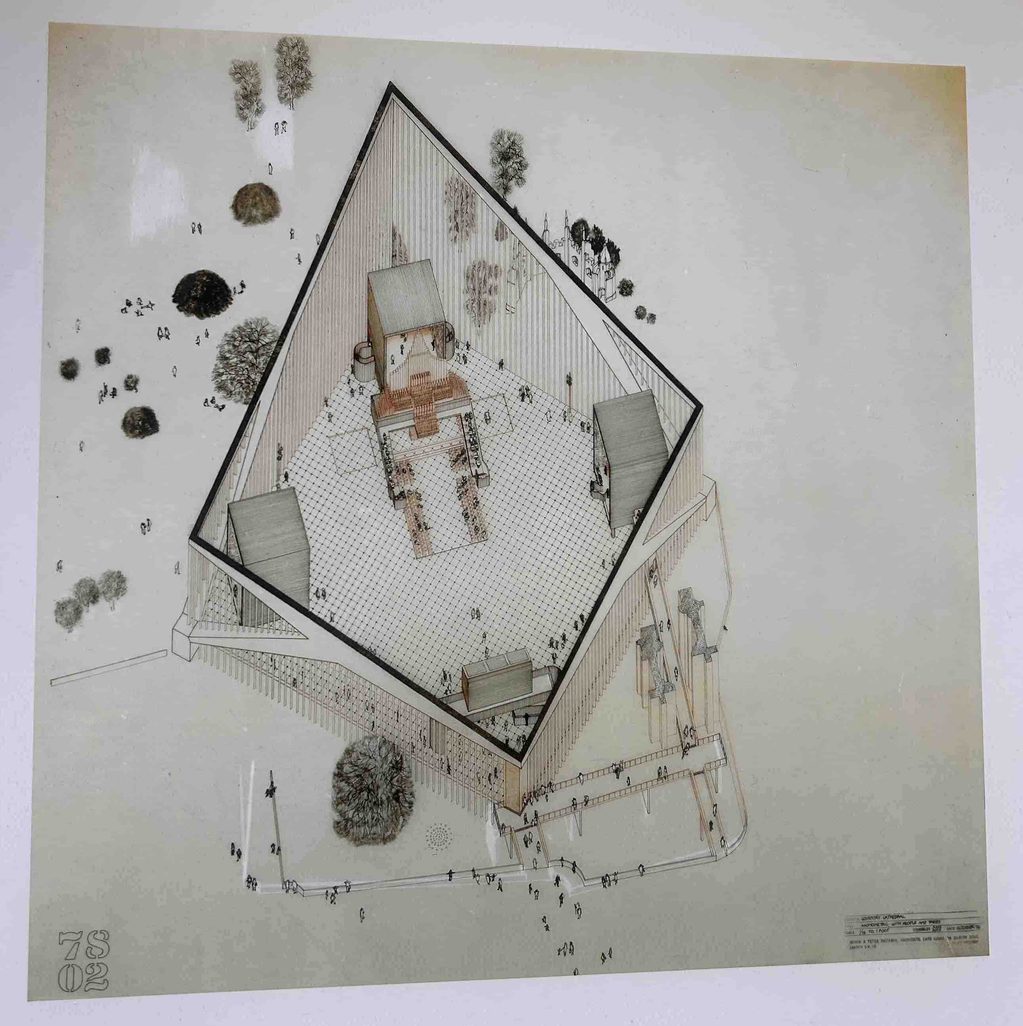
And then there was the vision of Alison and Peter Smithson, an image of which we were able to licence from the Royal Institute of British Architects (where most of these documents are archived) to include in the documentary. But the elevation and overhead shot, both included below from the exhibition, give a far better sense of their idea.
The Smithson’s uncompromising proposal, often considered the competition’s ‘critical winner’, conceived the cathedral as a monumental enclosure raised on a podium, largely erasing the medieval fabric except for the tower, apse and crypts. A square plan rotated forty-five degrees established a diagonal axis between city and high altar, with elevated walkways and ramps choreographing movement, including a route through the surviving tower’s west window. Subsidiary chapels were dispersed around a vast open worship space. An anticlastic concrete shell, supported by inclined struts and slender mullions, expressed religious meaning through structure and form.
I would have loved to have seen the realisation of the Smithsons’ proposal, but on the whole, walking once again around Spence’s marvel, I felt that the judges made the right call.
The exhibition, curated by Harry Foley, a PhD candidate at UCL Bartlett School of Architecture (although there’s no credit that I could see in the show itself), concludes with a thoughtful label about architectural competitions:
Architectural competitions are often remembered only for their winners. Yet the Coventry Cathedral competition of 1950-51 generated far more than the building eventually realised by Basil Spence. It produced hundreds of drawings, models, photographs, letters, exhibitions, books, newspapers and debates that together shaped public understanding of post-war architecture. As architectural historian Hélène Lipstadt has argued, competitions are forms of publication: they make architectural ideas visible, inviting comparison, criticism and speculation long before construction begins.
This exhibition follows the Coventry competition through three stages: the brief, the submissions and their afterlife. Alongside Spence’s celebrated design are drawings by architects whose proposals were never built, yet reveal an extraordinary range of responses to reconstruction, liturgical reform, memory and modernity. Rather than treating these schemes as failures, the exhibition considers them as alternative futures for British church architecture.
It also explores how the competition continued to generate exhibitions, publications and public debate throughout the cathedral’s twelve-year construction and beyond. In doing so, it suggests that competitions do not simply select buildings; they create cultures of architectural representation whose influence often extends far beyond the completed work itself.
And if you want to explore these ideas further, in addition to going to the show, see the 1989 volume of essays edited by Hélène Lipstadt titled The Experimental tradition : essays on competitions in architecture, which pleasingly is available to read for free on the ever-essential Internet Archive.
Leave a Reply