6th September 2025
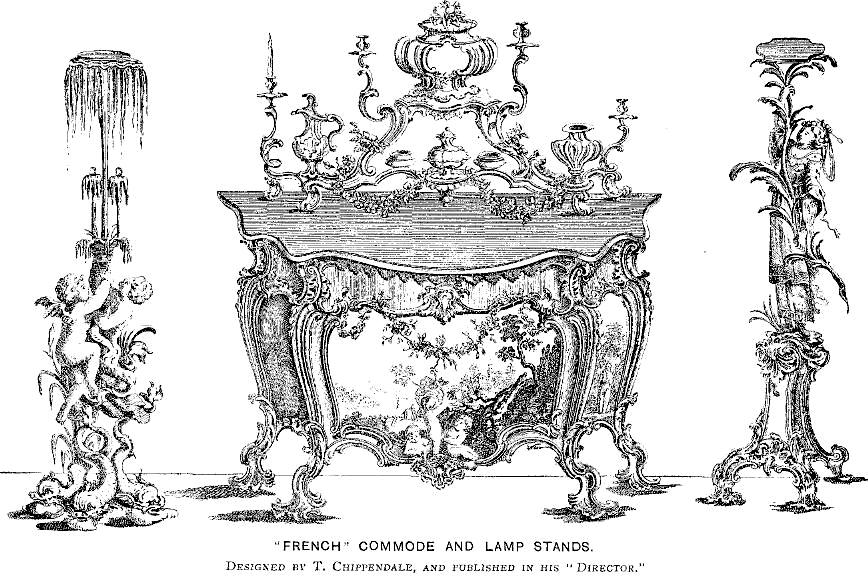
John Wyver writes: Wednesday 6 September 1933 saw the second performance on the 30-line service of Rokoko, a musical comedy programme selected from operettas by Leo Fall, Millocker and Emmerich Kalman. Henrik Ege contributed original dialogue and there were additional numbers by Mark Lubbock. Rokoko had been first played in late July, and it was one of the clearest examples so far of producer Eugene Robb’s ambition for the very basic portrait-format images of which the technology was so far capable.
Of the first broadcast, ‘Spectator’ wrote in Television:
Having secured the engagement of Naima Wifstrand, Sweden’s premier musical comedy actress, the producer determined to present her in an appropriate setting. So they all set to work, costumiers, carpenters, musical arrangers and dialogue writers and Rokoko, billed as the first television musical comedy programme, was the result. If the story was not altogether new, it was piquant, and the presentation was fresh and ingenious in detail.
The show opened with drawings depicting rococo design in its various forms, and the fussy elaboration of the costumes, the twists and curves of the figures and the furniture, emphasised in black and white, carried the looker straight back to the eighteenth century.
read more »
5th September 2025
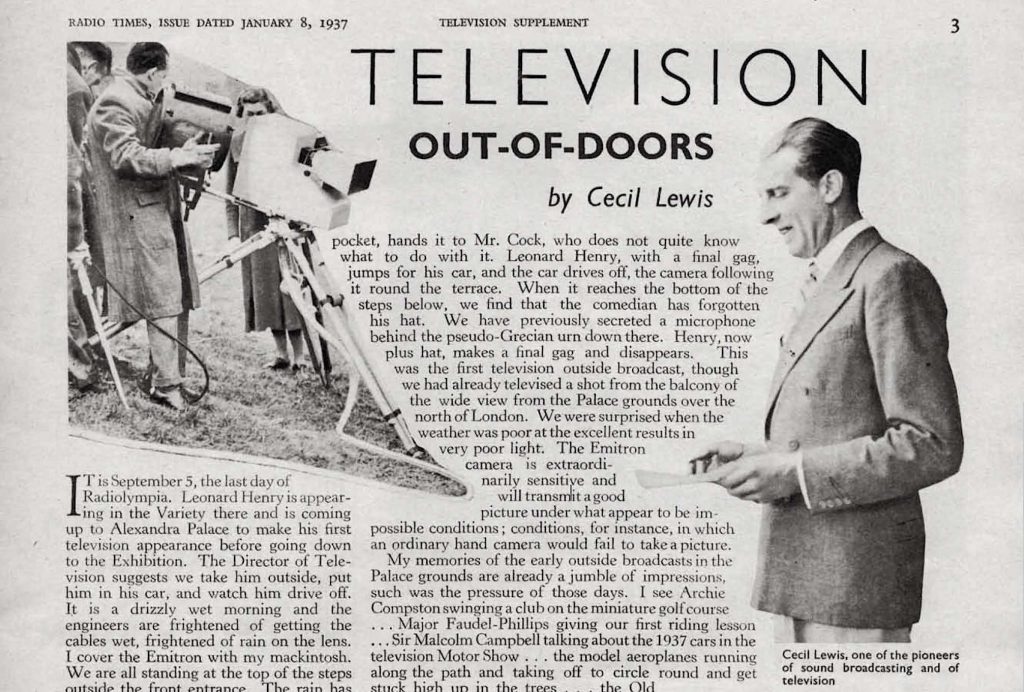
John Wyver writes: One last Radiolympia post, this time from the final day of the 1936 edition, Saturday 5 September. On this day producer Cecil Lewis, a radio pioneer and soon to be tempted to Hollywood to adapt his memoir of being a First World War fighter pilot, pulled together the first ‘local’ outside broadcast at just after midday. He recalled the occasion for Radio Times early in January 1937; this is his account.
It is September 5, the last day of Radiolympia. Leonard Henry is appearing in the Variety there and is coming up to Alexandra Palace to make his first television appearance before going down to the Exhibition. The Director of Television suggests we take him outside, put him in his car, and watch him drive off.
It is a drizzly wet morning and the engineers are frightened of getting the cables wet, frightened of rain on the lens. I cover the Emitron [camera] with my mackintosh. We are all standing at the top of the steps outside the front entrance. The rain has cleared and the sun comes out for a moment. Beginners’ luck.
The camera points up to the door of the building, and Leonard Henry comes out with Mr. Cock. They walk into close-up, and Leonard tells one or two stories, asks if he has passed out, and, producing a learner’s ‘ L ‘ from his pocket, hands it to Mr. Cock, who does not quite know what to do with it. Leonard Henry, with a final gag, jumps for his car, and the car drives off, the camera following it round the terrace.
read more »
4th September 2025
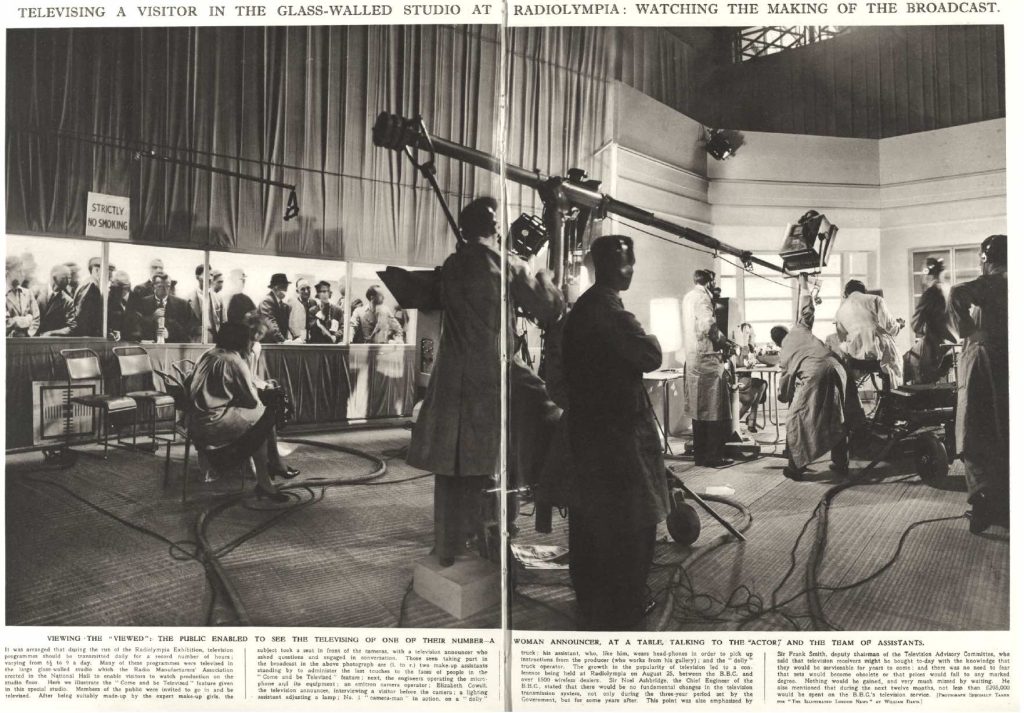
John Wyver writes: Perhaps this is a bit of a stretch but I want an excuse to return to 1938’s Radiolympia which closed ‘yesterday’. So I’m speculating that Sunday 4 September would have been the day when a crew dismantled the BBC’s elaborate Peter Bax-designed glass-walled temporary studio from which the BBC had been televising for some eight hours a day for the duration of the fair. Which gives me licence to feature the above truly remarkable photograph (taken by William Davis) from a spread in the Illustrated London News.
This is the only image I’ve seen which gives a clear sense of the windows, on the left, through which the public looked at the television operation, which were both praised for their transparent modernity. But this set-up was also criticised for excluding Radiolympia attendees from the shows, like Cabaret Cruise (see yesterday) that were broadcast from there.
read more »
3rd September 2025
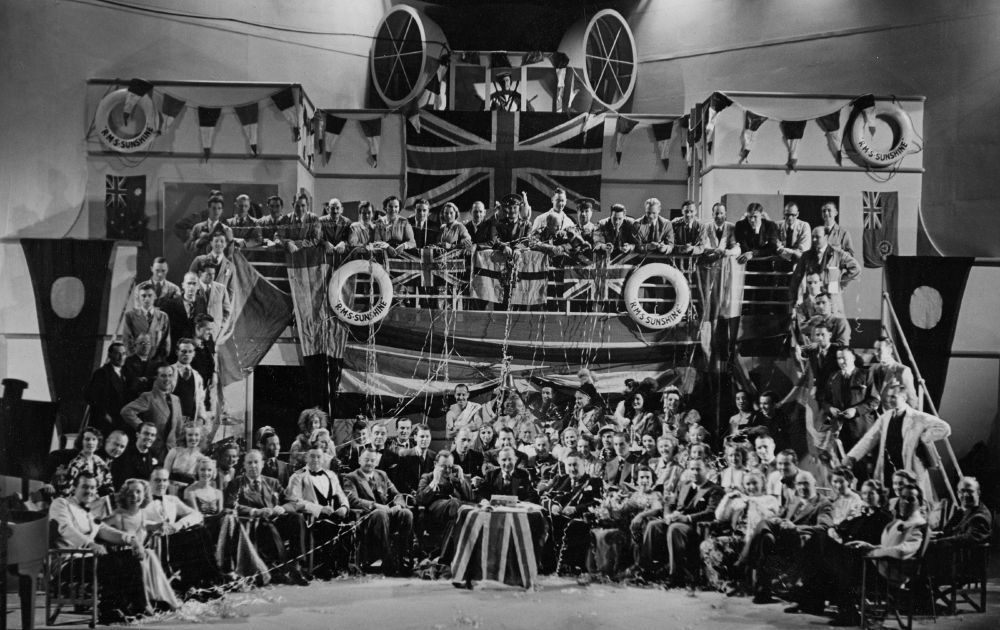
John Wyver writes: I have one further Radiolympia post to come tomorrow, but today (with apologies for the lateness and brevity of the post) marks the last day of the 1938 edition. This closed on the evening of Saturday 3 September with, first, a gala fancy dress edition of Cabaret Cruise and then a spectacular Review programme. Look at the detail in the BBC publicity image above, which shows that by around 10pm the set was crowded with ‘all available artists, BBC staff and RMA [that is, Radio Manufacturers’ Association] staff’, who together sang ‘Auld Lang Syne’.
[OTD post no. 260; part of a long-running series leading up to the publication on 8 January 2026 of my book Magic Rays of Light: The Early Years of Television in Britain, which can now be pre-ordered from Bloomsbury here.]
2nd September 2025
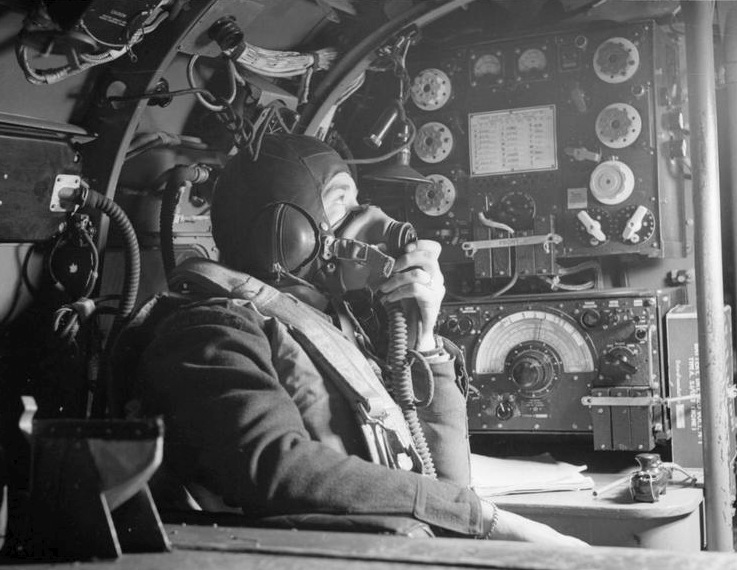
John Wyver writes: Tucked into an upbeat, celebratory schedule from Radiolympia in the early evening of Friday 2 September 1938 was a television reminder of the ‘war-mindedness’ of these days running up to the Munich crisis. In a five-minute slot at 6.20pm Captain Harold Balfour made an appeal over the airwaves recruiting wireless operators for the RAF.
Harold Balfour, a Conservative MP, was Under-Secretary of State for Air, with a distinguished First World War record as a fighter pilot. He spoke from Olympia, where the Radio Manufacturers’ Association had provided facilities to the RAF’s Civil Wireless Reserve to set up a booth to deal with enquiries. As a Daily Telegraph article trailing the broadcast noted,
A large percentage of eligible wireless enthusiasts. professional and amateurs. are either visiting the exhibition or employed on the stands.
Image: Flying Officer R W Stewart, a wireless operator on board an Avro Lancaster B Mark I of No. 57 Squadron RAF based at Scampton, Lincolnshire, speaking to the pilot from his position in front of the Marconi TR 1154/55 transmitter/receiver set; Royal Air Force official photographer, Clark N S (Plt Off), Public domain, via Wikimedia Commons.
[OTD post no. 259; part of a long-running series leading up to the publication on 8 January 2026 of my book Magic Rays of Light: The Early Years of Television in Britain, which can now be pre-ordered from Bloomsbury here.]
1st September 2025
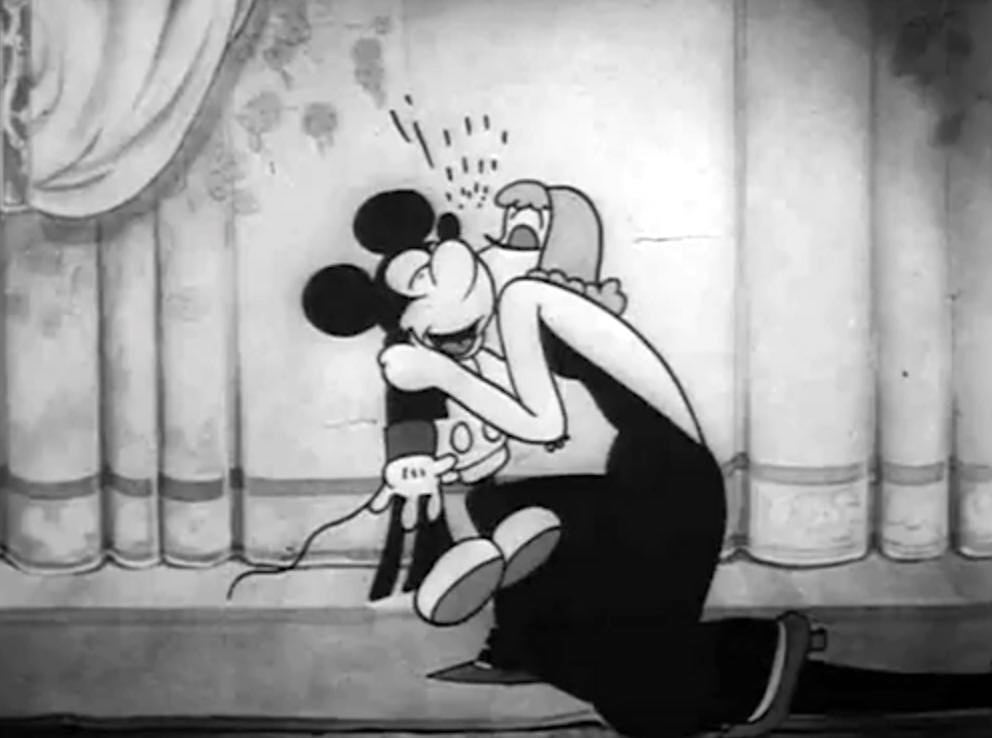
John Wyver writes (just after midday): On the morning of Friday 1 September 1939, AP broadcast an edition of Come and Be Televised from Radiolympia. Among Elizabeth Cowell’s guests were Mr J. McIntyre giving ‘his impressions of English life as a West Indian’ and the Misses Reilly talking about the benefits of all year round bathing. Then a minute or two after midday, there was an announcement of the following week highlights, even though by this point the order had been received to shut down the service.
Many years later chief engineer Douglas Birkinshaw recalled that director of Gerald Cock had called him at around 10 o’clock and instructed him to shut down the service at noon. Even so, the cartoon Mickey’s Gala Premier (1933; above, with Mickey and Garbo) was shown, followed by 20 minutes or so of sound and vision tuning signals. The service in fact closed down at 12.35, with no formal announcement.
Less than 48 hours later Prime Minister Neville Chamberlain informed listeners to the Home Service that, ‘This country is at war with Germany.’
[OTD post no. 258; part of a long-running series leading up to the publication on 8 January 2026 of my book Magic Rays of Light: The Early Years of Television in Britain, which can now be pre-ordered from Bloomsbury here.]
31st August 2025
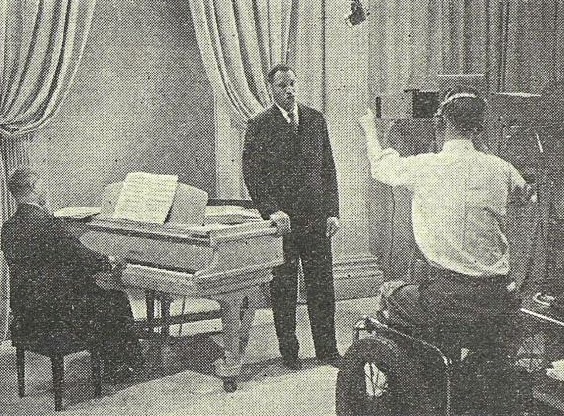
John Wyver writes: The day before closedown, Thursday 31 August, saw the publication of a Listener column by Grace Wyndham Goldie responding in part to a broadcast by Paul Robeson. A week and a day earlier the great singer had stood next to a piano (above) to perform ‘Water Boy’, ‘Night’, ‘Old Man River’ and ‘Lover’s Lane’. But Grace being Grace she could not simply wax lyrical:
Last week’s programmes were a treat. I might almost call them a fair treat. For they were designed for the crowd, animated by the needs of Radiolympia. Did we want to see what television can do with singing? Here was Paul Robeson. With ballet? We were shown Alice Markova. Outdoor stuff? There was Test Match Cricket and there were, tours of the Zoo.
Having passed those well-deserved compliments I now propose to draw a few less comfortable conclusions. The fact is that these programmes were deceptive; ingeniously and legitimately deceptive but deceptive all the same. For by picking artists of quite exceptional individuality and talent in various lines the authorities skilfully obscured the fact that the problems of presenting these lines in television are still unsolved.
read more »
30th August 2025
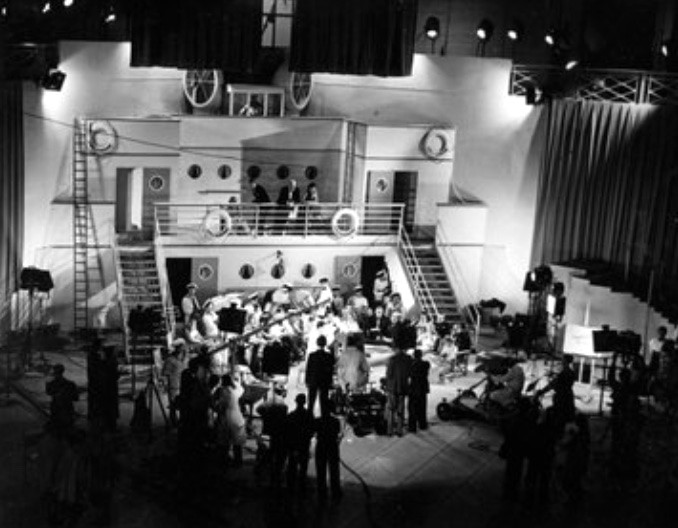
John Wyver writes: We are back at Radiolympia today, for the sixth day of the 1938 edition, on Tuesday 30 August. Come and Be Televised played in the morning, just after a broadcast from the fair by Mr Middleton about pruning roses. In the afternoon and also that evening there were transmissions of Cabaret Cruise, a variety show played across a spectacular set of an ocean liner built inside the television studio at Radiolympia.
Both afternoon and evening bills, hosted by ‘Commander’ Campbell, included impressions from Ernest Shannon, songs from Trudi Binar, a sketch with singing by Steve Geray and Magda Kun, and Chinese jugglers and acrobats The Five Lai Founs. All of whom featured around a fancy dress dance to music from Dennis van Thal and his orchestra.
Cabaret Cruise was shown several times from Radiolympia, but the Tuesday afternoon edition was special since it was also carried simultaneously on the Regional Programme as a ‘Sound and Vision’ radio broadcast. Quite how The Five Lai Founs came across on the wireless is unrecorded, not to mention the fancy dress frocks.
read more »
29th August 2025
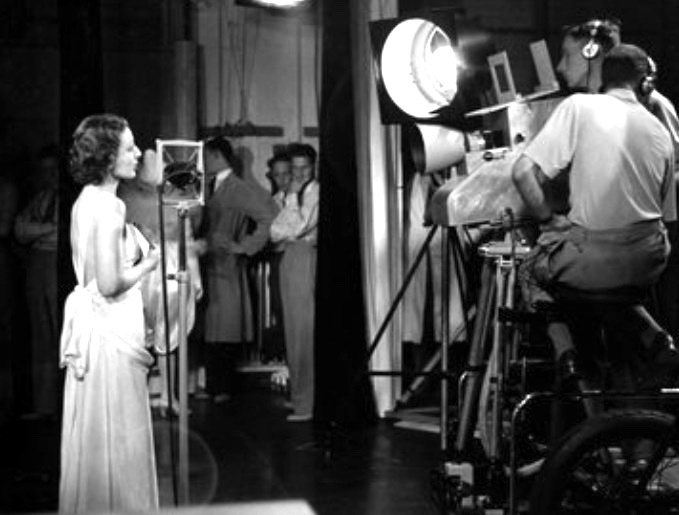
John Wyver writes: Saturday 29 August 1936 was the fourth day of test transmissions from Alexandra Palace arranged especially for reception at the Radiolympia trade fair in west London. The opening of the BBC’s ‘high definition’ service was over two months away, but for ten days AP put out a short schedule of variety and feature film extracts. Transmissions alternated daily between those via the Baird 240-line system and those from Marconi-EMI’s 405-line set-up.
The more reliable Marconi-EMI cameras were used on this first Saturday of Radiolympia, and after tuning signals in the late morning, the broadcast started at midday. A shot of Alexandra Park from a balcony was accompanied by commentary by producer Cecil Lewis. Leslie Mitchell took over announcing duties five minutres later, cueing up extracts from the Gaumont British feature First a Girl starring Jessie Matthews and then from Paul Rotha’s documentary about writers, Cover to Cover.
read more »
28th August 2025
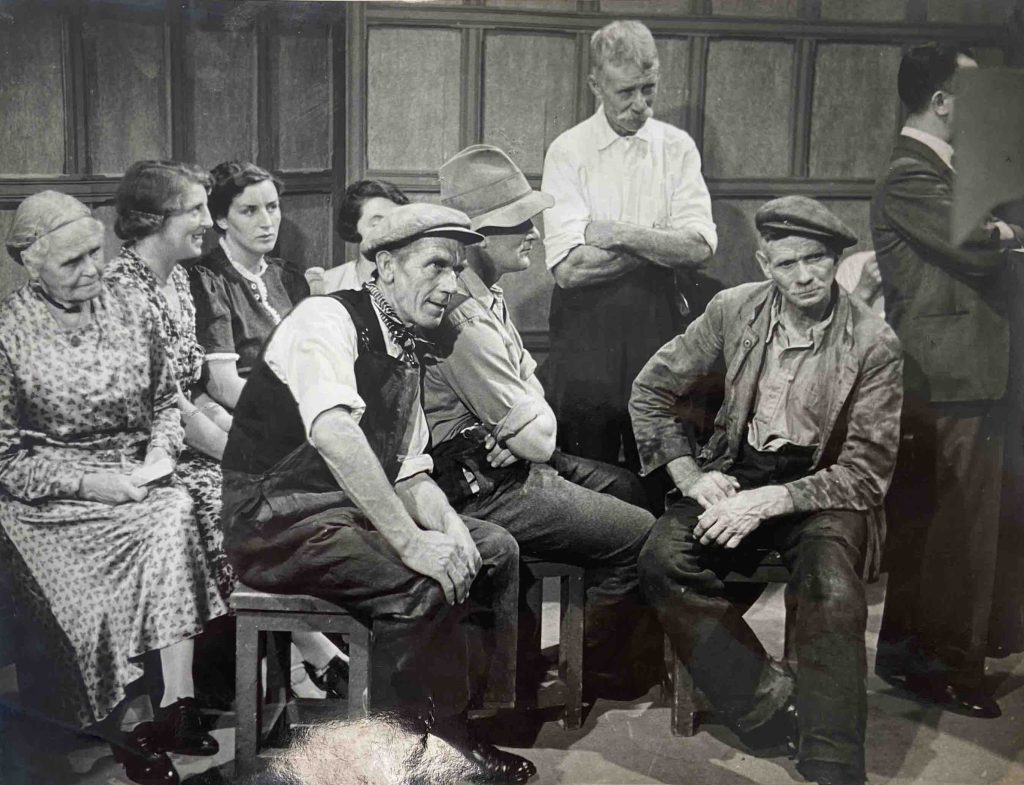
John Wyver writes: On the evening of Monday 28 August 1939, just five days before television’s closedown, producer John Pudney’s radio feature Modern Pastoral, about the coming of electricity to the Essex hamlet of Duton Hill, went out on the National Programme.
In a remarkable cross-media stunt Pudney arranged for a group of villagers, including the vicar Rev Sidney Spray, publican John Donnelly and roadman Harry Green, to come to Alexandra Palace to sit before the studio cameras as they listened to their own voices on the airwaves.
The fifteen minute broadcast, titled Up from the Country and produced by Mary Adams, also included a documentary film sequence of of life in Duton Hill, and was planned to feature a short introduction by Pudney. But despite Pudney having also produced television broadcasts at AP, because the programme began unexpectedly early, he missed the transmission.
The remarkable photograph of the occasion seems to capture a moment when a way of life that had changed little in several hundred years encountered modernity’s media world.
[OTD post no. 254; part of a long-running series leading up to the publication on 8 January 2026 of my book Magic Rays of Light: The Early Years of Television in Britain, which can now be pre-ordered from Bloomsbury here.]