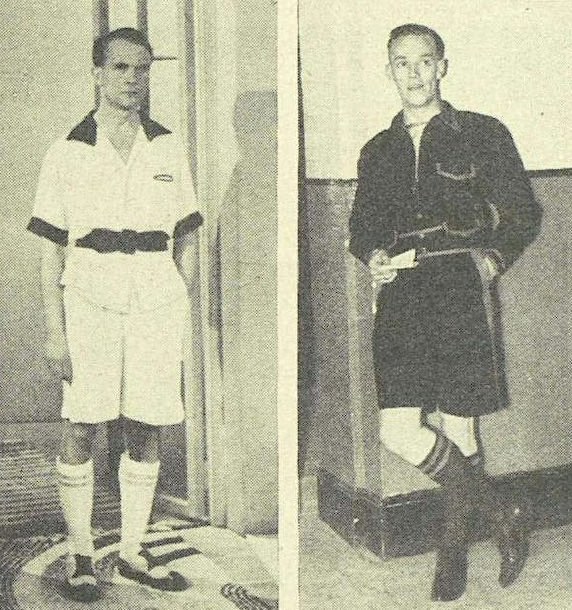
John Wyver writes: ‘Fashion’ in programmes from pre-war Alexandra Palace invariably meant clothes for women, but there was an outlier on the evening of Tuesday 6 July 1937. Men’s Dress Reform was a 17-minute programme produced by Mary Adams looking at costumes entered for the Coronation competition held under the auspices of the Men’s Dress Reform Party. It is fair to say that it was not a success.
Host Dr J.C. Flugel, author of The Psychology of Clothes, explained that the Men’s Dress Reform Party[MDRP] aimed to promote clothes which were healthy, attractive and practical. The competition was divided into two classes: (a) office, professional or other vocational wear, and (b) ceremonial or evening wear.
As an anonymous television reviewer commented drily in The Listener:
No first prize was awarded because the judges felt that no design reached the required standard…
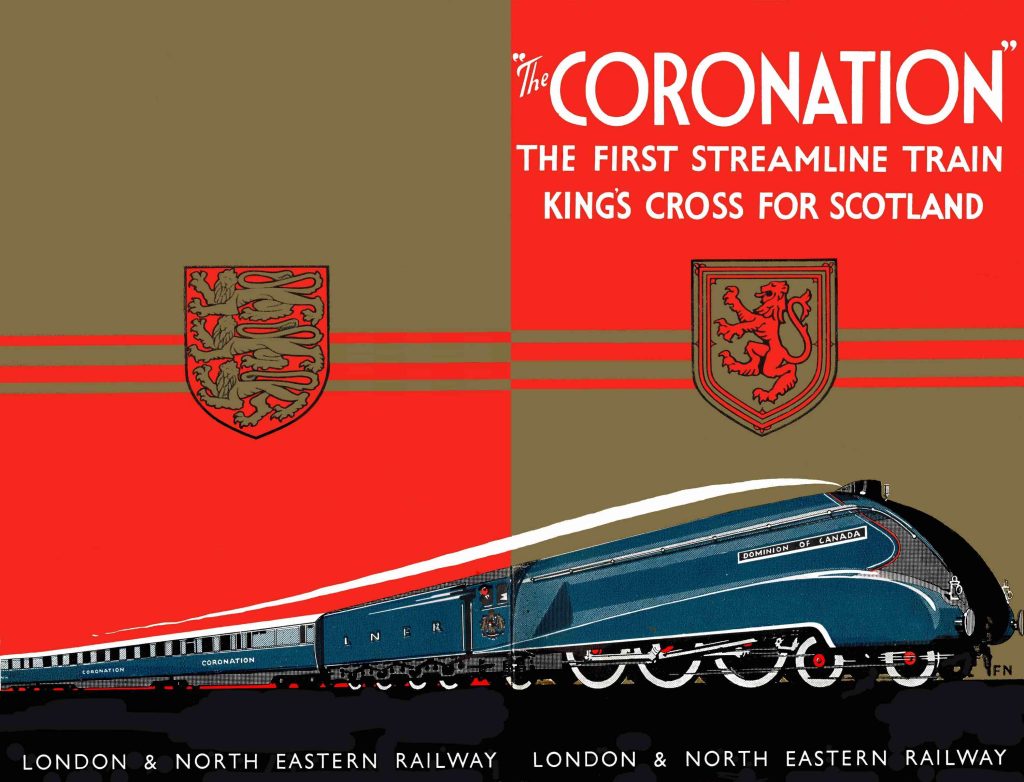
John Wyver writes: Tucked in at the end of the afternoon’s programming on Monday 5 July 1937 is a curious three-minute ‘local OB’ titled The Coronation Train. Goodness knows that the result was like but, with commentary by Leslie Mitchell, this was apparently a shot from a studio Emitron run out onto the balcony of Alexandra Palace of LNER’s ‘Coronation Train’ passing by in the distance.
LNER’s streamlined train had left King’s Cross at 4pm on its inaugural six-hour journey to Edinburgh. The header image is the cover of the marketing booklet issued by the train company.
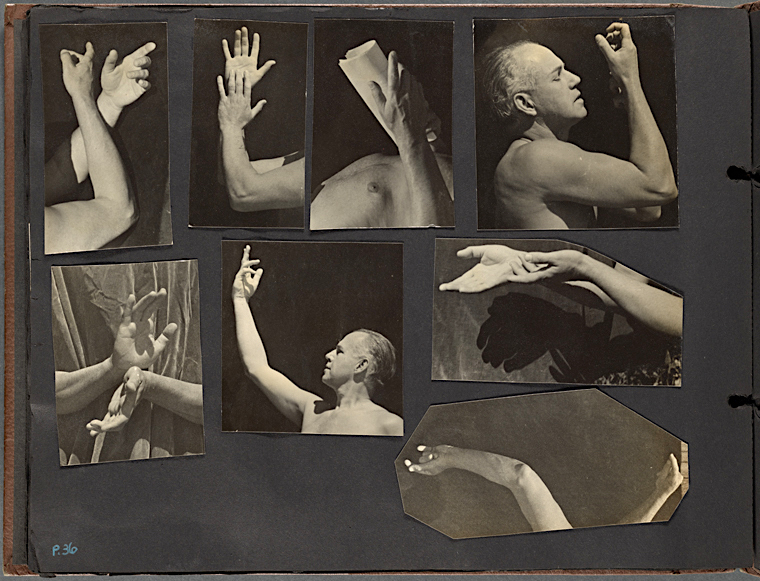
John Wyver writes: The late-night 30-line broadcast on Tuesday 4 July 1933 featured alongside comedian Sydney Arnold and Olive Groves with songs from John Gay’s The Beggar’s Opera, the Russo-Finnish dancer Cleo Nordi. Trained in St Petersburg, she had been a celebrated soloist with Anna Pavlova’s company between 1926 and 1931.
That night in July, in one of her many appearances on the 30-line service, she gave a rumba to a tune by Lewis Gensler, a ‘gypsy dance’ to a Riccardo Drigo composition, and a Glazunov ‘Bacchanale’. Accompanying her were a trio of piano (the ever-reliable Cyril Smith), harpsichord and drums.
John Wyver writes: Stage representations of the Great War were rare in the first decade after the Armistice, and it was R.C. Sherriff’s Journey’s End, which became a major hit after its premiere in late December 1928, that defined the theatrical representation of the western front. The play offered an unsentimental, tragic sense of the conflict, and in November 1937 this was the Television service’s first substantial dramatic presentation of the war.
Unsurprisingly perhaps, given the ways in which loss and grief marked the interwar period so deeply, there were then another ten or so AP dramas that engaged directly with the conflict and its legacies. These war plays included Ernst Johannsen’s Brigade Exchange, set in a German telephone dugout on the western front, which was first produced for radio in Munich in 1929.
John Wyver writes: For just over an hour on the afternoon of Sunday 2 July 1939 OB cameras from Scanner 2 (its counterpart was at Wimbledon) relayed the parade of National Service organisations in Hyde Park. Some 20,000 volunteers marched past the King taking the salute, with representatives participating from ARP Services, Auxiliary Police, Civil Nursing Reserves and more.
According to ‘E.H.R.’ in The Observer, the pictures ‘were very good indeed’. As for Grace Wyndham Goldie’s view:
You can’t beat an outside event like the National Service Rally when bands are playing, crowds are cheering, and the camera work is good.
Two months later, the nation was at war with Germany, and in retrospect both the event and the media coverage, including newsreels and a National Programme broadcast, can be seen as part of preparing a ‘war-minded’ nation.
[OTD post no. 197; part of a long-running series leading up to the publication of my book Magic Rays of Light: The Early Years of Television in Britain in January 2026.]
John Wyver writes: Lookers-in on the evening of Saturday 1 July 1939 were treated to a 50-minute anthology of scenes from literature about the law. Compiled by Barbara Nixon and produced by Desmond Davis, this followed on from a selection of love scenes shown in January under the title of O Mistress Mine.
The earlier transmission featured scenes from Romeo and Juliet and As You Like It, Congreve’s Love for Love and John Gay’s The Beggar’s Opera, as well as J.M. Barrie’s Quality Street, Noel Coward’s Private Lives, and – perhaps somewhat incongruously, act 3 of Ibsen’s A Doll’s House.
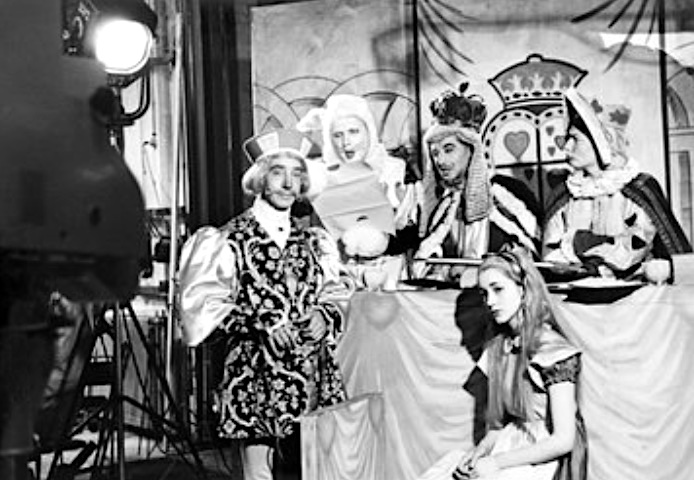
The running order for Fiat Justitia was even more eclectic. A scene from Alice in Wonderland (illustrated above) was followed a Dogberry episode from Much Ado About Nothing, then extracts from Six Men of Dorset, a tale of the Tolpuddle Martyrs written by Miles Malleson and H. Brooks.
Following this were an A.P. Herbert tale, The Last Glass, and the melodrama Young Madame Conti by Bruno Frank Taut, which had recently been staged on Broadway [and in London – see below]. A scene from Elmer Rice’s Judgement Day preceded a return visit to Alice’s world, before Portia from The Merchant of Venice rounded things off, presumably with ‘The quality of mercy’ from act 4 scene 1.
The company was extensive and impressive, and included Barbara Nixon, Jessica Tandy, Selma Vaz Dias, Holland Bennett and Basil Cunard. Grace Wyndham Goldie was broadly supportive:
This was better acted, notably by Jessica Tandy and Arthur Young, than the earlier example in the style, O Mistress Mine. It was also more obscure and generally rather less successful. But this was probably inevitable. Justice, after all, presents more problems than courtship.
[OTD post no. 196; part of a long-running series leading up to the publication of my book Magic Rays of Light: The Early Years of Television in Britain in January 2026.]
John Wyver writes: Today’s post, as I also note below, is the 195th in this series which I is a kind of extended trail for my forthcoming book from Bloomsbury/BFI, Magic Rays of Light: The Early Years of Television in Britain, which is to be published in January.
Cerain of the posts have been extracts from the manuscript, while many more have been extensions of and complements to things that I uncovered in my research. I have been much cheered by the likes and shares on social media, and by the occasional comments on the blog, although I woulkd unquestionably appreciate more of both.
I started the posts at the end of November and in January I plan to mutate the project into another form, which is likely to be less demanding for both author and readers. So today’s post is something like a halfway point, and I am using it simply to select 10 of my favourite contributions since the last group of reprises in early April.
The entries are featured here in the chronological order of the events they reference, and I have included only minimal descriptors in the hope that this will encourage you to click through to the full posts.
John Wyver writes: The magazine show Picture Page was the widely recognised ‘hit’ of the pre-war Television service from Alexandra Palace. By the summer of 1939 it was mounted twice on Thursdays, in the afternoon and evening, with often little or no repeat of guests between the two transmissions. Which was the case on Thursday 29 June 1939, when the line-ups were typically eclectic.
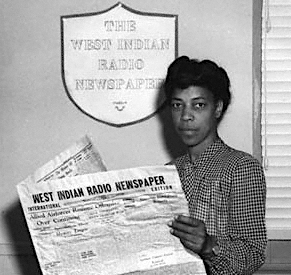
The show was linked by Joan Miller at a putative telephone switchboard, and each guest was rigorously rehearsed in advance for their two- or three-minute spot with interviewer Leslie Mitchell. In the afternoon the job of ‘handling’ Indian economist and educator Malcolm Adeseshiah, Travelling Secretary at the Student Movement House, was entrusted to the Jamaican writer and activist Una Marson, who worked on occasions with the programme through 1939.
After achieving success as a poet and playwright in Jamaica, Marson first came to London in 1932, where as her detailed Wikipedia entry notes
The racism and sexism she found in the UK “transformed both her life and her poetry”: the voice in her poetry became more focused on the identity of black women in England. In this period, Marson not only continued to write about women’s roles in society, but also put into the mix the issues faced by black people who lived in England.
She lived again in Jamaica between 1936 and 1938, after which she returned to London, working as a journalist and for Picture Page. Then during the war, in 1941, she was hired by the BBC Empire Service, becoming producer of the show Calling the West Indies, which she transformed into the hugely influential Caribbean Voices.
John Wyver writes: The afternoon and evening of Monday 28 June 1937 saw one of pre-war television’s most innovative performance programmes. Artists who worked regularly in the Alexandra Palace studios often found the resources of time and space frustrating, but the challenges were greater still for dancers and companies who added a day or two at AP to an existing London engagement or British tour.
Nonetheless, a remarkably cosmopolitan procession went before the cameras, exposing the watchful viewer to a wide range of international dance. Most memorable was the troupe Colonel Wassily de Basil formed in the early 1930s and ran, somewhat fractiously. with fellow impresario and co-founder René Blum. The group claimed the legacy and name of Diaghilev’s Ballet Russes, which had dissolved on the death of the maestro in 1929.
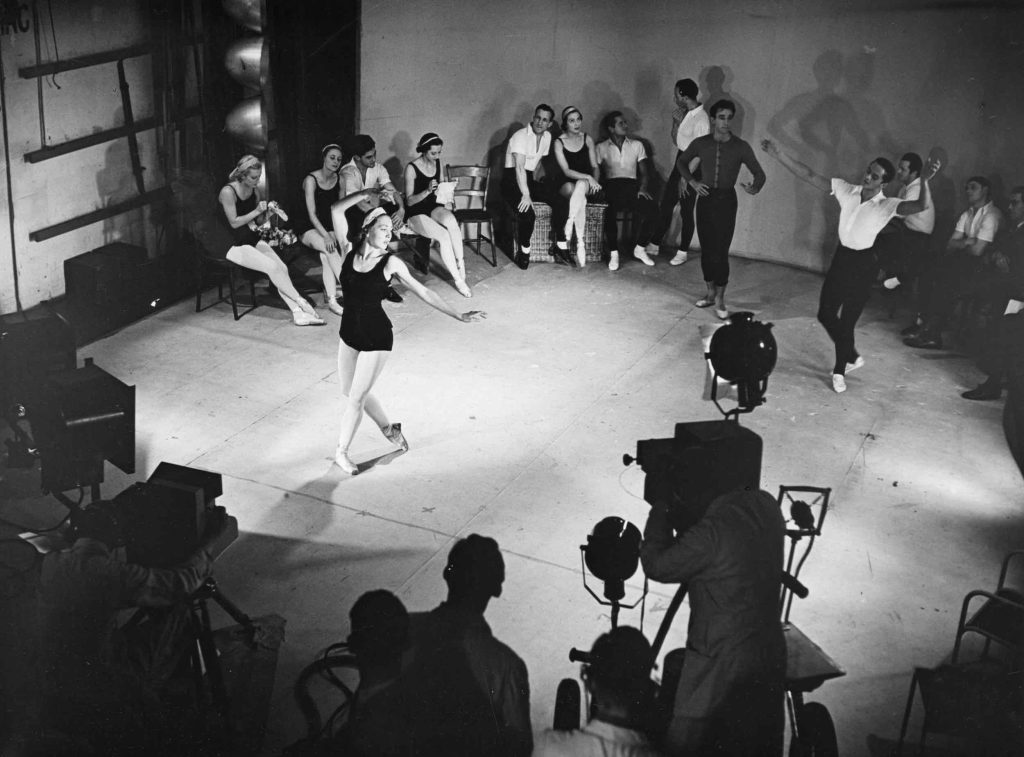
Performances were given at AP in 1937, 1938 and 1939, but the great innovation came on 28 June in the first summer when a rehearsal class was broadcast from Studio A by a company that included two of the celebrated ‘baby ballerinas’, Tatiana Riabouchinska and Irina Baronova. One remarkable image (above) captures Baronova and George Zoritch dancing the pas de deux from Gluck’s Orphée
Producer D.H. Munro recalled
a completely unscripted, unrehearsed programme… Just a bare studio with one or two odd bits of scenery and Arnold Haskell, the famous ballet critic, in front of a studio monitor to do a running commentary.
The cameramen were in certain positions: one on a low tripod, one overhead in the gantry and another on a tracking dolly and it was shot completely off the cuff. I think it was one of the most successful programmes I ever did.
A critic in The Listener concurred:
To compare the ballet rehearsal recently broadcast from Alexandra Palace to a painting by Degas is perhaps bordering on the trite. On this occasion, however, it happens to be true… the image on the screen of the receiver in many ways suggested a painting.
The experiment was repeated the following summer, again with Haskell as a guide, along with future conductor Georg Solti as accompanist. This time it was the writer Thomas Baird who sang its praises in World Film News for
bringing alive this peculiar quality with a spontaneity and immediacy which belongs to television. This production eavesdropped on reality. It was television doing its own peculiar job and therefore television at its own very best.
[OTD post no. 193; part of a long-running series leading up to the publication of my book Magic Rays of Light: The Early Years of Television in Britain in January 2026.]
John Wyver writes: The issue of trade paper Kinematograph Weekly (KW to its regular readers) on Thursday 27 June 1935 carried across two pages a report of an important speech made by Captain A.G.D. West about television to the Cinematograph Exhibitors’ Assoication (CEA). The owners and operators of cinemas gathered for their annual meeting in Cardiff were only just beginning to consider how the new medium might change their world.
With its founder John Logie Baird effectively sidelined, Captain West had been taken on by the Baird Company, and its owners Gaumont-British Picture Corporation, to drive forward its television operations. He was setting up an extensive studio operation at Crystal Palace, alongside the company’s business manufacturing receivers.
G-BPC’s corporate ambitions, however, had just suffered a blow with the decision of the Television Advisory Committee to base the planned BBC ‘high definition’ service not alongside his operation in south London but rather north of the river at Alexandra Palace.