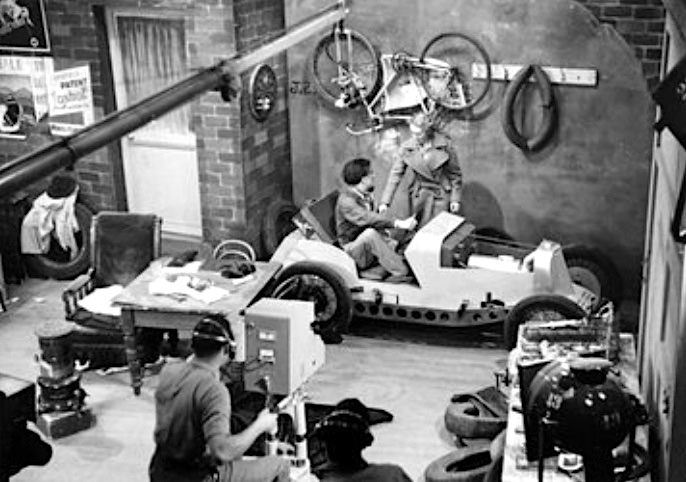
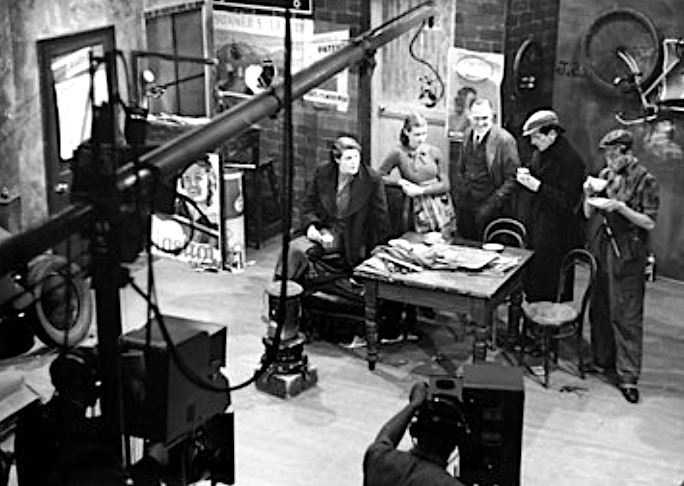
John Wyver writes: The idea of a Sunday evening play from Alexandra Palace was well-established by 28 May 1939 when the schedule was given over to Nicholas Phipps‘ crime drama First Stop North. Charles Hickman’s production, with the author in a key role, had been playing for a week at the King’s Theatre, Hammersmith, and what was clearly a relatively elaborate set, designed by Roger Furse, was de-rigged and re-assembled in less than 24 hours.
Set in a garage north of London that specialises in re-purposing stolen cars, the drama sounds as if it might have been a rare slice of pre-war televisual social realism. ‘E.H.R.’ in the Observer praised it as ‘good entertainment’. The author was celebrated for his contributions to revues, including for television, and in the late 1940s and 1950s, he scripted a run of British film comedies including Doctor in the House (1954), together with three sequels, and The Captain’s Table (1959).
The drama is notable for being one of series played by a repertory company run by Wilson Barrett and Esmond Knight, who also had a role in First Stop North. Presenting 24 plays on a weekly basis between January and July 1939, the venture appears to be been a moderate artistic success, although not an especially profitable one.
[OTD post no. 162; part of a long-running series leading up to the publication of my book Magic Rays of Light: The Early Years of Television in Britain in January 2026.]
John Wyver writes: The Saturday evening schedule on 27 May 1939 was taken over by a production of George H. Grimaldi’s drama Behind the Schemes. The scene was laid in the publicity office of Fleet Street’s (imaginary) Daily Quiver, and for the Times critic the play ‘did not have a dull moment’.
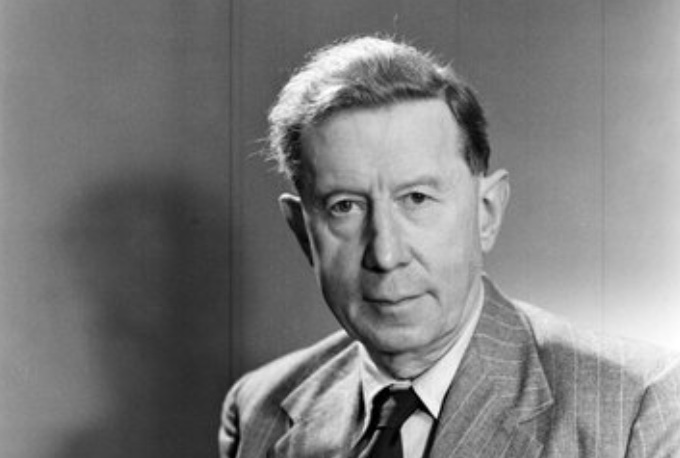
The play had been given at the Richmond Theatre in the autumn of 1938, which is presumably how it came to the attention of AP drama producer Fred O’Donovan (above, in 1951), who the Times writer was happy to credit with the transmission’s success:
Mr Fred O’Donovan thinks in terms of his cameras, which means that viewers never think of them, but only of the story, and his production had pace and clarity.
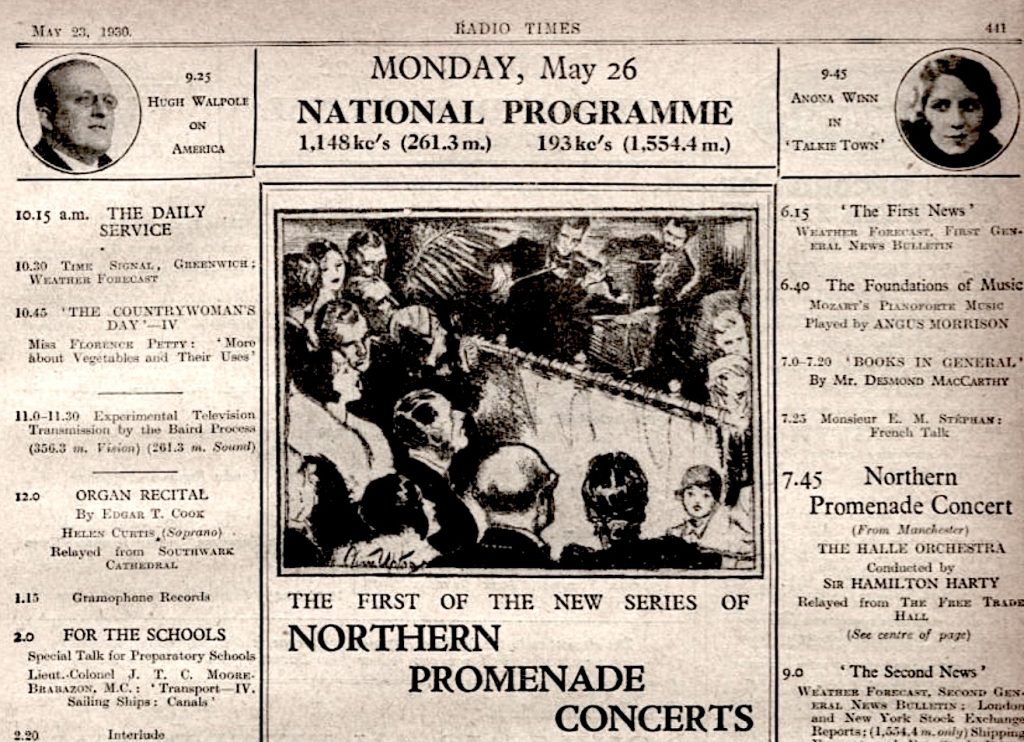
John Wyver writes: By the late spring of 1930 Baird Television Ltd had been transmitting thrice weekly half-hour variety bills for around 18 months. The 30-line images were very basic and the service’s profile can be judged from the minimal visibility in Radio Times, halfway down the left-hand column, of the broadcast on the morning of Monday 26 May: ‘Experimental Television Transmission by the Baird Process’.
Although Radio Times provides no details, the Programme-as-Broadcast record details that this show featured musical comedy artist Nancy Fraser and comedy entertainer Doris Palmer, along with Dorothy Gadsden and Richard Hughes in ‘duets’. That’s the magic word, which appears for the first time on this day in the Baird listings and suggests that the system was by this point sophisticated enough to feature two figures on screen together.
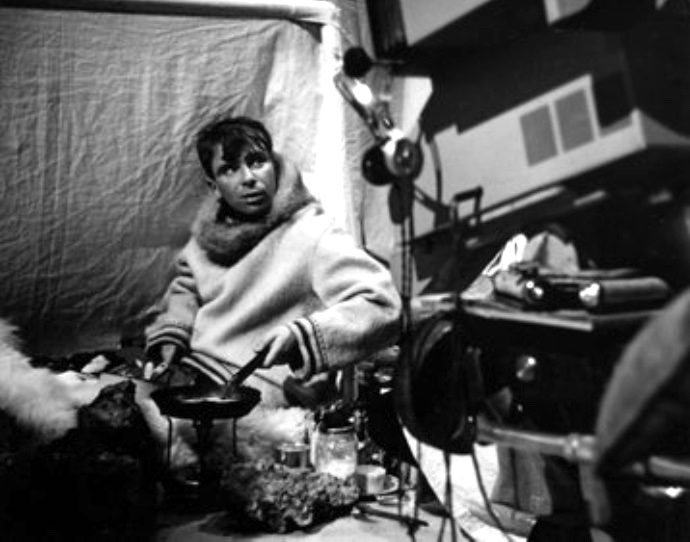
John Wyver writes: At the heart of the evening schedule on Wednesday 25 May 1938 was a 25-minute talk by Reynold Bray illustrating the conditions in which he lived for two summers in Arctic Canada. As can be seen above, a replica of 2-metre long tent was set up in the studio and Bray sat in his fur coat surrounded by his stove and the stuffed birds he was there to collect. He was assisted in this by Patrick Baird, who had accompanied him on various expeditions.
An obituary in Nature in March 1939 noted that Bray was ‘an Arctic explorer of considerable achievement and much promise.’ But it continued with an explanation of events soon after this broadcast
In 1938, Bray planned with P[atrick] Baird to continue his exploration of the western coast and the interior of Baffin Island. Ice, however, interfered with the ship’s progress and eventually the two men were landed on the south-east of Melville peninsula, whence they set off in their boat last August in an attempt to reach Igloolik Island, 300 miles to the north at the eastern entrance to Fury and Hecla Strait. Some forty miles south of the island, on September 14 last year, Bray was blown out to sea in a canvas boat and lost.
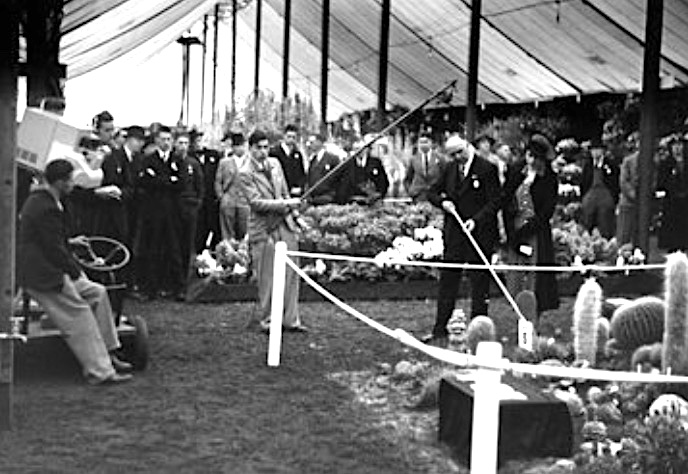
John Wyver writes: Just as for the BBC’s coverage this week, 87 years ago the corporation’s mobile unit visited Chelsea Flower Show (above) for three broadcasts, beginning with a 40-minute broadcast on Sunday 22 May with Freddie Grisewood and Elizabeth Cowell, along with television gardener Mr Middleton, looking at the construction of various gardens.
The team returned the next afternoon for a half-hour transmission, with Mr Middleton interviewing various exhibitors, and on Tuesday 24 May a 20-minute show late morning featured a discussion of flowers in the East Tent (likely the scene in the image above), as well as consideration of topiary and garden furniture.
The Times approved:
Television afforded a new delight to viewers last week, when they were taken by Mr C.H. Middleton on a personally conducted tour of the Chelsea Flower Show. Mr Middleton always gives the impression that he has come straight to the microphone with the mud still clinging to his boots, and this time we could see him in a real garden [as opposed to patch of ground taken over near the AP studio] and enjoy to the full the easy informality of his talk.
The visit to Chelsea on Monday was especially interesting, for not only did we have glimpses of busy workmen creating the gardens before our eyes, but some of the most famous exhibitors were brought before the cameras to tell us about their exhibits and to show them to us.
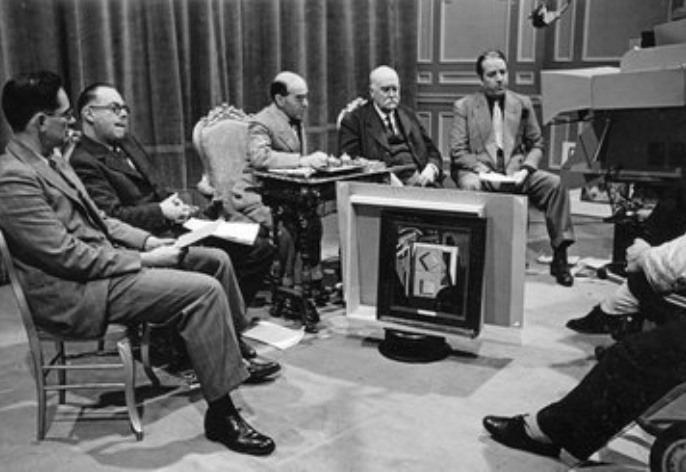
John Wyver writes: Television’s main offering on Tuesday 23 May 1939 was a 45-minute studio debate titled simply Modern Art. As the billing detailed, ‘Sir William Rothenstein took the chair. Mr Wyndham Lewis and Mr Geoffrey Grigson championed ‘unconventional’ modern art and Mr Reginald Blomfield and Mr A.K. Lawrence attacked it and put forward ‘conventional’ modern art.’
By this point in his late sixties, William Rothenstein was a distinguished portraitist and writer on art who from 1920 to 1935 was Principal of the Royal College of Art. Wyndham Lewis was a former enfant terrible and Vorticist, who had only recently returned to painting, while Geoffrey Grigson was known mostly as a poet, although he had exhibited in the 1936 London Surrealist Exhibition.
Reginald Blomfield was a prolific architect, architectural historian and garden designer, and his confrereA.K. Lawrence was a fine figure painter and muralist, as well as a stalwart of the Royal Academy. From this distance, you would have to say that the ‘moderns’ fielded the stronger team.
As can be seen from the photograph, the studio set-up allowed a range of paintings, prints and photographs to be displayed on a kind of magazine rack in front of the speakers (De Chirico’s ‘Death of a Spirit’ is visible.) Among the reproductions shown were artworks by Van Gogh, Cezanne, Picasso, Miro, Magritte and Paul Nash, along with a number of representational works.
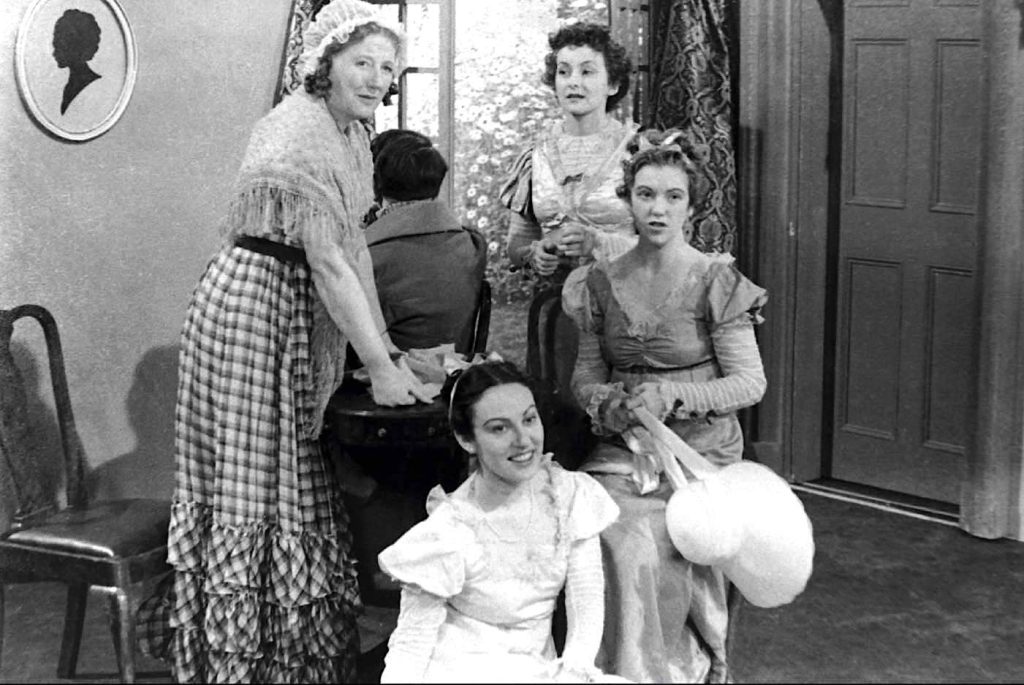
John Wyver writes: British television’s love affair with the works of Jane Austen, which today shows little signs of abating, began 87 years ago today on 22 May 1938, with a 55-minute adaptation of Pride and Prejudice. The fact that this was a Sunday is a pleasing continuity across nearly a century, although television on the Sabbath had started only seven weeks before. (Janeites had been first catered for by radio over a decade earlier, as David Hendy’s recent ‘History of the BBC’ post notes.)
As the rare photograph suggests (there’s no recording), television’s first foray into Austen’s universe had time and space for only three of the Bennet sisters, played by Antoinette Cellier (Jane), Curigwen Lewis (Elizabeth) and Eileen Erskine (Lydia; there was no Mary or Kitty), while Barbara Everest was Mrs Bennet and Allan Jeayes her husband.
Television’s first Mr Darcy was Andrew Osborn, André Morrell was Mr Wickham, Lewis Stringer took the role of Charles Bingley, and Dorothy Green incarnated Lady Catherine de Bourgh. To date, I have found no review of this live presentation [but see Comment below], which was played again on the afternoon of Friday 27 May.
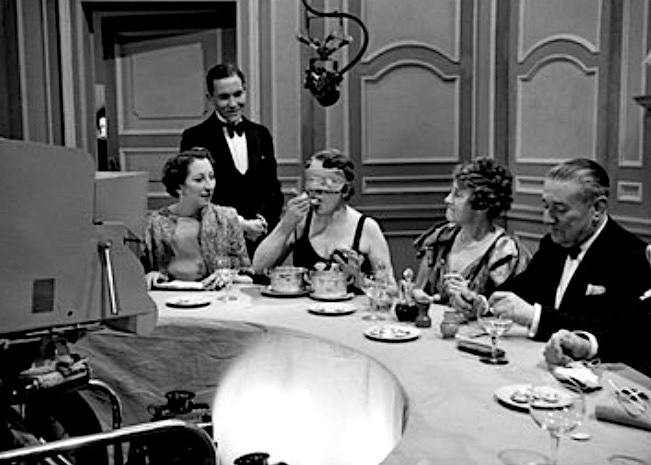
John Wyver writes: The day before the transmission variously called Bee for Boulestin or Blind Man’s Buffet on the evening of Sunday 21 May 1939, the Daily Telegraph ran an excited preview. ‘Mrs Mary Adams, the BBC producer,’ ‘Our radio correspondent’ promised, ‘has invited a number of guests who will consent to be blindfolded and led to a buffet laden with food and drink.’
A team of three men was to compete against three women, who
may be asked to distinguish between Camembert, Gruyere and Gorgonzola cheese, red and white wines, the various constituents of hors d’oeuvres, tinned and fresh food and different kinds of poultry.
One of the participants was to be philanthropist Dowager Lady Swaythling ‘who recently confessed she preferred a kipper to caviare.’
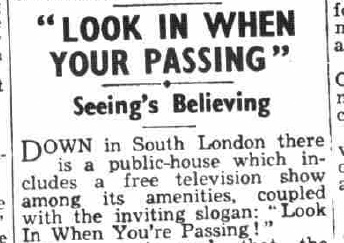
John Wyver writes: At the bottom of column 5 on page 2 of the Thursday 20 May 1937 edition of The Era newspaper was a story headlined ‘Look In When You’re Passing’. Part of the Gaumont British media conglomerate, this weekly journal was almost a house magazine for the theatrical and cinema professions, and it was increasingly turning its attentions to the service from Alexandra Palace that had started six months earlier. In full, this brief news item ran:
Down in South London there is a public-house which includes a free television show among its amenities, coupled with the inviting slogan: ‘Look In When You’re Passing!’ Response is such that the lounge is invariably crowded at the crucial hours and there is as yet no sign of the novelty losing its charm. CEA headquarters, asked if any definite steps had been taken in regard to the licensing-house entertainments, replied darkly that there was ‘something brewing’.
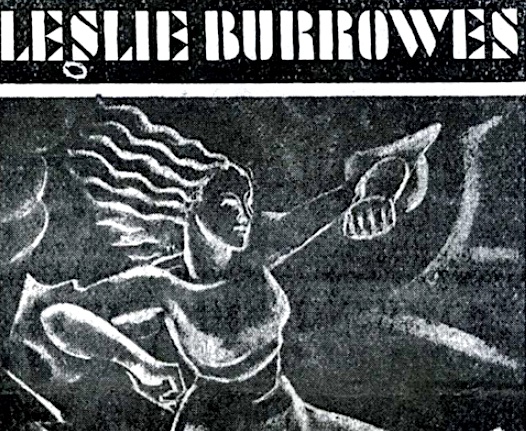
John Wyver writes: The line-up for the BBC’s 30-line transmission starting at 23.03 on Friday 19 May 1933 featured Russian singer Dimitri Vetter together with Lilian Lloyd-Taylor ‘with songs and costumes of the seventeenth century’. But the most interesting featured performer, at least for those of us interested in modern(ist) dance, was Leslie Burrowes, who gave her solos ‘Fear’, ‘Three Studies from a Celtic Suite’ and ‘Pastoral Dance’.
had studied and performed with Margaret Morris, whose ‘free dance’ method belonged to the Hellenic and Duncanesque nonballetic dance techniques of early twentieth-century Britain. Burrowes rejected her original dance training in favor of [Mary] Wigman’s expressionism, returning to London in 1931 to proselytize on its behalf and to serve as Wigman’s official British representative. Burrowes’ attempts to establish Wigman’s dance in Britain were largely unsuccessful, caught in the squeeze between the better-established ballet and Hellenic dance.
She had already appeared in a 30-line broadcast in March 1933, and she would return to the studio in October, and then twice more under her married name of Leslie Goossens in February and July 1935, on each occasion giving a different selection of solos.
Burrowes is the subject of a richly detailed 2010 Dance Research journal article ‘Leslie Burrowes: A Young Dancer in Dresden and London, 1930-34’ by Larraine Nicholas (available open access here). This focuses on Burrowes’ professional life from the point when she went to study with Mary Wigman in Dresden to when she was back in London teaching and struggling to establish herself as a professional dancer. Nicholas doesn’t mention her television appearances, but her article is fascinating for the context that it provides for these transmissions.