
Guest post: ‘Centre Play’ recalled and ranked
We are delighted to showcase as a guest post this richly interesting and and remarkably useful guide to the BBC drama series Centre Play by our friend and television scholar Billy Smart (who himself blogs here). Our thanks to him for permitting us to share more widely his reflections that were originally compiled for a group of friends and colleagues. We very much hope he will contribute other posts that draw on his extraordinarily extensive viewing and deep understanding of the history of television drama.
Billy Smart writes: In 1973 the long-running BBC2 Thirty-Minute Theatre (1965-73) strand bifurcated into two separate series. Second City Firsts (1973-78) plays were produced from BBC Birmingham at Pebble Mill, with a specific remit to create new writing and filmmaking from the regions. If you have a keen interest in old British television drama you will probably recognize the name and have seen one or two.
But the complementary Centre Play strand, which ran until 1977, has never achieved the same name recognition, despite its very distinctive opening credits design that looks like a rainbow going down a plughole. Amazingly, almost all of the surviving corpus can now be found online.
Centre Play was in essence the continuity Thirty-Minute Theatre, presenting new half-hour television plays from Television Centre. There is a conspicuous absence of film and outside broadcast material across the plays, which are almost exclusively concentrated upon studio drama as a distinct form.
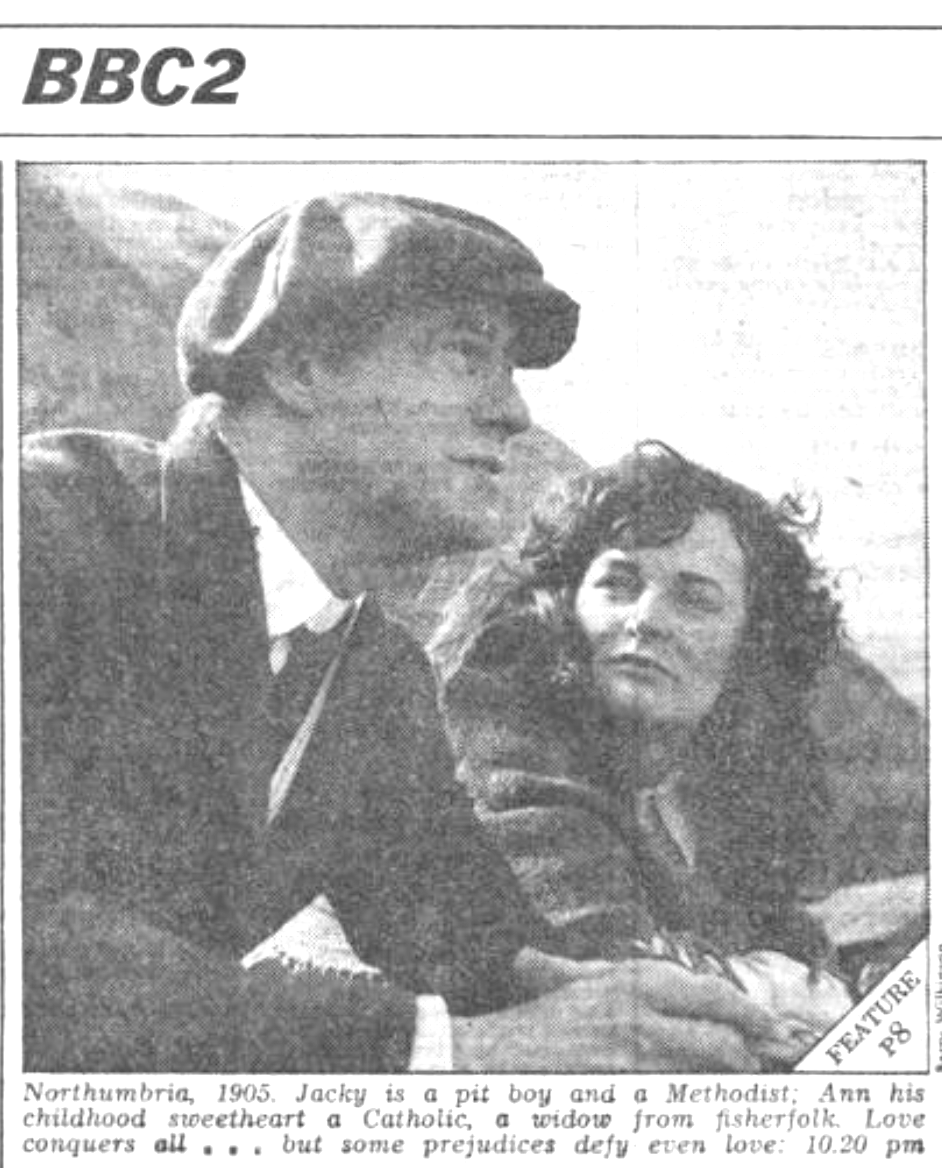
There were just a handful of filmed exceptions, only one of which I have seen. Presumably, unlike the videotape dramas, the film prints are yet to be digitized (so sadly Howard Schuman’s A Helping Hand is still a closed book to me). The only film in circulation is the Northumbrian period drama God Bless Thee, Jacky Maddison (above) – a surprising BAFTA nomination for a short TV drama, thanks to Jack Gold’s direction.
There were also a very few Outside Broadcast plays, most notably Dummy Run (probably initially commissioned as a 30MT), in which some old rugby internationals are reunited at Cardiff Arms Park, one of whom (Ray Smith) tries to disabuse his former teammates of their consoling delusions of Welsh national identity.
I have managed to see 51 of the 55 surviving plays and can report that to my mind a very large number are of exceptional merit, rather more than with Second City Firsts. There is an intense focus upon what can be achieved through the studio space – as an artificial representative space that conveys the protagonist’s subjective understanding (The House On The Hill), as a swishy arms dealers’ office that then becomes a locus of political torture (Article Five – a banned play!), as the humdrum space of a motorcycle mechanic’s shed that also contains a rock opera (Grease Monkey), as a magic mirror (Mirror, Mirror), etc. etc.
The first three of these disparate examples were all directed by John Bruce, who died last month, whose natural feel for the dramatic possibilities of studio interiors over short plays made him Centre Play’s recurring auteur.
The 30MT mission of providing a seedbed for new writers continues, especially in the themed series of plays from the Commonwealth and ‘Showcase’ season of authors new to television. There was a real merit in providing, for example, a novelist like Barry Unsworth with the opportunity to try his hand at writing a television drama on a scale that was modest enough to not be too much of a risk, but using the in-house BBC resources and skilled performers to make the exercise good enough to be worth watching – even if it doesn’t come off.
The play (The Stick Insect) turns out to be quite engaging, but the novel was clearly Unsworth’s natural medium. Elsewhere, you get uncompromising plays from young Turks of the theatre such as Howards Barker and Brenton, who were both given their head.
Here is my personal order of preference, including links to three of the best plays:
4-stars
- 1. In The Labyrinth (1976 w. Maggie Wadey d. Derek Martinus)
Two different memory plays overlaid, the one dependent on the other. Dandy Nichols is always extraordinary in anything half-good that I see her in. With her character in this play, there’s a lot of quick shifts in her perception, half the dialogue, that the actress has to convey. A double peripeteia (plot twist) at the end. The shift in the son’s understanding, and then the shift in the viewer’s understanding of the reality of the entire world of the play is neatly done visually. First you think that this sparse studio production is looking a bit more artificial by this stage, and then you realise.
- 2. God Bless Thee, Jacky Maddison (1974 w. Tom Haddaway d. Jack Gold)
- 3, Two Men From Derby (1976 w. Barry Hines d. John Glenister)
The continual, unrelenting, flurry of physically demanding housework that Sharon Duce has to do in this play is both an impressive feat of performance and a physical realisation of the conditions and expectations of the time and milieu that the character lives in. The two men are very much the good cop and the bad cop from Derby.
- 4. Post Mortem (1975 w. Brian Clark d. Roy Battersby)
- 5. The Sniffler & The Pug (1977 w. Andrew Taylor d. Hugh David)
- 6. The Cornet Lesson (1973 w. Roy Kendall d. John Bruce)
- 7. The Saliva Milkshake (1975 w. Howard Brenton d. Robert Knights)
- 8. You Talk Too Much (1976 w. Tim Aspinall d. John Black)
- 9. Piano Lessons (1976 w. Richard O’Keeffe d. John Bruce)
I was excited to come across an addition to the tiny canon of lesbian plays in British television drama from this period (I make it seven). This one starts off formally bold and quite chilly, giving the viewers an unusual subjective understanding and then rewarding them when it turns into a more conventionally realised narrative. And the sense of something undeclared being emotionally at stake is rare and convincing.
- 10. Talkin’ Blues (1977 w. Nigel Williams d. John Mackenzie)
- 11. William Wilson (1976 w. Hugh Whitemore (from Edgar Allan Poe) d. James Ormerod)
- 12. Grace (1975 w. Andrew Davies d. Brian Parker)
- 13. Mutinies (1974 w. Howard Barker d. Derek Bennett)
- 14. The Emperor’s Hat (1977 w. Angela Huth d. Desmond Davis)
3-stars
- 15. Rehearsal (1977 w. Evan Jones d. Brian Tufano)
- 16. The House On The Hill (1975 w. Peter Ransley d. John Bruce)
- 17. Only Looking (1976 w. Jack Gardner d. Mary Ridge)
- 18. City Of Fear! (1976 w. Robert Buckler d. Brian Parker)
- 19. Article Five (1975 w. Brian Phelan d. John Bruce)
- 20. Initiation (1974 w. Peter King d. Brian Parker)
- 21. Sisters (1976 w. John Elliot d. Mark Cullingham)
2-stars
- 22. Judge The Bloody City (1975 w. Don Shaw d. Mary Ridge)
- 23. A Passage To Inverness (1977 w. Chris Thomson d. Robin Nash)
- 24. Kipper (1977 w. Anthony Read d. Raymond Day)
- 25. Dummy Run (1974 w. Ewart Alexander d. John Hefin)
- 26. Our Terry (1975 w. Keith Dewhurst d. John Black)
- 27. England, Summer, Sunday (1976 w. & d. Chris Thomson)
- 28. The Weekend (1976 w. Diana Souhami d. John Bruce)
- 29. Grease Monkey (1976 w. Robin Chapman d. John Bruce)
- 30. New Zealand: Old Man March Is Dead (1976 w. Bruce Stewart d. Chris Thomson)
- 31. Canada: For The Whales (1976 w. Ty Haller d. Moira Armstrong)
- 32. The Stick Insect (1975 w. Barry Unsworth d. Chris Baker)
- 33. Is It Something I Said? (1974 w. Richard Harris d. Kenneth Ives)
1-star
- 34. The Ghost Of Adelphi Terrace (1975 w. Gwyn Thomas d. Roger Tucker)
- 35. The Squad (1976 w. Martin Dillon d. John Bruce)
- 36. Gambitt’s Move (1975 w. Fanny Galleymore d. John Reardon)
- 37. A Wily Couple (1976 w. Peter McDougall d. Ian Macnaughton)
- 38. Trinidad: Home Sweet India (1976 w. Sam Selvon d. Vivian Matalon)
- 39. Fair Tradin’ On The Dancin’ Ground (1976 w. Del Henney d. Gareth Davies)
- 40. A Man Of Morality (1976 w. Peter Whalley d. Vivian Matalon)
- 41. The Imp Of The Perverse (1975 w. Andrew Davies (from Edgar Allen Poe) d. James Ormerod)
- 42. Nigeria: A Kind Of Marriage (1976 w. Buchi Emecheta d. Mary Ridge)
- 43. Mirror, Mirror (1975 w. Derek Fuke d. Jane Howell)
- 44. Auntie Kathleen’s Old Clothes (1977 w. Michael Hastings d. Frank Cox)
- 45. The Flight Fund (1975 w. Penelope Gilliatt d. Graham Evans)
- 46. Risking It (1977 w. Peter Whalley d. Desmond Davis)
- 47. The Water Baby (1975 w. Jonathan Raban d. Jane Howell)
- 48. Sea-Change (1976 w. Chris Thompson d. James Cellan Jones)
- 49. India: Apply, Apply, No Reply (1976 w. Dilip Hiro d. Mark Cullingham)
(no stars)
- 50. Australia: Sweeping Plains (1976 w. Peter Smalley d. Ken Hannam)
- 51. Snooker (1975 w. Jonathan Raban d. Claude Whatham)
Leave a Reply