
JLG in the age of Aquarius
John Wyver writes: On Sunday Michael Witt’s revelatory screening season of Jean-Luc Godard: Unmade and Abandoned at London’s ICA threw up another gem. As part of British Sounds and Images, the first edition of the LWT arts series Aquarius was screened, and it proved to be a fascinating snapshot of the British cultural left on the cusp of the Sixties becoming the Seventies.
The programme also included Godard’s confrontational, exhausting British Sounds (co-directed with Jean-Henri Roger, 1969) and the later film essay for Channel 4, Soft and Hard: Soft Talk on a Hard Subject Between Two Friends, directed by Godard and Anne-Marie Miéville in 1985. See Michael’s informative programme notes here for more on both productions.
Early in 1969 Kestrel, a group of radical programme makers set up within the newly established ITV company London Weekend Television, commissioned a film from Godard which he shot in the spring. When they saw the delivered 52-minute production, LWT, which had been going through a turbulent period of realignment towards the populist, balked at screening it.
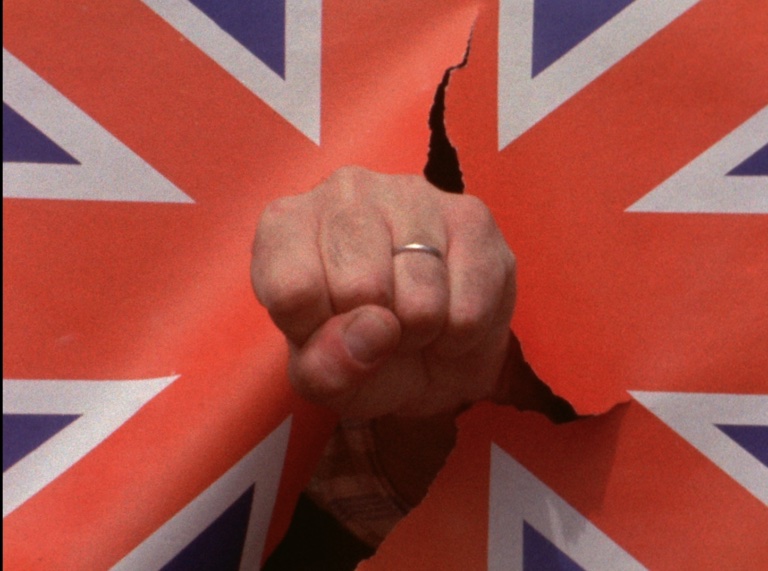
Their concerns included the film’s Marxist revolutionary politics, the inclusion of a naked young woman, and the harsh formalism of its aesthetics – lengthy tracking shots of car manufacture; political tracts read beneath a disorienting industrial soundtracks; Sheila Rowbotham also on the soundtrack an early feminist essay, but similarly aurally o=bscured; repeated slogans read against a fist punching through a Union Jack, and more.
Former LWT head of Drama, Arts and Music Humphrey Burton, who was deeply involved in commissioning British Sounds, had by late 1969 resigned from his executive position before returning as a freelance to produce and host a new arts magazine series, Aquarius. For its opening edition, transmitted on 2 January 1970, he embraced the controversy over the as-yet unbroadcast (and as it was destined to be) British Sounds, and to feature a discussion about its merits and politics.
The discussion was shot in the cinema of the ICA, which had recently moved into its new home in The Mall, and where we were watching on Sunday. Before the edited version was presented, part one of Aquarius featured a witty short film by Charlie Squires about actors who plays animals in panto and then an impossibly arch ‘comedy’ segment with John Wells as an ac-tooor preparing to go on stage.
Both items, as well as Humphrey’s links in a brightly lit, predominantly white studio set adorned with two uncredited Robyn Denny prints, appeared the more eccentric following on, as they did, immediately after Godard’s uncompromising tract. Were these cuddly animal impersonators somehow part of Godard’s universe? Was John Wells’ address to the studio camera a further example of the extreme alienation techniques of JLG’s interpretation of Brecht? A South Bank show had rarely looked so strange.
It was unclear to whether the projected digital version of the programme’s second half, which featured the discussion, was exactly as broadcast, or whether the video distortion, frame slippage and at one point an interpolated colour card before a repeated sequence, were somehow leftovers from an earlier edit. But they too only added to the overall Verfremdungseffekt.
Humphrey introduced the discussion by expressing his admiration for the ‘old’ Godard of À bout de souffle (1960) and Pierrot le Fou (1965), from which an extract was shown. But did I really hear him translate the title as ‘Mad Peter’? He titillatingly trailed as ‘coming up’ an extract of the nudity from British Sounds, although according to Michael Witt this was excised in one version of the programme and covered over with the Aquarius logo in another; Sunday’s version retained the shot.
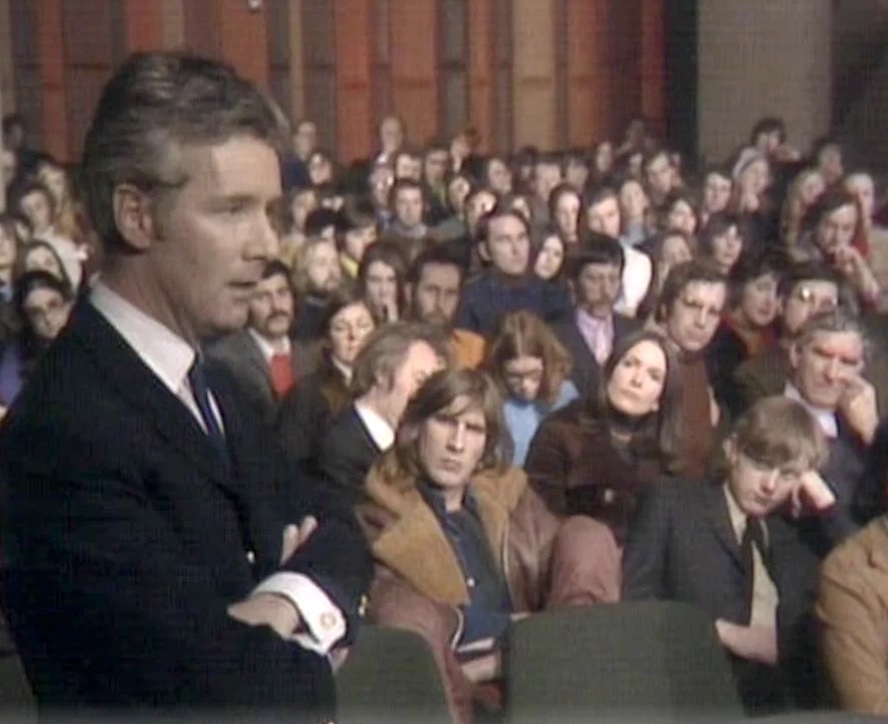
The discussion itself, which followed a showing of British Sounds, features on the platform producer Irving Titelbaum, who would later work with Ken Loach, and who here makes a decent stab at defending Godard’s stategies. Alongside him is ICA Director Michael Kustow, who says not a word, and Humphrey as chair. Everyone who is shown speaking from the floor, including critic Alexander Walker (above), is also a white man – although there is a mute cutaway of Joan Bakewell, who can also be seen in the framegrab above looking somewhat sceptically at Walker.
Other contributors from the floor include Kestrel producer Kenith Trodd, influential agent and firebrand Clive Goodwin, media theorist Nick Garnham, documentary filmmaker Jo Durden-Smith and (unidentified) former Controller of BBC Television, and indeed former Communist, Stuart Hood.
Welsh journalist John Morgan introduces himself as ‘socialist’ and is mocked for this by some of those there. Agitprop co-founder John Hoyland, who with Goodwin was behind the magazine Black Dwarf, also contributes, along with two deeply unimpressed (and unidentified) workers, who walk out in disgust.
What does British Sounds mean? Why is it so naive, and so boring? What would workers make of it? Can it bring about the revolution? All this and more is worked over with no useful conclusion. But as a snapshot from London’s culture wars of the time this archival trace is completely fascinating and, I have to admit, at least last Sunday afternoon a better watch than British Sounds itself.
Leave a Reply