
OTD in early British television: 14 August 1939
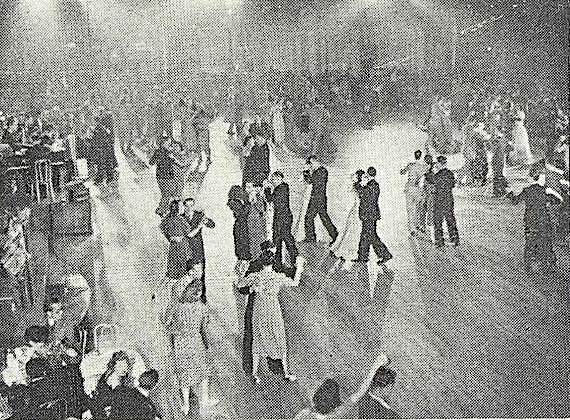
John Wyver writes: Late evening on Monday 15 August 1939 saw a mobile control unit in Hammersmith for an hour-long outside broadcast from the Palais. Viewers saw dancing including the ‘Palais Glide’, ‘Big Apple’, , ‘Jitter Bug’, and ‘Boops-a-Daisy’, as well as a crooning competition. Leslie Mitchell was the commentator and the music was courtesy of Oscar Rabin and his Band.
Our essential guide to pre-war television, Grace Wyndham Goldie writing in the Listener, included the broadcast in a state-of-the-art article about television at the end of the third year of the 405-line service:
There can, I think, be no doubt that the technical achievements of television production are far outstripping any advance in the quality of the programmes. Just consider the progress of the last twelve months. Where has it been? Why, in camera handling, lighting, scenic-designing, costuming and make-up (though not perhaps in wigging), grouping and setting and every kind of detail of method.
The change in all these things has been so marked that studio work has altered beyond recognition. And that, I agree, is important enough.
But now look at the other side of the picture. Turn from the way in which the programmes are put over to the material w,hich is put over in them. What do we find? Why, that the television week is dominated by studio light entertainment and that the mark of this is a trivial, shallow sophistication ; that it is usually cabaret and that its typical content is a pair of acrobatic ballroom dancers, a crooner, a contortionist or juggler and an at-the-piano singer of sophisticated comic songs.
Now all these things are excellent in moderation and nobody enjoys them more than I do. But it is, I suggest, a very serious mistake to give us so many of them. For they tend to give a dangerously false impression of the attitude of mind which governs television.
And even in the serious programmes an oddly similar trend can be seen. Here, certainly, and conspicuously in some of the talks series, we do get quality. But it tends to be the quality of intellect and of sophistication rather than of simplicity and humanity. And the typical talkers of television have been the Nicolsons, the Hallidays and the Tattersalls rather than the Seth-Smiths and the Streets.
The television programmes as a whole, in fact, are curiously lacking in any feeling for everyday life and everyday humanity. This is seen in the handling even of those programmes which are deliberately intended to show us ordinary life.
These are, for the most part, presented ‘straight ‘ as news events. This is obviously the right treatment for boxing matches and processions, but even the ‘feature’ programmes (last week’s Palais de Danse is an example) have the same flavour and show little of that personal angle of human interest which a good film editor gives to a good documentary film and a good feature writer like Mr. D. G. Bridson or Mr. Stephen Potter gives to a similar programme in sound broadcasting.
[OTD post no. 240; part of a long-running series leading up to the publication on 8 January 2026 of my book Magic Rays of Light: The Early Years of Television in Britain, which can now be pre-ordered from Bloomsbury here.]
Leave a Reply