John Wyver writes: The schedule from Alexandra Palace on Wednesday 28 April 1937 was unremarkable. As was the schedule two years later on Friday 28 April 1939. Which is more or less the point of this post, prompted in part by Billy Smart suggesting that I might write about the scheduling pattern of television in these years, and what changes – if any – this went through between 2 November 1936 and 1 September 1939.
This post can at least begin an outline, starting with a comparison of the hours of broadcasting. On both days television was transmitted in two main blocks, starting each day at 3pm and 9pm. The differences, however, included the additional transmission in 1939 of an hour in the morning so that television showrooms had something to demonstrate to potential customers.
There was no test card then, and so sales people showed potential customers The BBC Television Demonstration Film each day from 11am, followed by an edition of the soft-centred newsreel-type Ace Magazine film to make up an hour until midday.
Also in 1939, on the television wavelength the BBC had begun to broadcast selected elements of radio broadcasts prior to each block of television, so on 28 April 1939 users who had their television receivers switched on could hear The Daily Service from the National Programme at 10.15am, followed by an annoucnement relating to a speech by Adolf Hitler and then the weather forecast for farmers and shipping. At 8pm that evening the audio from the Regional Programme was carried, with a variety bill titled Ours is a Nice ‘Our, Ours Is.
John Wyver writes: ‘There were three, large, hearty failures in the television programmes last week and I propose to discuss them.’ That was how the splendid television critic for The Listener, Grace Wyndham Goldie, began her 27 April 1939 column which was headed ‘Sad Trio’. And I propose to feature excerpts from her discussion to illustrate and celebrate her writing.
Yes, I know that any service must have failures and that television, being a new service, must have more failures than most. And I realise that Alexandra Palace turns out at least twenty-five productions a week and that three misses out of twenty-fiveshots isn’t bad marksmanship. Why, then, dwell on the three and ignore the remaining twenty-two?
Because the ways in which these programmes failed are of the utmost importance to listeners and it is most necessary that we should differentiate between them. Programme A was a valuable experiment and the sort of thing we welcome even at the cost of failure. Programme B promised to be good but it misfired because of the way in which it was presented. Programme C was an earnest piece of unmitigated boredom and had, as far as l could see, no justification of any kind whatever.
John Wyver writes: We take for granted live coverage and analysis of Budget speeches today, but television had to learn how to make such broadcasts, a process that began on Tuesday 26 April 1938. That evening from the studio at Alexandra Palace economist and tax expert Sir Josiah Stamp, G.C.B., G.C.E. (no, me neither) provided ‘an eyewitness account of the Budget speech’ given earlier that day by Chancellor of the Exchequer Sir John Simon.
This was preceded by a commentary from broadcaster (and noted marine biologist) Geoffrey Tandy accompanied by visuals valiantly compiled by Hannia Heyman (who appears to have left no other archival trace). Explaining that the year’s budget estimate was more than one billion pounds sterling, Tandy dug into the details. And mention of the time civil servants took to prepare the figures was paired with an image of a pile of Estimate Books.
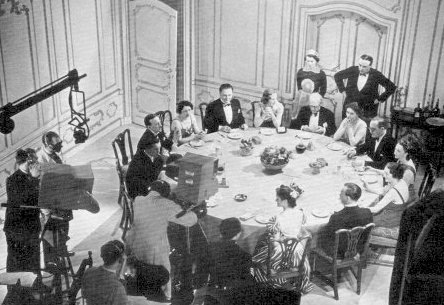
John Wyver writes: The first half-hour of the afternoon transmission on Tuesday 25 April 1939 was graced with the second performance of a production J.M. Barrie‘s one act, and according to the author ‘unfinished’, Shall We Join the Ladies? The cast of 16 included Margaretta Scott, Basil Radford, Richard Goolden and Frank Allenby.
As the Radio Times billing noted:
Technically, Shall We Join theLadies? is extremely difficult to produce for television, the action being confined to diners seated round a circular table. It will be interesting to see how producer George More O’Ferrall copes with the problem of showing the diners’ faces and not their backs.
It is not at all clear from the above publicity shot that the ever-inventive More O’Ferrall found a satisfactory way of tackling the problem.
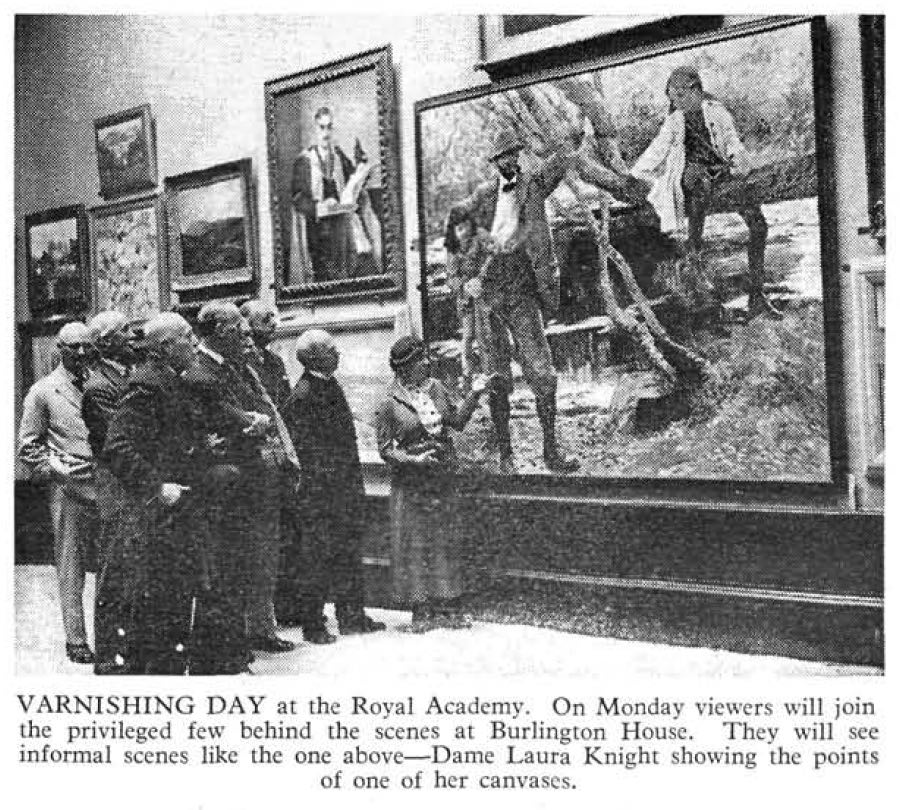
John Wyver writes: Monday 24 April 1939 saw one of the BBC’s pair of mobile control rooms parked outside Burlington House for an afternoon outside broadcast from Varnishing Day for the Royal Academy’s Summer Exhibition. Above is the image Radio Times used to trail the transmission.
Before moving inside, viewers saw filmed shots of works being taken down the adjacent lane for consideration on sending-in day and then a fragment of British Movietonenewsreel showing the selection committee at work.
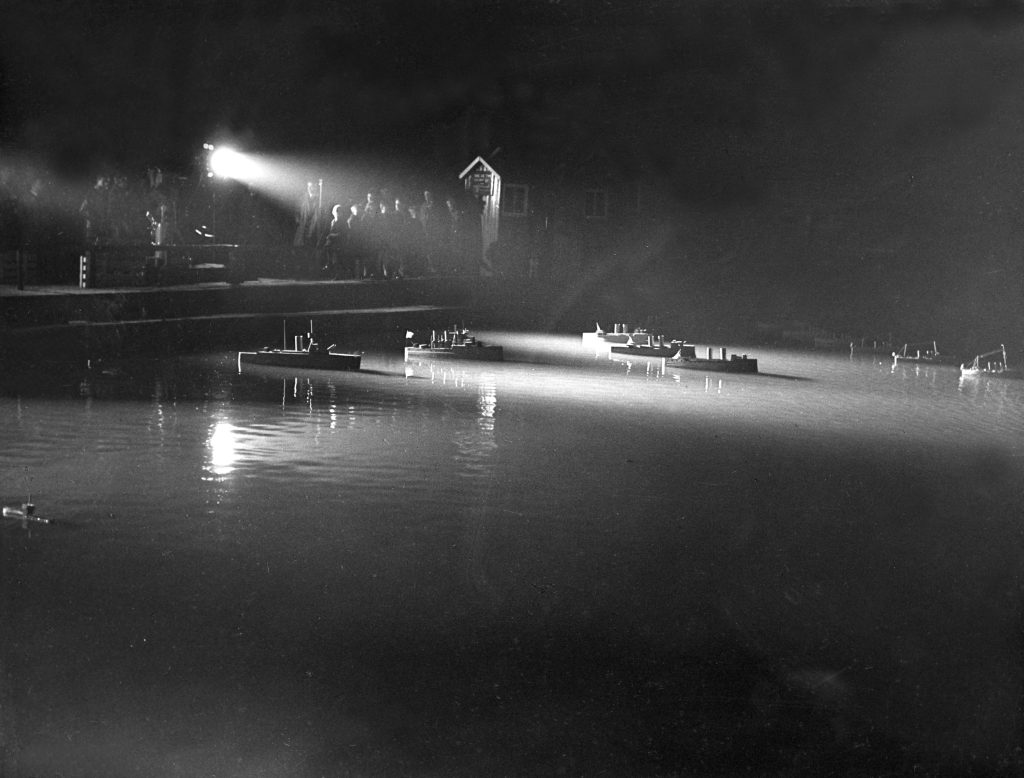
John Wyver writes: On St George’s Day 1938, Saturday 23 April, and on the following evening, a ‘local OB’ from the lake close by the AP studios transmitted a reconstruction of the First World War naval attack exactly twenty years before on the Belgian port of Zeebrugge.
Used by the Imperial German Navy to support U-boats and other vessels, Zeebrugge was targeted in a wartime mission intended to shut down its operation by scuttling obsolete warships. Despite the block ships being sunk in the wrong position, the loss of 227 Royal Navy servicemen, and the port being accessible again after a few days, the raid was hailed as a success and exploited to raise Allied morale.
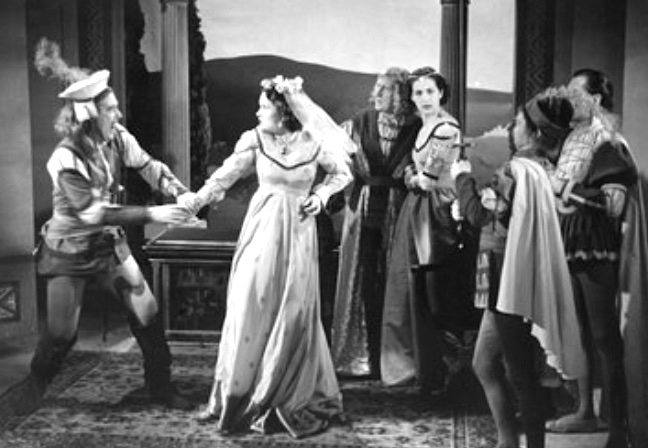
John Wyver writes: The afternoon of Saturday 22 April 1939 saw the first performance of Dallas Bower’s production of Katharine and Petruchio, a radically shortened ‘acting version’ of William Shakespeare’s The Taming of the Shrew that had originally been prepared in the late 18th century for David Garrick.
By this point, Bower had mounted in the AP studio his successful modern-dress production of The Tragedy of Julius Caesar and his problem-plagued version of The Tempest, and Katharine and Petruchio was the final Shakespeare to be offered by television before the imminent war shut down the service on 1 September.
His cast was packed with actors who already had extensive television experience: Margaretta Scott as Katharine, Austin Trevor as Petruchio, and Alan Wheatley as Hortensio, while Vera Lindsay, a Shakespearian specialist from the Old Vic, took the part of Bianca.
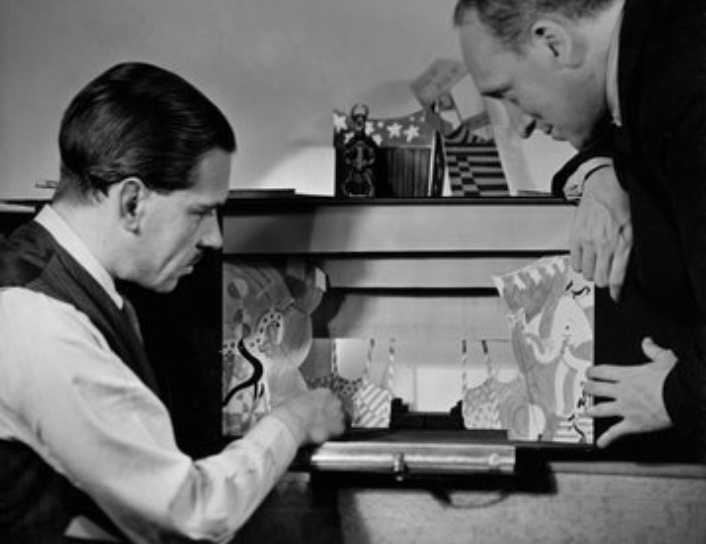
John Wyver writes: From 11.12pm on Friday 21 April 1933 viewers fortunate enough to own a 30-line television receiver could watch the half-hour Looking In, billed as ‘the first television revue’. Written by John Watt with music composed by Harry S. Pepper (that’s them above, with their set for the revue for Radiolympia in 1933), this featured ‘celebrated Première Danseuse’ Iris Kirkwhite, singer Anona Winn, and comedians Veronica Brady, Horace Perceval and Reginald Purdell, plus six of the Paramount Astoria Girls along with a band of four. All marshalled into a 40-minute broadcast by producer Eustace Robb.
Unlike most other 30-line transmissions, the occasion attracted a good deal of press comment, being regarded by the Daily Telegraph ‘rather a highly interesting experiment than as an entertainment’. And as Daily Herald critic wrote, there was ‘no room on the screen to show more than two, or at the most three, of the four [sic] dancers at once, and only two-thirds of a sketch.’ Despite this, the writer recognised, ‘Television moves on, slowly but surely.’
Even more remarkably, an amateur recording exists of four minutes of this broadcast, which as its restorer Donald McLean argued ‘easily challenges [the] myth of poor quality programmes and an amateurish service.‘
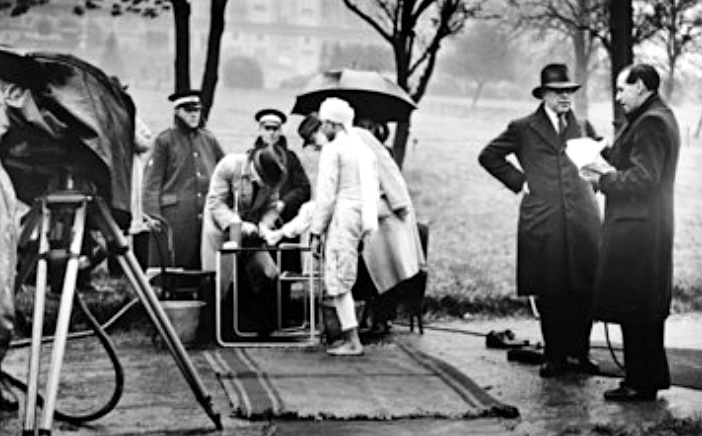
John Wyver writes: On what from production photographs looks like a rainy Tuesday afternoon on 20 April 1937, the fledgling Television service at Alexandra Palace, ever in search of noteworthy elements to broadcast, elected to screen as a local OB from the Park a demonstration of fire-walking. This was arranged by Harry Price (in the hat, second from right), of the (unofficial) University of London Council of Psychical Investigation, and was undertaken by Indian magician Ahmed Hussain and British amateur fire-walker Reginald Adcock.
As the Programme-as-Broadcast form recorded, during the 21-minute broadcast, for which Freddie Grisewood (on the right, talking to Price) was the commentator, both men ‘walked without injury over the red-hot embers of a wood fire laid in a trench 12ft [roughly four metres] long.’ In an article in August that The Listener described as ‘considered judgement’ on the substance of the broadcast, Price declared that, ‘We have solved the mystery of fire-walking.’
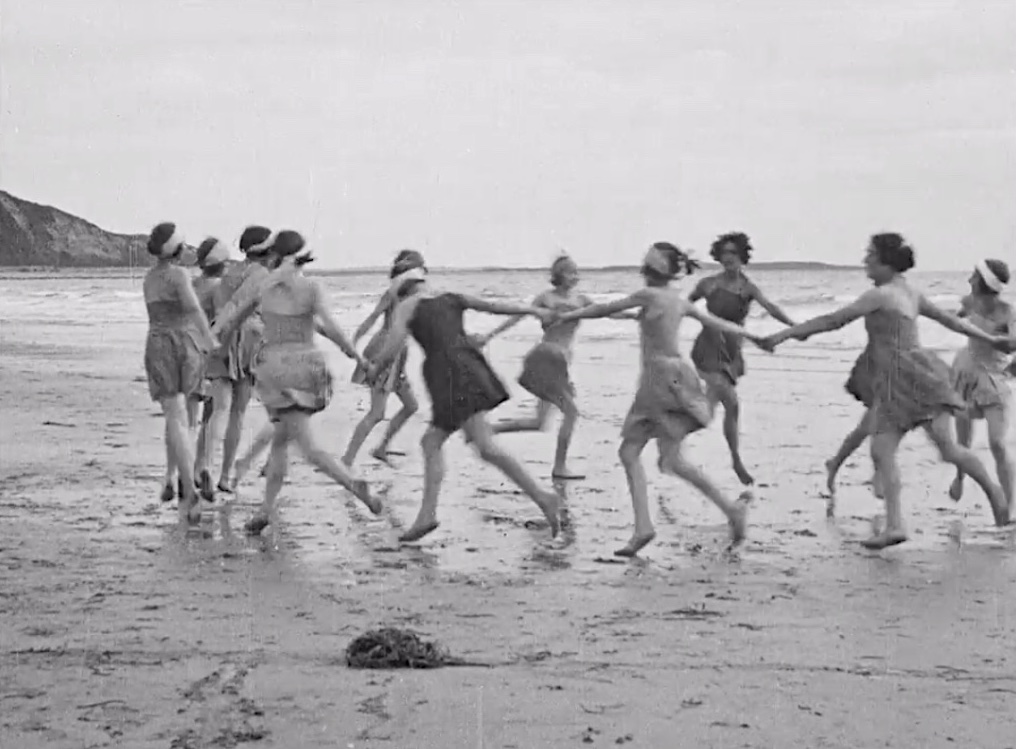
John Wyver writes: On Monday 19 April 1937 Alexandra Palace hosted a troupe billed as the Margaret Morris Dancers, who performed in both the afternoon and evening. Their first 13-minute slot featured seven short works, performed to Beethoven and Chopin among other composers, while the later, slightly longer programme showcased a somewhat different selection of seven dances. Eight dancers are named in the Programme-as-Broadcast records, including Morris herself performing ‘Luncheon hour’ to a score credited only to ‘Bradford’.
Margaret Morris led the Margaret Morris Movement (MMM), a successful school teaching a form of classical Greek dance that, in contrast with the rigid forms of ballet, celebrated freedom and movement. After performing at the start of the century as a teenager in productions of Shakespeare by Ben Greet Frank Benson and Sir Herbert Tree, she studied with Isadora Duncan’s brother Raymond and in 1910, encouraged by her lover John Galsworthy, opened a school in London.