
Bransby’s Ebenezer
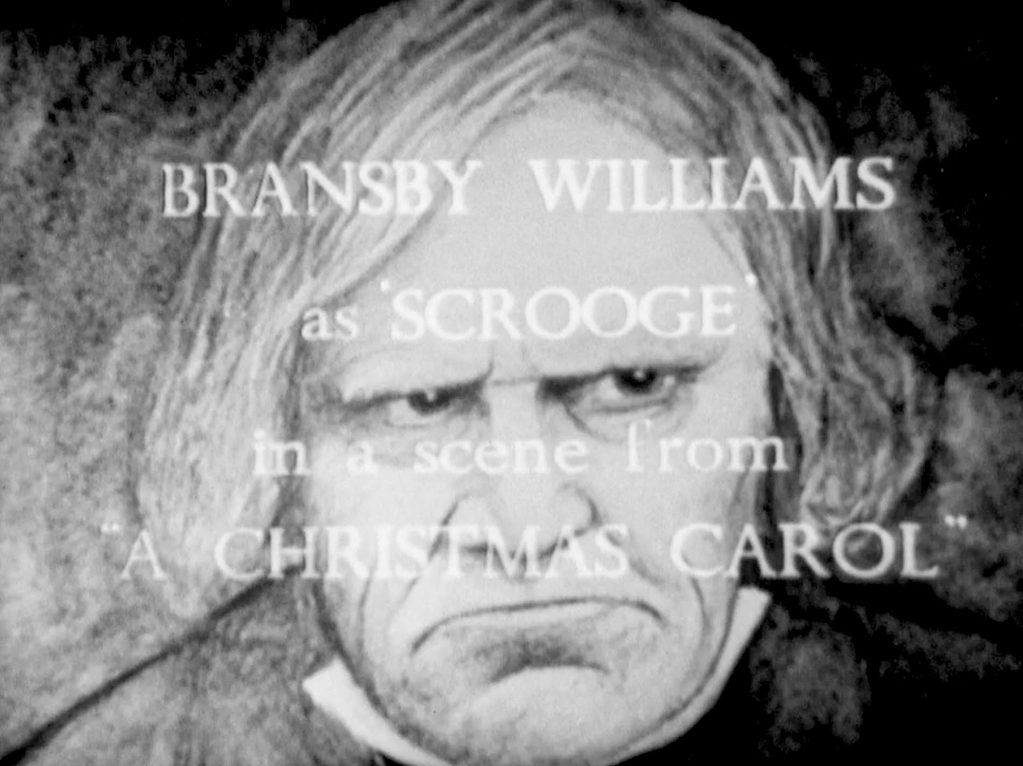
John Wyver writes: BBCiPlayer’s controversial early release of a selection of this year’s Christmas specials has thrown up, along with Stacey & Joe’s Crafty Christmas and A Ghost Story for Christmas:The Bride’s Chamber, a pair of remarkable archival relics. Both feature actor, comedian and monologist Bransby Williams, himself a remarkable relic of the Victorian theatre and music hall.
First shown on Christmas Eve 1952, Scrooge with Bransby Williams (below) is a 19-minute performance by Williams (and an off-screen ‘boy’) of three sections of Charles Dickens’ 1843 tale A Christmas Carol. Introduction to Bransby Williams is a 4-minute fragment from a year later. Both are extraordinarily welcome to the assembled riches from the past on iPlayer, although the former is said to be ‘considered the BBC’s first televised Dickens adaptation’. To whoever considers it so, including presumably iPlayer, the only appropriate response is ‘Bah! Humbug!’.
(Apart from the earlier adaptation of A Christmas Carol, which is mentioned below, the details of other televised versions of Dickens will have to wait for a future blog.)
By 1952 there was already a strong tradition of Dickens adaptations, but before we get to that, a word or two about Bransby Williams, who at the time of the Scrooge recording was 82 years old. Williams had started his career doing impersonations of famous actors in working-men’s clubs and then from 1896 in music halls (all this is courtesy of Wikipedia). The following year he began creating his celebrated characters from Dickens, including Mr Micawber, Bill Sikes and Fagin.
In the early years of the twentieth century Williams ran a successful theatre company that toured not only across Britain but throughout the Empire and in the United States. He starred in a number of silent films, including as Gradgrind in Hard Times (1915) and in The Adventures of Mr Pickwick (1921). A DeForest Phonofilm recording of him giving Scrooge was made in 1928, and before this he had recorded The Awakening of Scrooge for an Edison audio recording in 1913 and also for Columbia in 1926, both of which can be heard here:
By the 1930s Williams was turning up in newsreels, as here, for Pathé in 1932, transformed into Tony Weller from The Pickwick Papers:
Williams was also a regular on television, and before this radio. His first turn before the microphone was in April 1923 giving a short talk for 5NO Newcastle, and his first documented presentation of his characters from Dickens was in August 1925 for 2LO London. On Christmas Day 1929 he could be heard as Scrooge on 2LO London and far more widely via 5XX Daventry. For Boxing Day 1932, Radio Times promised that
For thousands Christmas is not complete without a re-reading of Dickens’s full-blooded creation of the old-fashioned festive spirit; Mr. Bransby Williams’s well-rounded performance, aided by the sound of the bells, the cries of the street-boys of Victorian London, and the clanking of Marley’s ghostly chains will make the illusion even more complete.
For the Baird Company’s 30-line broadcasts Williams seems to have given impressions just once, on 9 April 1930, and he may have decided not to return because there was a 7-minute breakdown in the middle of his performance. With the arrival in 1936 of the BBC’s high definition service from Alexandra Palace, he was booked to give Scrooge for Christmas Eve, and was billed to appear both mid-afternoon and in the evening. But clearly something went wrong, and he was replaced in the first slot by George Robey and later by Cecil Dixon at the piano. His 405-line debut eventually came in a Cabaret line-up in April 1937, and that year he appeared twice more from AP.
Post-war Williams first appeared on television as James Telfer in a November 1949 production of Pinero’s Trelawny of the Wells. The following year, in March, he reprised one of his great stage successes as Matthias in Leopold Lewis’ The Bells, and then on Christmas Day that year producer Eric Fawcett presented a full dress adaptation of Dominic Roche’s stage version of A Christmas Carol, with Williams as Ebenezer Scrooge.
There were other solo appearances, including in programme for children and one on 14 August 1954, the day of his 84th birthday. And there were still other solo turns too after this, shepherded to the screen as telerecordings by producer Kenneth Milne-Buckley, who was directing the cameras for the Scrooge broadcast in 1952.
Having been an stage actor and for films, Milne-Buckley was a studio manager at AP in the years after the war and started producing television drama in 1951. The following year he devised and produced The Betty Driver Show. He was later responsible for episodes of In Town Tonight and a keep-fit show with boxer Freddie Mills. Again according to Wikipedia, Milne-Buckley met television announcer Sylvia Peters on her first day at the BBC [in 1947]. Despite being married with children at the time, he and Peters formed a close professional relationship that later led to marriage.
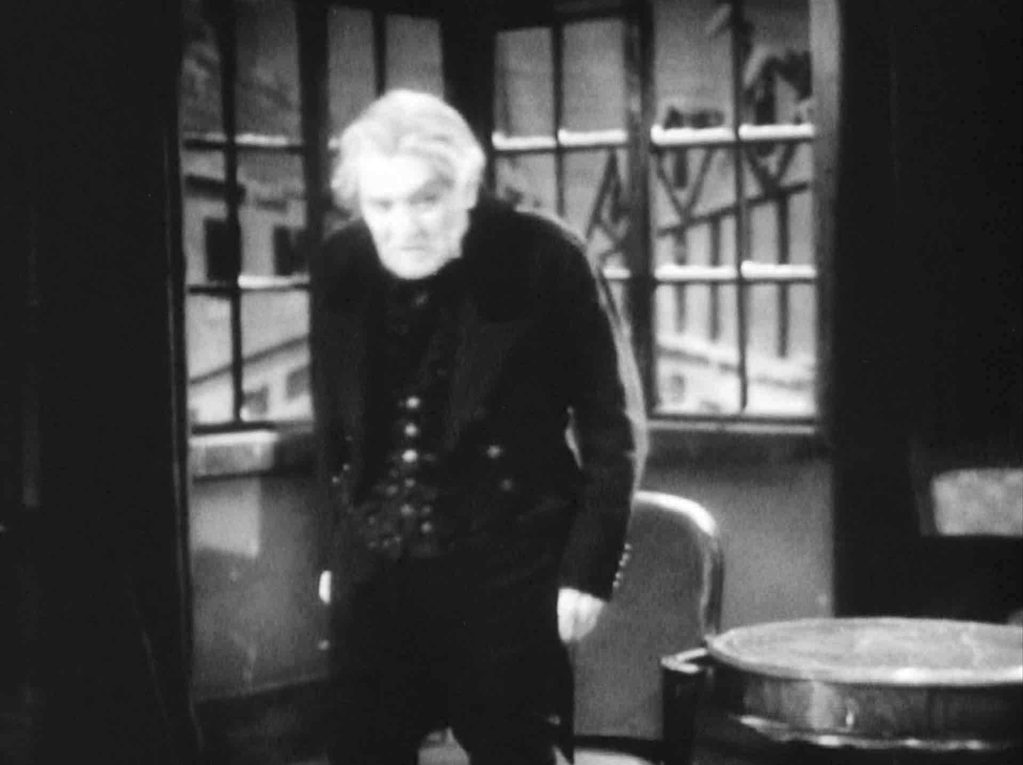
Preserved for us (and for subsequent BBC showings) as a 35mm telerecording, the 1952 Scrooge is a penny-plain studio presentation with a single room set and, by my count, three cameras. Following a single title card (see the header image; this is Williams’ own painting of himself in character), a pan takes the shot past a window with a stylised townscape outside, complete with falling snow, to a door through which Williams enters in costume. Complaining about the cold, he removes his coat and shuts the window, so silencing the carol singing on the soundtrack, and begins to speak to himself.
Although he occasionally glances briefly towards the camera, Williams speaks throughout to himself, not to the viewer. He recalls Marley and reflects on meeting Bob Cratchit in the street, and throughout he has to put into words the events of this Christmas Eve, including the encounters with the three ghosts. These of course Dickens describes as prose. There is some modest alternation between mid-shots as well as restrained use of zooming in on the central character.
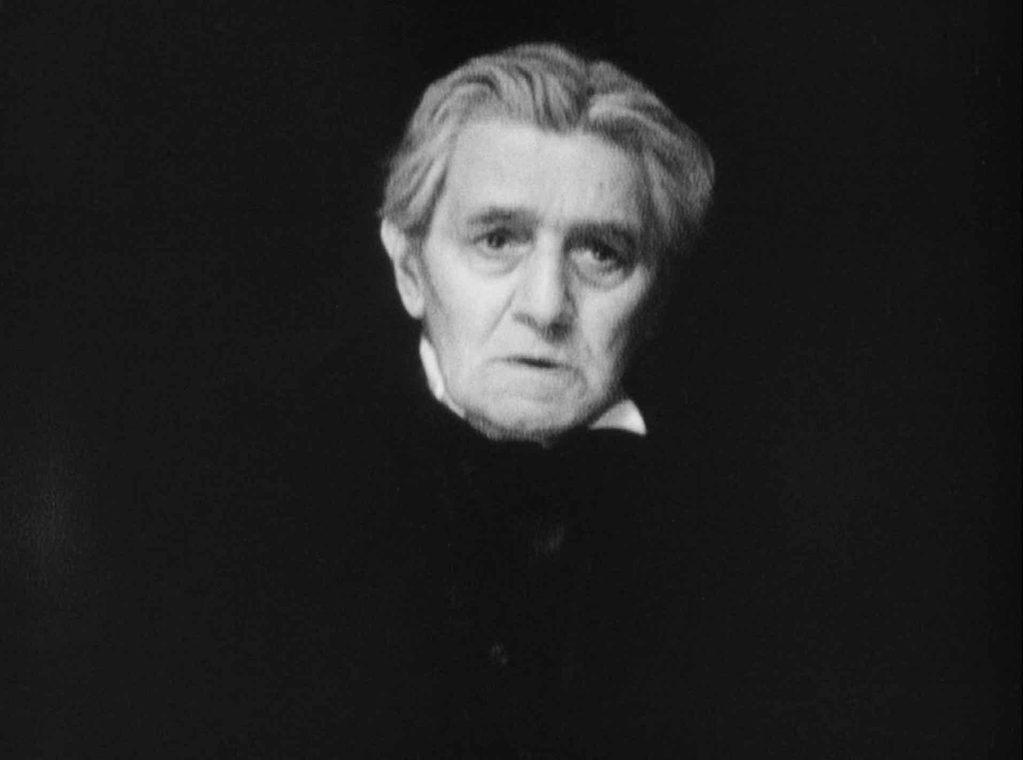
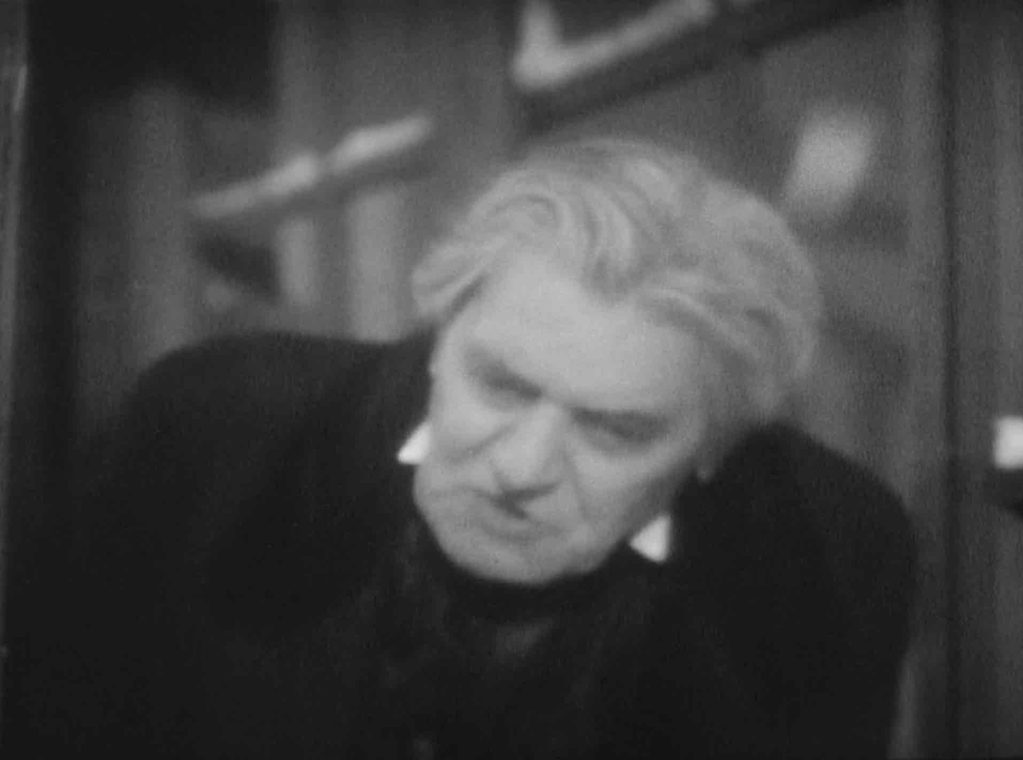
Five minutes or so in, Scrooge falls asleep and an overlaid mist and soft ethereal music indicates his travels with the ghosts. On waking, as he recalls events with horror, he moves into a darkened space in which his face alone is spot-lit (above). A second transition, with more mist, leads to his character in reformed mode, with the exterior townscape more brightly lit (below).
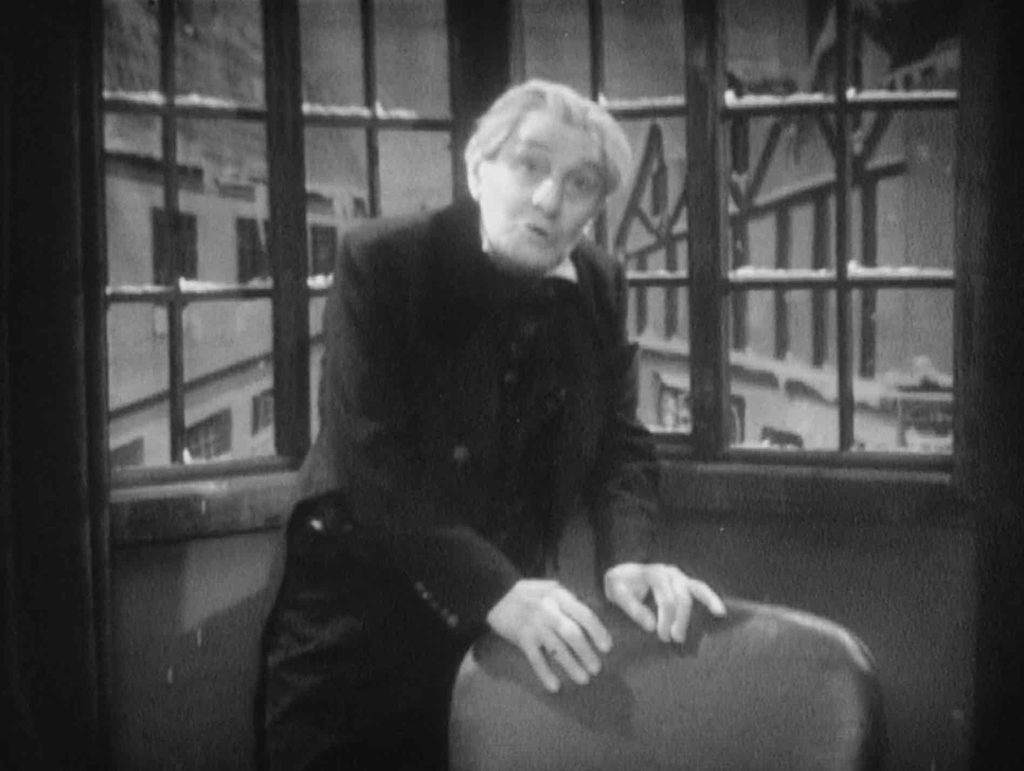
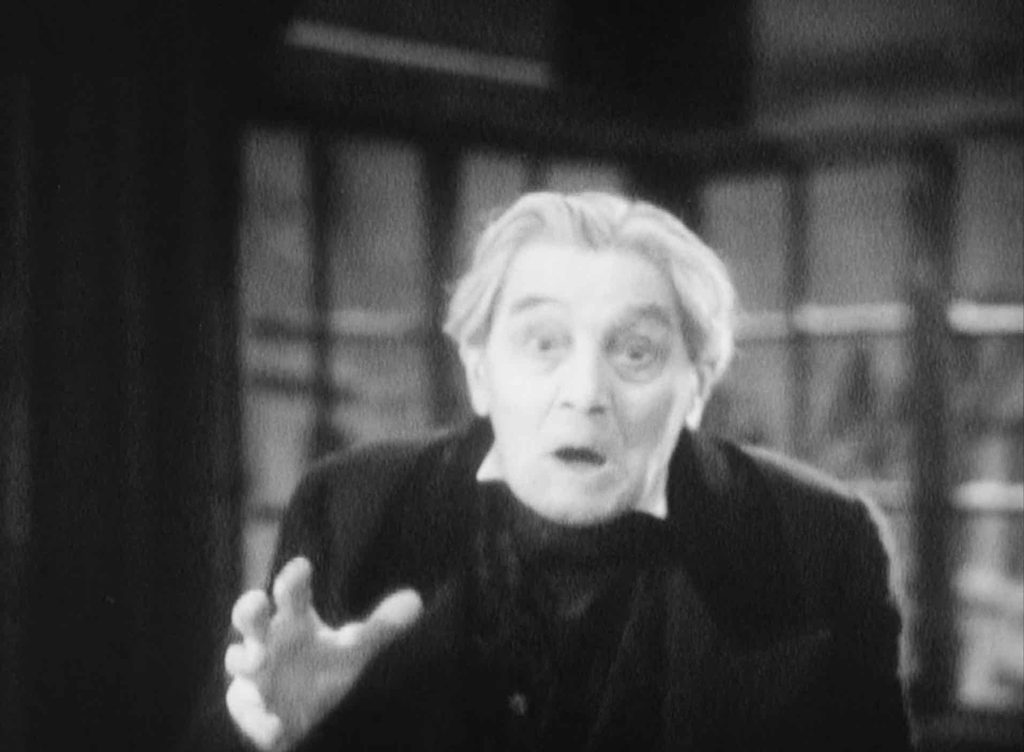
At which point Scrooge goes to open the window, and the camera cuts ‘outside’ as Scrooge leans through the opening and shouts ‘Oi! Oi, boy! Oi.’ (below). The scene is perhaps most familar with Alastair Sim in this pose in Scrooge, Brian Desmond Hurst film version of the story released the year before this broadcast. And of course it has also given birth to a thousand online memes.
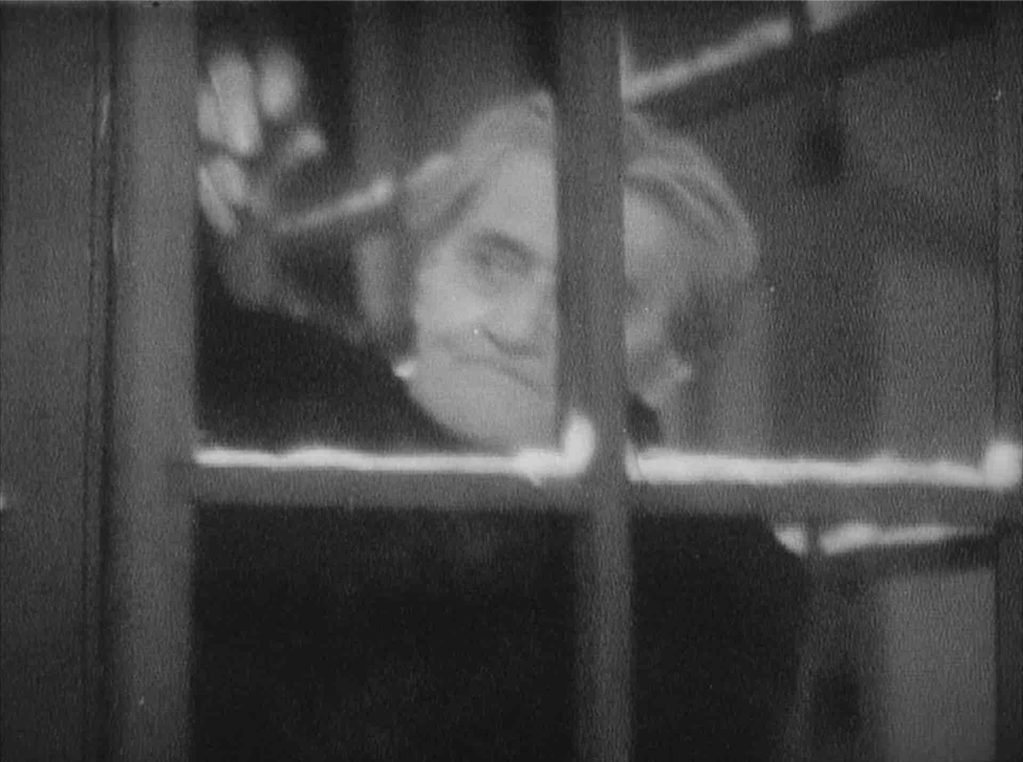
An off-screen ‘voice’boy’ tells Scrooge that it is indeed Christmas Day, and then during a subsequent visit to the window agrees to purchase the big prize turkey from a nearby shop. As Scrooge makes plans for his Christmas Day good deeds the camera moves in for a further close-up and ‘God rest ye merry gentlemen’ returns to the soundtrack. Another single card caption gives simply a ‘presented by’ credit, and we’re out.
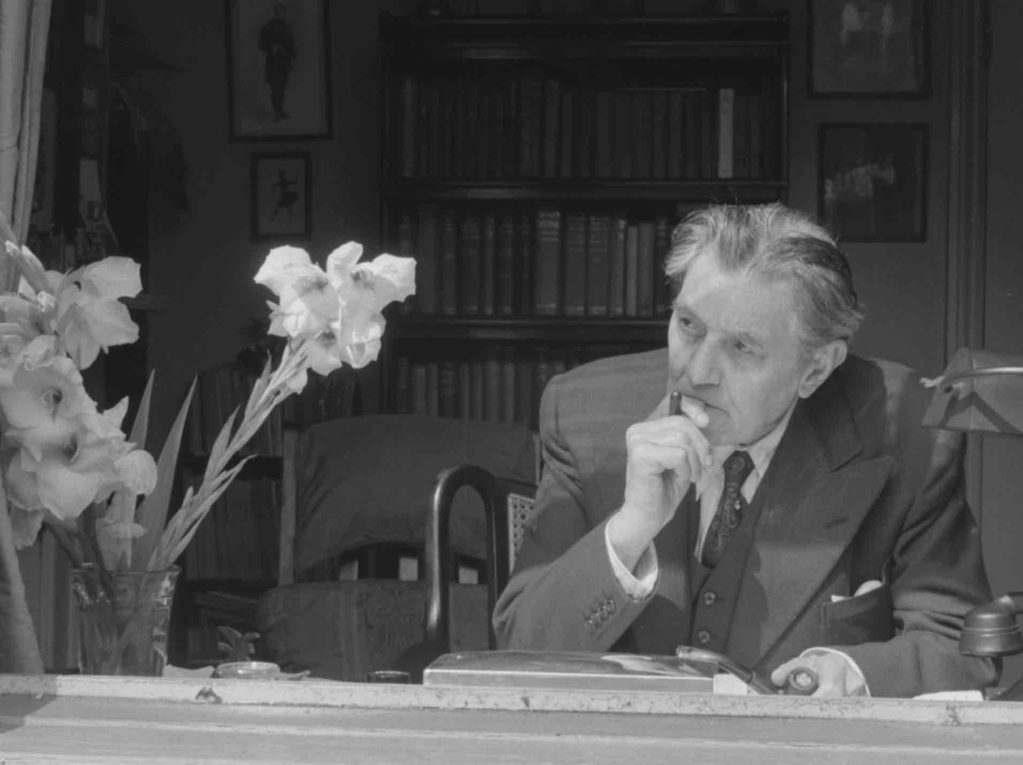
The following year, on 21 December 1953, the telerecording of Scrooge was shown with a short introduction to Williams, and on iPlayer this forms an eccentric complement to the performance. Williams is seen writing and musing at the window of his flat, but he does not speak, and otherwise the camera pans reverently around the books and memorabilia in his dwelling as a voice-over explains the actor’s many achievements.
Coming soon: Dickens on early British television. Remember you can sign up to receive these posts as e-mails. Just enter your address on the webpage. Unsubscribing is just as easy.
Leave a Reply