
The Sunday dozen
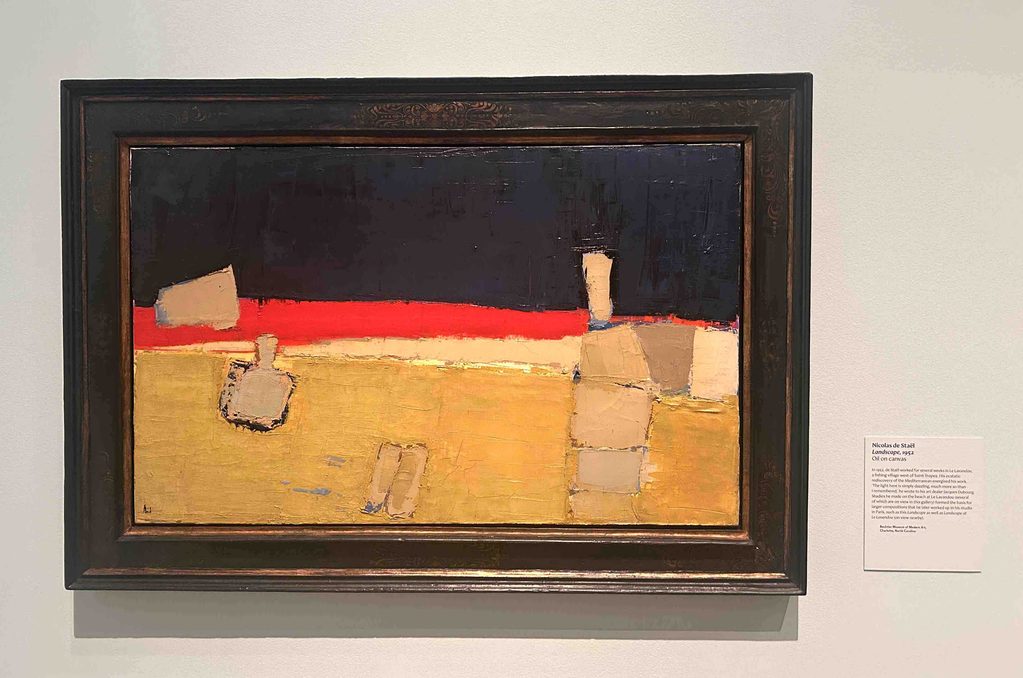
John Wyver writes: Back at last to Sunday publication, although I’m not sure I can keep to the schedule going forwards. Anyway, here is a selection of links to articles and more that have engaged and interested me over the past days. My header image is Nicolas de Staël’s Landscape, 1952, currently on view in the Royal Academy’s often glorious Painting the French Riviera exhibition (until 31 January).
• The radical clarity of NAZA makes You Can See Everything seem irrelevant: excellent from Charlotte Higgins for the Guardian…
• Mr. Fielder, I’m ready for my close-up: … yet You Can See Everything is also really well worth seeing, and arguing over, and this by Julia Simons for LA Review of Books is one of the best pieces I’ve read about it – but warning, spoilers!
• Movies in the time of MTV: Mark Asch for Criterion’s Current is really interesting on films from the 1980s and 90s by directors including Michael Bay, Hype Williams, Spike Jonze, Dominic Sena and David Fincher.
• A shadow history of independent cinema: an essential essay by Richard Brody for The New Yorker [£; limited free access]:
[T]he myth of how American independent filmmakers break into the business has always masked a troubling reality, which is that the system failed some of the best work. Even in more robust times, plenty of truly great movies went all but unseen, leaving directorial careers of stunning potential cut off almost as soon as they had started. Entire swaths of cinematic history were thus foreclosed in advance. I’ve come to consider these missing movies and overlooked filmmakers as a shadow history of independent cinema—one that is every bit as important as the official one.
• Elsinore revives a legendary, closeted actor. It also revives his rival: really good by Sam Adams for Slate on Ian Charleson and Derek Jarman.
• Decency and tradition: Colm Tóibín on Thomas Mann and Fatherland: a rich interview with the Irish novelist by Andrew Marzoni for The Paris Review.
• The genius of Jan van Eyck in three works: beautifully presented close looking from Emily LaBarge for The New York Times [gift link] with three paintings from the recently-opened National Gallery exhibition.
• Inside the archive – preserving the TV-am collection: terrific from the BFI… and see also The dawn of morning television: how TV-am changed British broadcasting by Chris Hall.
• The amazing cinematic artistry of Grand Theft Auto 6: lots of good writing this week about GTA VI, much of which is interesting even for those of us with neither the desire nor the capability of playing it; this is Luke Buckmaster for Flicks.
• Now & Then with Robert Saunders: Royal Scandal! The Abdication Crisis 90 years on: a completely fascinating podcast episode with the historian in discussion with David Runciman about Edward, Mrs Simpson and the wider context of the events of 1936; there is also a complementary episode, Now & Then with Robert Saunders: The Abdication Crisis 90 years on – The fallout.
• The reset summit and beyond: Chris Grey’s continuing commentary on all things Brexit, delivered in fortnightly blog posts of which this is the latest, is ever more valuable.
• My Booker year: immaculate writing by Patricia Lockwood for the LRB [£; limited free access] about being a judge this time round.
• Close reading for life: on three literary virtues: Dan Sinykin for HouseHouse Magazine:
Reading…is good for its own sake. It is also a—maybe the—foundational skill in education. Much of our trouble comes from failing to instill reading’s goodness because of its exigency. See: reading is hard. In the long history of our species, we learned to read extremely recently, just a few thousand years ago. To do so, we had to reconfigure our brains, which… did not evolve for this, to make sense of written marks. Mass literacy, where most of a population can read, only emerged in the last century or two. It requires an immense collective effort. Adequately comprehending the text in front of you takes considerable training.
• Six experts on reclaiming AI for the public good: concise and productive from The MIT Press Reader, with thoughts from Francine Berman, Cindy Cohn, Jim Fruchterman, David Weinberger, Bruce Schneier, and Esther Dyson.
• And finally…: I am hugely enjoying Another Timbre’s recently released 4-CD box-set John Tilbury at Home, which is a wonderful collection of the great pianist playing some of the most beautiful contemporary classical work; to celebrate that here he is with violinist Darragh Morgan (violin) performing Morton Feldman’s ‘For John Cage’ in concert at Salzlager, Hall in Tirol, Austria, 16 March 2013.
Leave a Reply