24th September 2025

John Wyver writes: Monday 24 September 1928 was the second day of a week of demonstration transmissions by John Logie Baird’s company for the National Radio Exhibition at Olympia. Radiolympia attendees could step out on a dance floor to tunes from Jack Payne and his BBC Orchestra, but presumably to avoid an intolerable cacophony broadcast demonstrations were not permitted in the hall. As a consequence, manufacturers hired nearby premises to show off the latest systems.
So it was that the first performances for British television of songs and comedy were given at 1 Hammersmith Road, sent by landline and watched on the opposite side of Olympia in a shop in Maclise Road.
read more »
23rd September 2025

John Wyver writes: Over the weekend of Friday 23 and Saturday 24 September 1938, the BBC’s mobile unit made a return visit to Pinewood film studios for three OB broadcasts. Pinewood was the location for the first and most successful of three groups of OBs from London’s film studios a year previously, and this return offered the opportunity not only to attract a little more of the silver screen’s stardust but also to employ the unit’s improved cameras in a nightime interior from the ‘Pinewood Ball’.
Friday afternoon, when a 20-minute broadcast was hosted by Tod Rich, included an appearance by Elizabeth Bergner; the shooting of a test for So This is London, a comedy being made by 20th Century Fox’s British subsidiary; and shots of the filming of a scene from the drama short Beyond Our Horizon.
read more »
22nd September 2025

John Wyver writes: From time to time it’s worth checking in on the guest list for the magazine series Picture Page, in this case on the evening of Thursday 22 September 1938. The magazine show comprising brief interviews by Leslie Mitchell with a very wide range of guests featured an extraordinary range of the famous and the anonymous, including writers, diplomats, sports persons, screen stars, eccentrics, variety performers, hobbyists and so many others.
Contributors often brought a prop with them, and were mostly spoken with standing in or walking about the studio. They were rigorously prepared for their four minutes or so of fame, and in the early days at least were pretty much expected to learn their answers by heart. Broadcast twice weekly, in both an afternoon and evening edition, Picture Page was the single uncontested studio ‘hit’ of pre-war television, and it returned again in 1946.
read more »
21st September 2025
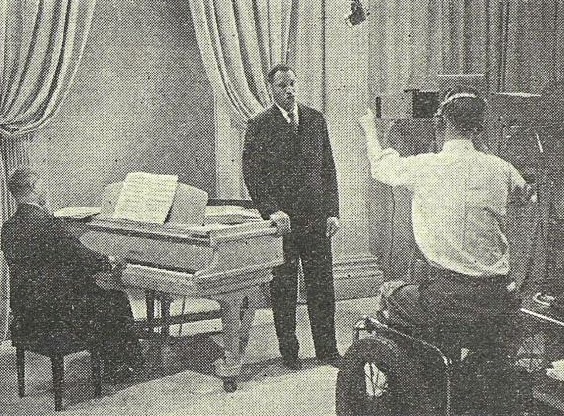
John Wyver writes: It’s still the weekend, and I still have many pages of my proofs to work on, so here are further links to previous blog posts that I especially enjoyed writing.
OTD in early British television: 10 August 1931
Early television appearances as a dancer of the composer Avril Taylor-Coleridge.
OTD in early British television: 8 January 1937
Burnt Sepia, British television’s first programme featuring exclusively Black artists, headlined by American singer and dancer Eunice Wilson.
OTD in early British television: 31 August 1939
Grace Wyndham Goldie responds to a television appearance by Paul Robeson (above).
20th September 2025
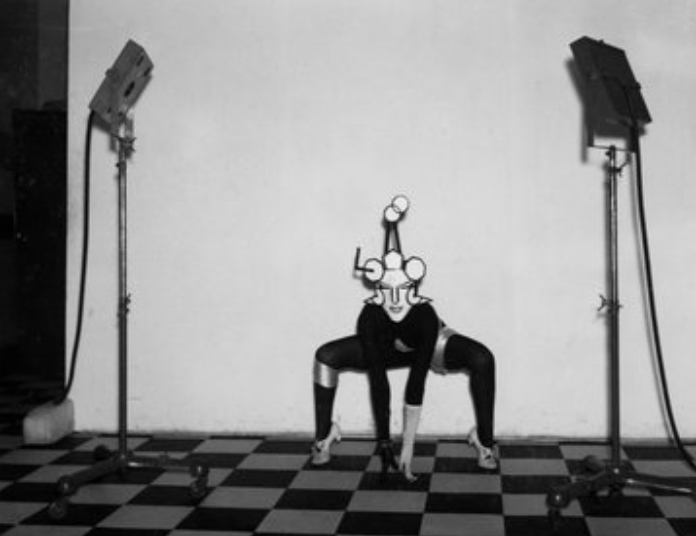
John Wyver writes: It’s the weekend and I’m deep in the page proofs for Magic Rays of Light, and so here are three previous posts from this series for you to explore. Each one reflects an aspect of the modernist culture of the time and its appearance in very varied forms on television.
OTD in early British television: 22 February 1933
Acrobatic dancer Laurie Devine (above) and the impact she made on early British television.
OTD in early British television: 24 July 1938
Dallas Bower’s modern-dress production of Shakespeare’s Julius Caesar.
OTD in early British television: 15 February 1939
The presentation of the Finsbury A.R.P. Plan for structural defence with architect Berthold Lubetkin.
19th September 2025

John Wyver writes: Today, a short original post about an outside broadcast from Euston station on Monday 19 September 1938, along with links to two earlier columns about railway-related broadcasts.
The OB was a half-hour mid-morning presentation with Leslie Mitchell to celebrate the centenary of the London, Midland and Scottish Railway company, which in fact had only been formally created in a complex merger of numerous companies in January 1923. I assume therefore that the anniversary was for the London & Birmingham Railway, a precursor to the LMS, which completed its main line in 1838.
The Monday broadcast followed a more elaborate hour-long transmission the previous day which was billed as A Hundred Years of Railways: 1838 to 1938. Mitchell was again the Michael Portillo of the moment, along with D.S. Barrie of the advertising and publicity department of the LMS.
Actual engines at Euston were shown alongside models, with trains and carriages featured including Queen Victoria’s saloon, an 1847 ‘Cornwall’ engine, a 1911 ‘Coronation’ engine, the ‘Lion’, and the Coropnation Scot class ‘Duchess of Gloucester’.
The ‘Duchess of Gloucester’ took centre-stage on Monday morning, when it was seen steaming out of Euston driven apparently by Lord Stamp, LMS chairman, who would die in a German air raid in April 1941. The ‘Lion’ was there too, driven by a crew in period clothes, and there were speeches from the Mayor of St Pancras and the Lord Mayor of Birmingham.
For more about early television’s alignment with the modernity of the railways, see:
OTD in early British television: 17 April 1937
A ‘local OB’ from the railway terminus adjacent to Alexandra Palace (pictured).
OTD in early British television: 5 July 1937
A shot from a studio Emitron run out onto the balcony of Alexandra Palace of LNER’s ‘Coronation Train’ passing by in the distance.
[OTD post no. 275; part of a long-running series leading up to the publication on 8 January 2026 of my book Magic Rays of Light: The Early Years of Television in Britain, which can now be pre-ordered from Bloomsbury here.]
18th September 2025
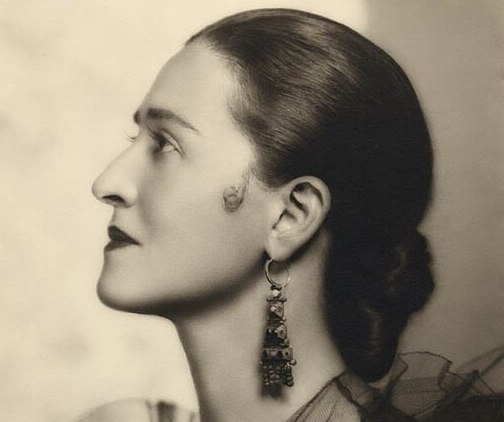
John Wyver writes: The ambition of producer Eustace Robb’s 30-line television broadcasts is again witnessed by the 50-minute broadcast in the late evening of Tuesday 18 September 1934. In what was in fact a reprise of a broadcast from July, this was a full programme of excerpts from Bizet’s Carmen, with the noted Canadian soprano Sarah Fischer (above) as Carmen.
Lyric tenor Heddle Nash, fresh from performing Mozart in the inaugural season at Glyndebourne, sang elements of Don José’s role, Frank Sale was the Toreador, and famed teacher and choreographer Elsa Brunelleschi provided dances. The arias were sung in French, and the small six-piece orchestra (piano, two violins, viola, cello and bass) was conducted by operetta and light music composer Mark Lubbock.
Image: Sarah Fischer photographed in Hollywood, 1939; source Cannons, Sarah Fischer fonds. Library and Archives Canada, e002505714 /
[OTD post no. 274; part of a long-running series leading up to the publication on 8 January 2026 of my book Magic Rays of Light: The Early Years of Television in Britain, which can now be pre-ordered from Bloomsbury here.]
17th September 2025
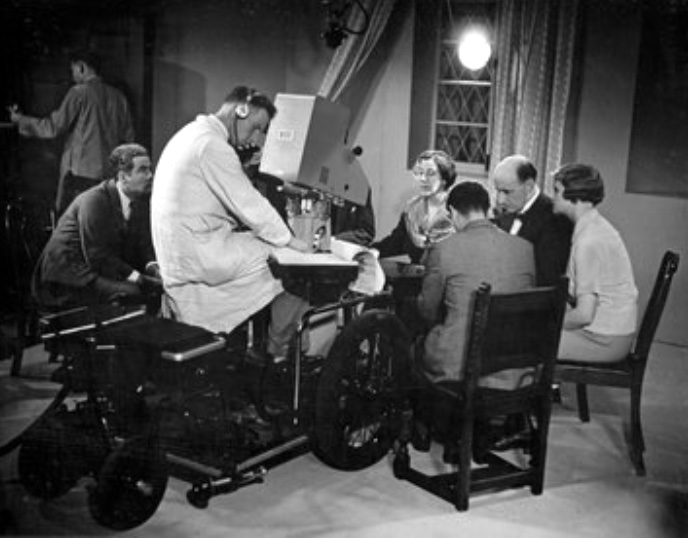
John Wyver writes: I hope you’ll forgive me over the next three weeks if on certain days I simply reprise via a link or links one or more earlier posts. Mostly this is because I have just received, and need to spend some serious time on, the page proofs of Magic Rays of Light: The Early Years of Television in Britain. If I keep to the deadlines, Bloomsbury will publish this in hardback and paperback, and as an e-book, on 8 January (and which can be ordered in advance and at a discount here).
I’m not going to count these posts in my running total, and I will continue to offer original columns every other day or so. But meanwhile I’m going to select a handful of favourite posts, as well as some that have some relevance to the particular day of publication, as today.
I wrote previously at the link below about the reprise presentation in March 1938 of W.B. Yeats’ supernatural drama The Words Upon the Window Pane (above), and it was on the afternoon of Friday 17 September 1937 that Eric Crozier’s production was first transmitted:
OTD in early British television: 16 March 1938
16th September 2025
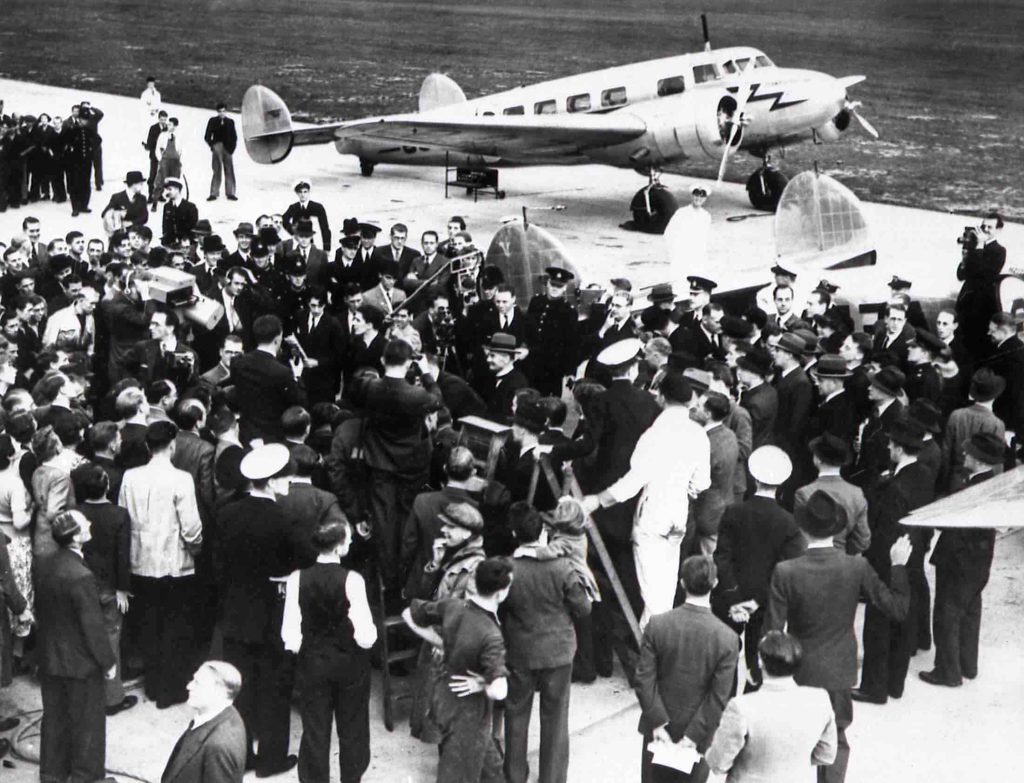
John Wyver writes: On Friday 16 September 1938 a television OB unit was among newsreel cameras at Heston Aerodrome to provide live coverage of Prime Minister Neville Chamberlain’s return from meeting Adolf Hitler at Berchtesgaden. You can see the camera in the upper-left of the crowd.
A first transmission that afternoon began at 3pm even though the PM was not expected to arrive until 5.15pm. Thirteen minutes of what was presumably regarded as a test for later were filled with general shots of the airfield and a Lockheed 14 arriving, from which disembarked Mr MacMillan, chief instructor of British Airways Ltd, who was interviewed on camera.
The main event started at 17.18, catching the arrival and landing of the PM’s plane as well as his address to the crowd. Lord Halifax and German chargé d’affaires Dr Kordt were in attendance. By 17.39 the broadcast was over.
For one of his last columns for The Listener, Peter Purbeck was watching:
When the Prime Minister arrived at Heston last Friday evening and, on alighting, made a brief speech about his mission to Germany, the owners of ordinary receiving sets were able to hear the speech broadcast. Owners of television sets did not only hear it, they saw it being spoken, they saw all the stirring background of aeroplane, pressmen and excited crowd.
Despite the brevity of the coverage, this was the event that, as Purbeck recognised, ‘gave us the first real taste of television as a news-gatherer.’ Unlike the largely predictable Derby or Coronation procession, this was
news of the quick, sudden, mobile sort, the real news of the tape-machine, the singing telegraph wires, the special edition and the strident voice of the paper boy.
[OTD post no. 273; part of a long-running series leading up to the publication on 8 January 2026 of my book Magic Rays of Light: The Early Years of Television in Britain, which can now be pre-ordered from Bloomsbury here.]
15th September 2025
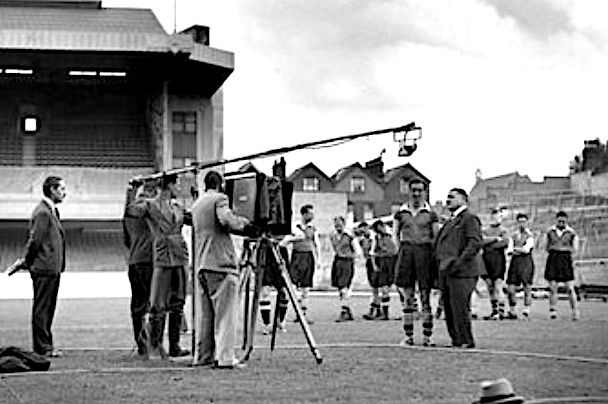
John Wyver writes: For just over half an hour from 5.29pm on Wednesday 15 September 1937, a test outside broadcast from the Arsenal Football Club at Highbury showed part of a match between Arsenal Reserves and Millwall Reserves. Unbilled in Radio Times, this was essentially a trial for light levels, and yet it is nonetheless the earliest transmission of a professional football match.
The broadcast was the prelude to two days featuring broadcasts from Highbury. On Thursday, there was a 15-minute presentation from the pitch with commentator John Snagge, footballer Clifford Bastin and legendary Gunners manager George Allison (above). Friday featured shots of training, with team members including George Maleand Ted Drake introduced by Allison.
read more »