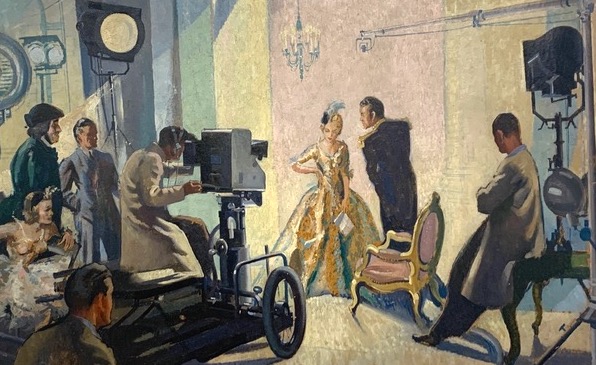
John Wyver writes: When the BBC television service at Alexandra Palace began operations officially on 2 November 1936, Studio A was fitted out with four Emitron electronic cameras supplied by the recently-established joint venture company Marconi-EMI. One or more of these 405-line cameras was mounted on a crude dolly, and so was minimally mobile.
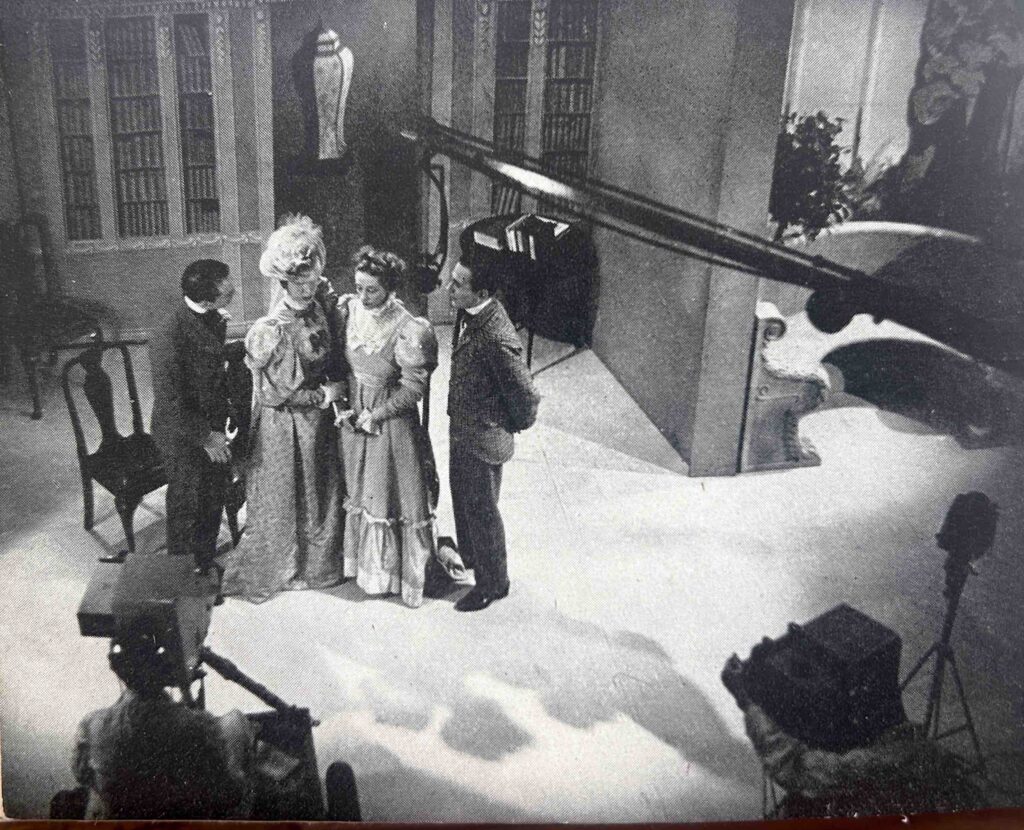
There were two further cameras linked with a pair of film projectors to provide telecine facilities to play in film sequences. And the six vision channels fed into a control room that allowed producers to mix between them. In very basic terms, this is the set-up that television studios have worked with ever since. (The image, from John Swift’s Adventure in Vision, 1950, shows two cameras in the studio for The Importance of Being Earnest, December 1937.)
The mystery is that there appears to have been no model for this configuration. The BBC’s two television studios before this, operational from 1932 to 1935, as well as that used by John Logie Baird’s company before them, were effectively black boxes. Through a hole in one wall a single scanner beam was projected into near-darkness. Reflections from the subject were picked up by photo-electric cells above the beam, and these converted the visual image. Mixing was initially impossible, although it was introduced in a crude manner later with a subsidiary caption card scanner.
At AP, the Baird camera set-up which was installed in Studio B combined a refinement of this ‘spotlight’ scanner system and a fixed internmediate film system. This was quite distinct from, and quickly proved inferior to, the Marconi-EMI set-up. So where did the idea of Marconi-EMI’s 4-plus-2 camera set-up and mixing desk come from?
John Wyver writes: In the global scheme of things, the concern I want to highlight this morning is little more than a mote. But apart from the irritation it has provoked, it is a small but potentially significant sign of a shift in the relationship between the BBC’s television channels and BBCiPlayer. It also has implications for the discovery of arthouse films on the corporation’s streaming service.
Until recently, on the Films page for iPlayer there was a ‘Sort by’ dropdown menu with the choices ‘Featured’ / ‘A-Z’ / ‘Recent’. Using this you could rearrange the layout of the features on offer, and by clicking on Recent you could find those films that has been broadcast in the past few days.
This menu remains on, for example, the Drama & Soaps page. but as far as I can see it has disappeared from Films. There, now, ‘Featured’ is the only way in which you can access the catalogue on offer. And ‘Featured’ is structured, much like a streaming service index page, with groupings of films under headings that include ‘Spider-Man’, ‘Family Favourites’, ‘Based on a True Story’, ‘Screen Two’ and ‘Wallace and Gromit’s Wacky World’. We are not so far it seems from Borges’ Celestial Emporium of Benevolent Knowledge.
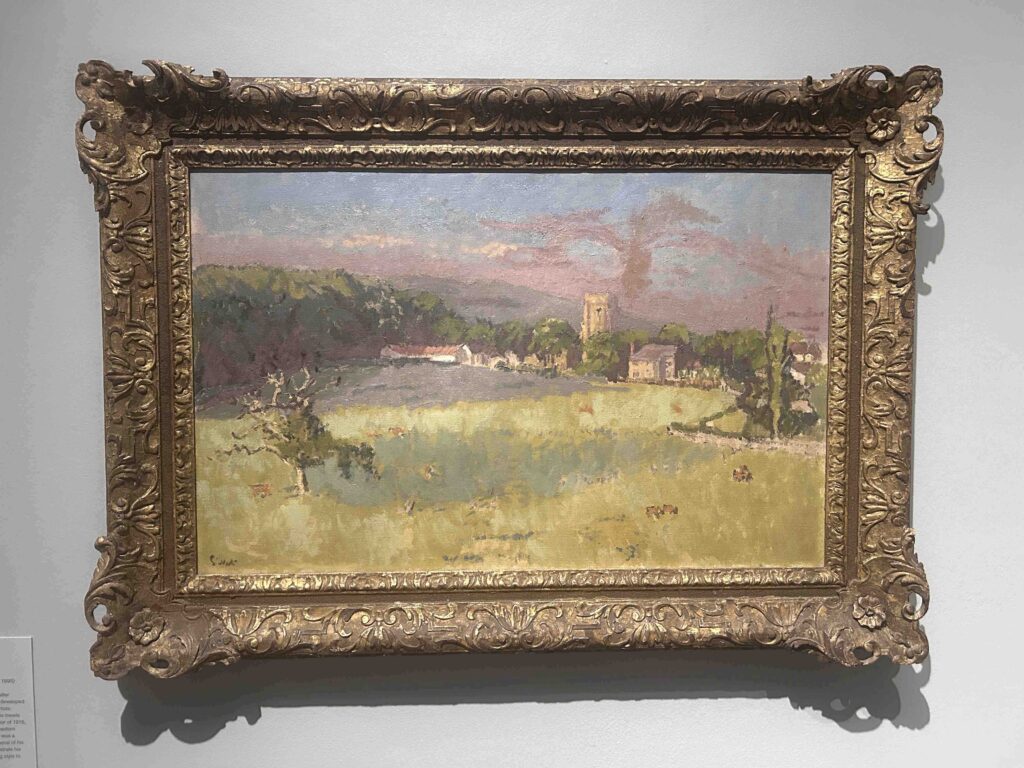
John Wyver writes: A splendid wedding on Saturday and generally just life got in the way of producing my usual Sunday collection of stuff that has interested me in the past week. So here it is a day late. The header image is a 1916 English landscape by Walter Sickert, Chagford Across Fields, hanging in British Landscapes: A Sense of Place, until 1 November, at Chichester’s Pallant Gallery. I found the show as a whole disappointing, but this is one of its surprising treasures.
• Florentina Holzinger’s naked ambition: an exceptional profile of the Austrian performance artist by Lauren Oyler for The New Yorker [£; limited free access]; I saw Holzinger’s production of Ophelia’s Got Talent last summer in Paris and it has stayed with me in ways that few shows do.
John Wyver writes: To the ICA on Saturday last for another fascinating programme in Michael Witt’s Jean-Luc Godard: Unmade and Abandoned series. This has been a revelatory season, shown more or less monthly, of films by Godard and others that, as Witt claims, ‘sheds light on the huge and varied phantom body of unmade and abandoned ventures that lies behind or in the intervals in his completed oeuvre.’
John Wyver writes: Just over a fortnight since The Cultures of Early Television wrapped, with much – although far from all – of the admin done, and with the distractions of a weekend in Paris and the World Cup now past, I have finally settled down to reflect briefly on the conference.
For those of you just joining us, this was a two-day University of Westminster conference about television before the Second World War in Britain, the United States, continental Europe and the Soviet Union. Two events earlier in the year presaged the event: the centenary of the first public demonstration of what John Logie Baird called ‘true television’ on 26 January 1926, and the publication by Bloomsbury/BFI of my book Magic Rays of Light: The Early Years of British Television. The conference programme with abstracts and speaker biographies, as well as a further reading list, can be downloaded here.
In broad terms it feels as if it was a success. More 150 people registered and our venue Portland Hall felt consistently busy but never over-crowded. Thanks to the support of a conference grant from The British Academy, we were able not only to invite speakers from abroad, but also to offer free registration, complimentary teas, coffee and waters throughout both days, and a very welcome drinks reception. It looks like we came in pretty much exactly on budget. For much of the time, the tech worked well, although I still deeply regret that I could not coax Lance Sieveking’s audio message from 1930 to play during my opening remarks.
John Wyver writes: Something of a catch-up today, and even so my posting is both late and melancholy. The past few weeks have been somewhat consumed by The Cultures of Early Television conference, and only now am I getting back to the blog and a selection of Sunday links. I’ll aim to do better going forward, but here are pointers to stuff that has engaged and interested, and it has to be said saddened me recently. No Andy B and no AI, or only glancingly, but those are topics to which we’ll most certainly return in future posts.
• Features and reviews by Tony Rayns: it has been a bad few weeks for losing friends and collaborators, since the critic, programmer and cinephile Tony Rayns is also with us no more; here are links to a strong selection of articles that he wrote for the BFI, each of which demonstrates his knowledge, his critical acuity and elegant writing style.
• The Japanese American Toy Theatre of London presents James Bonk in Matt Blackfinger: there was news this past week too of the sad death of the artist and special person Akiko Hada, who back in 1988 I worked with on a commission for my Channel 4 series Ghosts in the Machine, and which still makes me smile…
John Wyver writes: After months of preparation The Cultures of Early Television conference takes place at Portland Hall in London on Thursday and Friday this week. A University of Westminster conference, supported by The British Academy, this two-day event will explore television before the Second World War in Britain, continental Europe, the United States and the Soviet Union.
I am delighted to say that the full, 24-page conference programme, with a schedule, detailed abstracts and biographies of the speakers, as well as suggestions for further reading can be downloaded here.
The conference brings together scholars and archivists from Britain, Europe and North America to explore imaginings and understandings of early television, and its productions and people, rather than its technologies, which has been the dominant construction of this history to date.
With presentations, panels and screenings of rare archival material, the event marks the centenary of the first British public presentation of what John Logie Baird called “true television”, which took place in London in early 1926.
John Wyver writes: For the second Sunday running I have simply been too busy to compile the Sunday dozen. Apologies. But the preparations for The Cultures of Early Television conference next Thursday and Friday at the University of Westminster have rather taken over my life.
I think those attending are in for a treat, with a host of exceptional scholars and archivists talking about television before the Second World War in Britain, the United States, Italy, Hungary and the Soviet Union. I will post responses and thoughts arising over the coming days, and tomorrow I will introduce the full conference programme [click to download a .pdf]. There are still a very few tickets left, which are free – you can sign up here.
Otherwise, here’s another selection of stuff that has engaged and interested me over the past week. No Knicks, although I’m thrilled for them, for their fans and for New York, and no World Cup (maybe next week), but rich pickings nonetheless.
• An extended apprenticeship: a lovely piece of writing by Farran Smith Nehme about the director John Sturges at Columbia between 1946 and 1949, originally published in the Locarno Film Festival’s 2024 book The Lady With the Torch: Columbia Pictures 1929 – 1959, and just reprinted online.
• A dose of Duchamp: Hal Foster is among my favourites of the regulars for LRB, and this [£; limited free access] is his rich review of the Marcel Duchamp retrospective currently at MoMA.
John Wyver writes: I’m delighted to unveil the schedule for the The Cultures of Early Television, a University of Westminster conference that I am convening on 2 and 3 July at Portland Hall in London.
Organised with the support of The British Academy, this two-day gathering focuses on television before the Second World War in Britain, continental Europe, the United States and the Soviet Union. With presentations, panels and screenings of rare archival material, the event marks the centenary of the first British public presentation of what John Logie Baird called “true television”, which took place in London in early 1926.