For the end of 2015, when this blog has been less than it should have been, and for the start of 2016, when I intend it to be more than it has been, we offer five short lists of five cultural highlights from the past year. Each of the five of us at Illuminations has outlined five things, whether movies, television series, books, exhibitions or whatever, that have meant something significant to us during the year. Up first is Linda Zuck’s choice, offered in no particular order.
• P’tit Quinquin
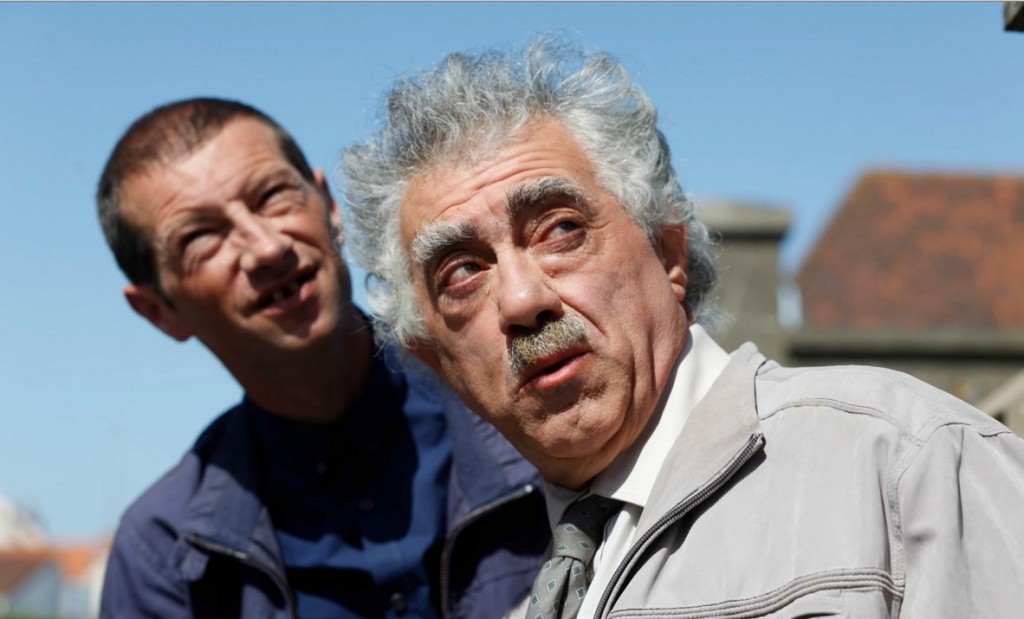
Made as a French TV mini-series for ARTE, Bruno Dumont’s French black comedy thriller P’tit Quinquin (featured image) was shown at a few British cinemas earlier this year. It concerns a series of unexplained grisly murders in rural northern France, two incompetent cops trying to investigate them, and young P’tit Quinquin, an adolescent boy with a misshapen face — he is our unlikely hero. Superb characterisation and performances, outrageous and weird comedic moments disrupted by reflections on life, death, racism and evil. There are many scenes that have stayed with me.
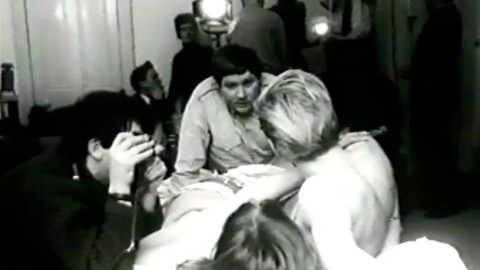
Tonight at BFI Southbank I am introducing three documentaries about the arts made for British television more than fifty years ago. The screening is part of the excellent BFI project Visions of Change about television documentaries from the 1950s and ’60s. Although much from these years has been lost, there is nonetheless an extensive archive of rich and resonant material from which to choose. It might have been interesting to mix up the genres more, rather than to have this evening devoted to films about the arts and another with Tim Boon looking at science documentaries, but nonetheless the triple offering tonight makes, if I may say so, for a great programme. John Read’s foundational profile Henry Moore (1951), British television’s first film profile of a living artist opens proceedings, followed by Ken Russell’s delightfully inventive Monitor film Watch the Birdie (1963) about photographer David Hurn. And to conclude there is the extraordinary New Tempo: Heroes, directed by Dick Fontaine in 1967, which now looks more like an avant-garde classic made perhaps by Bruce Conner than it resembles anything else that ITV might have shown on a Sunday afternoon 48 years ago. read more »
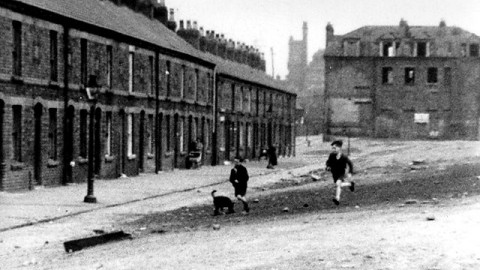
Tonight sees the opening of an exciting series of screenings and talks at BFI Southbank exploring the evolution of the television documentary in Britain. Visions of Change features a host of television treasures from the 1950s and ’60s – and early next month even features me introducing three significant early arts films. For the first programme this eveningIeuan Franklin introduces the work of ‘film poet’ Denis Mitchell, before the showing of three of Mitchell’s ground-breaking documentaries: Morning in the Streets, 1959, which he made with Roy Harris;A Wedding on Saturday, 1964, produced by Norman Swallow; and The Entertainers, also 1964, directed by John McGrath.
A striptease sequence in the latter, which was produced by Mitchell for Granada Television, led to the film being banned by the ITA and it took a year of negotiation before it eventually reached British screens in January 1965. I have written an article for Sight & Sound about the season and two complementary DVD collections forthcoming from BFI Publishing, but the piece is available online only to subscribers. (Equally frustrating is the fact that I can’t be at BFI Southbank tonight.) We’ll return to both the season and the DVDs, but below are some further resources about Mitchell’s work, and a first extract from my article. read more »
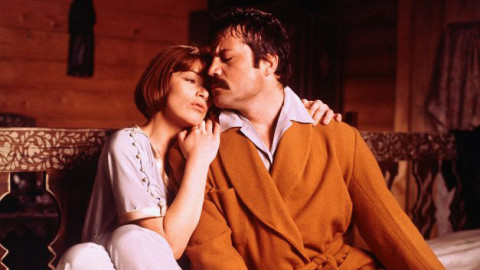
In the past week I have seen three exemplary film restorations courtesy of the BFI London Film Festival. Last Sunday offered a luminous, luscious print of Kiss Me Kate, 1953, in 3D; on Friday the Archive Gala screening was Anthony Asquith’s British silent Shooting Stars, 1928; and yesterday rolled out in NFT1 was Ken Russell’s 1969 adaptation of Women in Love. The first and second times, as well as the third which I think was also the last time, that I saw Russell’s film was 45 years ago. Revisiting it now, in all of its sparkling digitally touched-up glory, was a somewhat strange experience, of which more below. read more »
Tomorrow night Sky Arts premieres our new film for The Hot Ticket strand, Ai Weiwei at the RA. We have already produced Matthew Bourne’s The Car Man as a Hot Ticket and next week we are recording another major performance event for Sky. But this programme is a little different, most obviously because it is not a concert, play or dance event. Sky want their new series to embrace the whole range of the arts, including major exhibitions, and so we set out to find a more distinctive way than is usually employed to present a big show on screen. I am delighted with what our team has achieved, which I believe (and as I want to try to detail below) is modestly innovative – and the whole experience has made me enthusiastic to try to build on this the next time we get the chance to make a programme like this. read more »
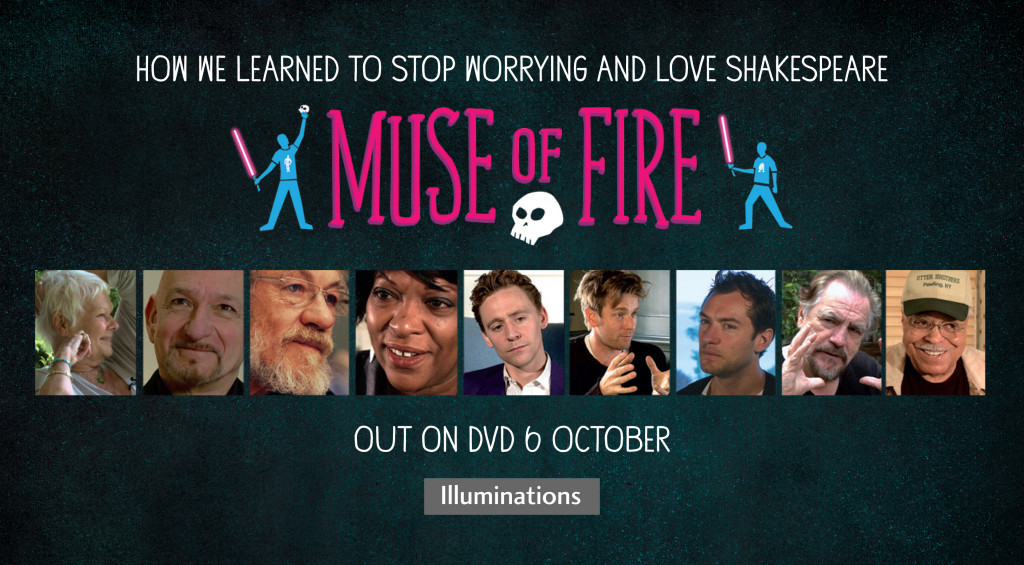
WIN a special limited edition DVD of MUSE OF FIRE signed by Judi Dench, Tom Hiddleston and Ian McKellen
MUSE OF FIRE is an epic road-trip buddy movie made by actors Dan Poole and Giles Terera that will change the way you feel about Shakespeare forever. Dan and Giles are two friends who loathed Shakespeare at school. Then one day, they saw Baz Luhrman’s Romeo and Juliet, starring Leonardo Di Caprio, and suddenly everything changed. They decided to become actors and in the process, fell in love with the Bard.
Determined to know what the secret is and whether others feel the same way – or not – they grabbed their cameras and began an incredible four-year journey covering 25,000 miles around the world: to Hamlet’s Elsinore in Denmark, London’s Globe theatre, a prison in Berlin, taking in Hollywood as they go. Along the road they consult a host of helpful luminaries, including Ian McKellen, Judi Dench, Jude Law, Baz Luhrmann, Derek Jacobi, and Ewan McGregor amongst others, to help to prove that there’s really no need to be afraid of Shakespeare at all.
MUSE OF FIRE is a heartfelt, fun and inspiring film that attempts to demystify Shakespeare’s work for just about anyone. Aiming to dispel the fear and stop us worrying, Dan and Giles simply want us to start loving Shakespeare!
COMPETITION Illuminations is offering someone the chance to win a signed DVD of MUSE OF FIRE through our competition prize draw. Simply email us ([email protected]) the answer to the following question and a winner will be drawn at random. Please also supply your name, email and telephone details. Competition closes at 6pm on October 20th.
From which Shakespeare play would you find the following quotation:
‘O for a Muse of Fire, that would ascend The Brightest heaven of invention, A kingdom for a stage, princes to act And monarchs to behold the swelling scene!’
Long ago and far away I was a ten-year-old trainspotter. I would stand on the station footbridge at Whitstable noting down the numbers of the recently introduced electric trains that passed beneath me. Then I would run home to underline with scrupulous care the collected digits in the lists published by Ian Allan in small books of shiny paper. A half century on I can recognise something of the same imperative behind the late summer project that I have taken on. For I am listening to, and mentally ticking off on a virtual list, every single note of BBC Proms 2015. That is, every concert at the Royal Albert Hall, every Cadogan Hall presentation, and every Extra Lates as well. Plus some of the interval talks, although one or two have felt a bit esoteric even for me. read more »
I’m not quite committing yet to (a) posting regularly, or (b) returning to a regular Sunday links, but here are some pieces that I have appreciated over the past week or so:
• The movies of my youth: Italo Calvino remembers going to the cinema in the late 1930s, via the blog of the New York Review of Books.
• Masters of space: Brad Stevens is very good for Sight & Sound on Max Ophuls, his 1955 film Lola Montes,mise-en-scène and cinematic space.
• City symphony: Matt Connolly at Reverse Shot on the glorious movie version of West Side Story.
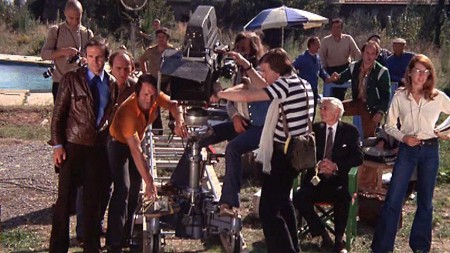
• Day for Night – are movies magic?: David Cairns for The Criterion Collection on Francois Truffaut’s 1973 joyful self-portrait (above).
• The close-up and the face in the films of Ingmar Bergman, with a text by Thomas Elsaesser
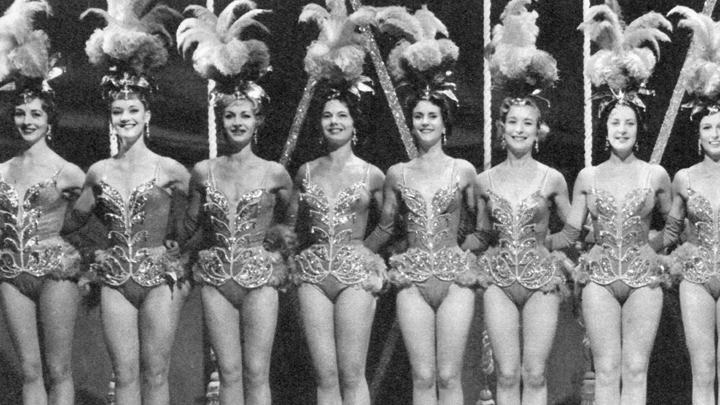
To BFI Southbank for the first screening in a short season marking the 60th anniversary of the ITV network that went on air on 22 September 1955. To celebrate the network’s 21st birthday, back in 1976, Thames Television put together a two-hour special edition of This is Your Life, and last night’s showing revealed it as a delightful and delirious, cringe-worthy and compelling (self-)image of what commercial television was like at its height. Here were shiny suits and bad haircuts in profusion, an awful lot of middle-aged men in charge together with numerous women objectified as game-show assistants and chorus girls (above, from Sunday Night at the London Palladium), the remnants of a long-established music hall tradition, and not a single non-white face. But here too were reminders of of t ITV brought to television in the late 1950s and ’60s: a robust approach to visual journalism in News at Ten, the vigour of a populist current affairs tradition in World in Action, and dramas in Armchair Theatre that showed the British how they looked like and spoke, and what they cared about, around 1960.
The format of the show was an uneasy mix of artistes doing a turn, including an accomplished contribution from Frankie Howerd, and short chat-show segments with host Eamonn Andrews speaking with stars and execs, including Armchair Theatre producer Sydney Newman and the first World in Action editor Tim Hewat. Much of the pleasure came, of course, from the plentiful extracts, including some nostalgia-prompting commercials for the likes of Daz and Oxo as well as a remarkable extract from a Liverpool-Arsenal game when commentator Jimmy Hill came on to replace an injured linesman.
Particularly notable, as so often with archival television, was the sense of what I can only call the texture of 1976 – gestures and body-language, the spoken language dripping with assumptions and associations, the details of clothing and make-up, all of the elements that are caught in visuals and audio fragments from that moment and that could never quite be recreated. And then there’s the sense of exactly what television looked like then: overlit and over-saturated colour images with a sharpness to set your eyeballs on edge, but at the same time the lines and the break-ups of an occasionally unstable image. Should you want to immerse yourself, truly and deeply, in the Britain of the mid-1970s, this is most definitely one place to start.
But let me also note one sublime fragment at the heart of this extravaganza. Writer-producer Andy Allan had his share of some truly terrible ideas. These included a bizarre appearance of a majorette band that marched through the audience and around the re-united team of the ITV sitcom The Army Game(1957-61), several of the cast members of which had clearly spent a fair while in hospitality before coming on stage. But Allan’s masterstroke was booking some fifty or more members of the the Royal Opera House chorus to perform a composition created from the ad jingles of maestro Johnny Johnston. Sublime it was to hear those rich, classically trained voices giving their all to ‘This is luxury you can afford from Cyril Lord’ and ‘You’re going well, you’re going Shell’.
(Sadly, this is not that clip, but rather 3 versions of the Shell ad with Michael Holliday singing.)
Perhaps you’ve noticed that this blog has been sadly neglected over past months. I have kept meaning to return to it but I have been doing so much other writing across the summer that somehow there has never quite been the time. Or perhaps that’s simply a way of explaining to myself why I fell out of love – temporarily, I think ( I hope) – with posting. But as the television world, after the excesses of Edinburgh and before that Tuscany, comes to end of the first week that I have always seen as the start of a new year, I am minded to begin again. Or at least to try to. In part this is because there is a host of interesting projects underway in which both I and the company are involved, including a new iteration of this website. In part I have been encouraged by one or two kind people who have asked recently why I don’t post any longer. And in part I am a proud parent of two offspring bloggers, Kate Wyver (on theatre) and Nick Wyver (on international development issues), and perhaps I feel the need to remain competitive.
One of the reasons I stopped, I think, is that there are so many smart people writing so much that’s smart about television, about digital media, about Shakespeare and about much more, and perhaps I lost confidence that I could offer anything that was different or distinct. But maybe it’s enough simply to point to things that are interesting (as I do on Twitter), and maybe add an occasional footnote. So let’s begin again with a stimulating piece from npr’s monkey see blog titled ‘Some Writing about Writing about TV’.
This article by Linda Holmes is one of a number on the npr blog prompted by the annual US Television Critics Association press tour to California. (There are links to related posts below.) The tour is a beanfeast during which the networks and new content creators like Netflix and Amazon unveil forthcoming shows and parade creators to win over those who write about the medium. Linda Holmes reflects on the changes in criticism prompted by the increased complexity of scripted shows and by new release patterns of episodes, including the ‘full drop’ pattern of online services when a complete series is made available at the same moment (her detailed post on that is here). Combined with the lifting of constraints on space offered by online, the result has been an explosion of writing, often in the form of re-caps of individual episodes, and frequently with a granularity of attention (to fashion, for example, or glimpses of books) that would have been unimaginable a decade ago. But this in itself throws up new problems, of which a key one – common across so many cultural fields now – is that of securing attention.
But just as the increasingly often-heard complaint that now “there’s just too much good television”, the concern about there being too much good writing on television is a problem that we’re lucky to have. As Linda Holmes concludes,
It’s a busy time, and it’s an active time, but it’s also an unsettled time. The sheer speed and volume of writing about TV is impressive, expansive and unnerving, at least for me. Which, again, is also a pretty good description of TV itself.
Except that on this side of the pond the exponential increase in writing about television simply hasn’t occurred – or if it has I haven’t yet noticed it. The Guardian does week-by-week live blogs for the likes of The Great British Bake-off and Strictly… but where is the really considered episode-by-episode engagement from a multitude of viewpoints with, say, BBC Two’s Wolf Hall or Channel 4’s recent Robots. If it’s out there and I’m simply missing it, would you let me know?
Other posts well worth your time from the series, which collectively throw up a lot of the key questions facing television in this end of days, include: