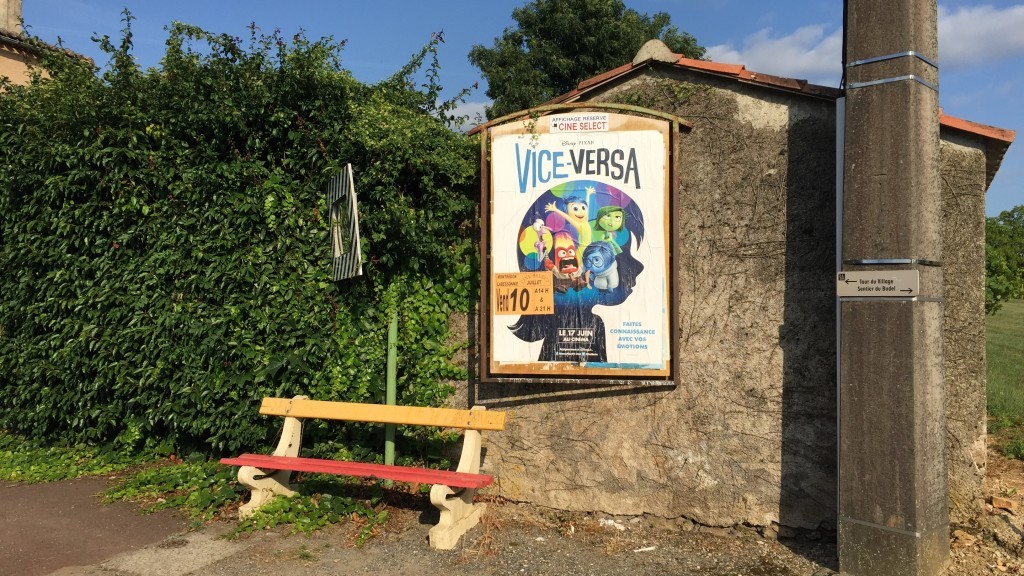
We have been on holiday in France, staying in an ancient manor house on the outskirts of the village of Montredon-Labessonié. Tucked away in the countryside between Albi and Castres, Montredon-Labessonié has a church, a bar and a recently opened pizza restaurant, a post office and two small supermarkets. Incongrously, there is a zoo just outside the village but the human population of the immediate area cannot be more than few hundred. Yet the village boasts a very fine 126-seat modern cinema where on Friday evening we watched the new Pixar film Inside Out (Vice-Versa in French, and delightful by the way) which was sparklingly and immaculately projected on a big screen in 3D and 5.1 audio. Three times a week on summer evenings (less frequently in winter), and on certain afternoons also, at Cine Select Maurice Boyez projects films to the kids of the area, to the region’s cinema-lovers and to the occasional tourist, Just as he has since 1957.
• Listen up: Nick Pinkerton for Artforum on Japan Speaks Out!: Early Japanese Talkies at New York’s Museum of Modern Art, including (above) The Neighbor’s Wife and Mine, 1931, directed by Heinosuke Gosho.
• Orson Welles and history’s first viral-media event: Vanity Fair offers an a compelling excerpt from A. Brad Schwartz’s forthcoming book about the wunderkind’s 1938 radio broadcast of The War of the Worlds.
• Time-lapse mining from internet photos: a fascinating – and rather beautiful – video paper from the SIGGRAPH 2015 conference; the full technical paper is here.
I’ve had a wonderful birthday week in France, and now I’m back with all sorts of new challenges to face. Here’s a selection of three things for today, before – inspired a bit by my birthday blog – I start posting more seriously once again.
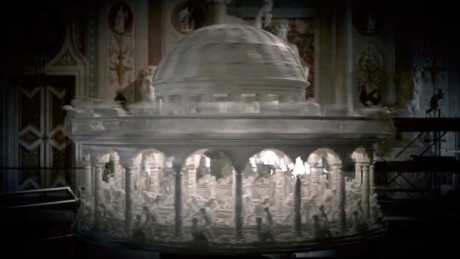
• ‘All Things Fall’: an astonishing 3D printed zoetrope (also above) created by Mat Collishaw based on ‘The Massacre of the Innocents’ by Rubens, with 3D modelling and animations by Sebastian Burdon.
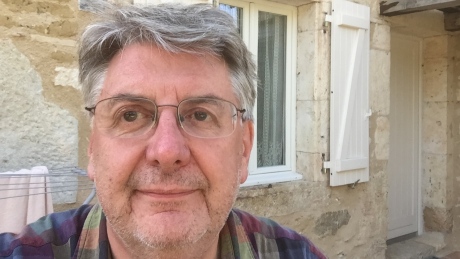
Today is my 60th birthday. I was born 60 years ago today. No-one, of course, believes that they will ever be 60. I do not believe I am 60 years old. But perhaps writing this short blog post will help reconcile me to the fact.
Indeed, one of my oldest and dearest friends, albeit one I see now more rarely than even I post here, has more or less challenged me on Facebook to write a blog post today. I am sitting in the garden of a house near the French village of Castelnau, halfway through a week’s walking with Clare. It’s very hot and there’s a small swimming pool which is very cold. I’m content – and I’m even content with being 60. Although I don’t know how to write that without sounding complacent.
I am of reasonably sound mind and body, albeit unfit and overweight (and there’s nothing like a walking holiday to prove that to yourself). I have a wonderful wife, with whom I am very much in love after being together for 35 years. We have three tremendous children, Kate, Ben and Nick, of whom I could not be more proud. But perhaps those are not the subjects for a post on the Illuminations blog.
The interests that have sustained me across those years have meant that I saw Peter Brook’s 1970 production of A Midsummer Night’s Dream; I have seen the films of Jean-Luc Godard and Ingmar Bergman and Roberto Rossellini and Ken Russell; I have read Dickens and Tolstoy and the Eliots, George and T.S.; I went back and back to the National Theatre’s Guys and Dolls and to the RSC’s Nicholas Nickleby; on the small screen I watched United win the Treble and England win the Ashes in 2005 and I saw Neil Armstrong step onto the moon and I cheered as Jonny Wilkinson made that drop-kick; I have thrilled to Mozart and Wagner and Benjamin Britten; I have travelled to India and China and Cambodia and Egypt and Canada and Australia and pretty much everywhere I’ve wanted to go – except Chicago; and I have worked consistently with people who are smarter and more imaginative and more talented than I will ever be – and I am intensely grateful for that and for everything else.
With a colleague I set up Illuminations 33 years ago, so it has been the focus of my professional life for more than half my number of years. I am intensely pleased that it continues to function as a small independent producer and distributor dedicated to the arts and culture. I own the company with my professional partner and friend with whom I have run it for nearly 30 years. Those with whom we work are committed and delightful and smart and challenging and an enormous pleasure to be with.
The company was set up to make programmes for the new Channel 4, which went on air in November 1982. We said that we would produce “distinctive programmes about contemporary culture”, which is what we have done – and what we continue to do.
What I haven’t done in my 33 years with Illuminations is direct a feature film. I haven’t written a novel or a play. I haven’t created a ground-breaking work of philosophy or of history or of cultural criticism. All of which I might once have believed that I could, and would. But I have been involved in, and at times responsible for, a number of television programmes and media productions that have been, and remain, worthwhile in some fundamental sense. And perhaps that’s more than one can expect.
Mainstream television is very different now from what it was in 1982. In some ways it offers fewer opportunities and is less rich. Which I regret, although I hope that in some senses I understand. It certainly seems harder to be a producer now than back then, but perhaps all producers have always felt that at all moments of retrospection. At the same time there are so many new media opportunities – Sky as well as the BBC, event cinema and other large-screen possibilities, and the myriad of online forms. I have tasted of the joys of the web in its earliest days, of 3D social spaces, and of innovative combinations of networks and broadcast, and I hope that there will be other such experiments to be part of in the years to come.
Bliss was it to be alive as Channel 4 came together, but to be involved in media today still is, as Wordsworth sort of had it, very heaven. Even on a day when both a major pitch with which I was involved has fallen short and a key project has been cancelled, it feels as if there are a thousand and more opportunities, had I but world enough and time (and energy). Working closely with the Royal Shakespeare Company remains more of a privilege than I can express, and it is immensely exciting to be developing a major new project with Sky Arts. I even enjoy, after three decades of change and turmoil and occasional heartache and rare triumph, being still on the distant boundary of the BBC.
To be fortunate enough to combine this work as a producer with work as an academic and historian of television and media is also constantly stimulating, and I am grateful through the University of Westminster and with other organisations to have had the chance to do research in depth and to write articles and to create resources with colleagues that make tiny but perhaps productive contributions to what we know about the past.
I haven’t changed the world in my 60 years, but I hope I’ve done more good things than bad. Long, long ago, I came to London as a schoolboy to see a new film directed by Lindsay Anderson. It made an enormous impression on me then, even if subsequent viewings have revealed that it hasn’t quite stood the test of time. But if I can express this without seeming selfish or, again, complacent, its title seems right for the way I feel about myself as I scribble these inconsequential notes: O Lucky Man!
Sometimes there are links between them, oftentimes there are not.
• State of Terror: innovative interactive report from veteran BBC journalist Peter Taylor about the financing of ISIS.
• Martha Graham – goddess of contemporary dance: a strong group of resources from BBC Arts about the great choreographer, with clips and a text by Paul R. W, Jackson, Reader in Choreography and Dance at the University of Winchester.
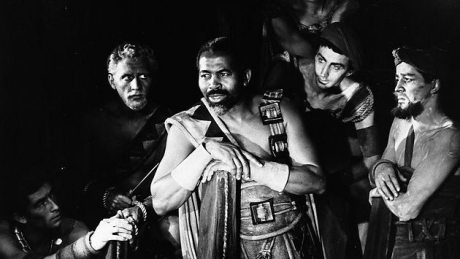
• British Black and Asian Shakespeare: the film below outlines the AHRC-backed research project exploring a critical history of multicultural Shakespearean performance in 20th-century Britain; I’m going to their discussion, ‘Who Owns Shakespeare?’, later today at Warwick Arts Centre – the image above is a detail of a Angus McBean/RSC image of Edric Connor in Pericles, 1958.
• Next practices in digital: a report from the Association of Art Museum Directors (freely downloadable) with 41 examples of recent digital initivatives in American art museums – lots of great ideas.
• Brave New Camera: a trailer for what looks like a fascinating documentary about the impact of digital photography, connectivity and vast storage systems (I’ve wanted to make essentially this for television for the past five years, but couldn’t interest commissioners); background and additional clips are at The Creators Project here.
Sometimes there are links between them, oftentimes there are not.
• The new new museum: Jerry Saltz for New York magazine riffs on the recent history of art museums and makes you long to see the new Whitney in Manhattan.
• A night at the museum: for Reverse Shot at the Museum of the Moving Image, Fernando F. Croce writes about Tsai Ming-liang’s extraordinary film Face (Visage, 2009, above), for which this is the trailer:
Sometimes there are links between them, oftentimes there are not.
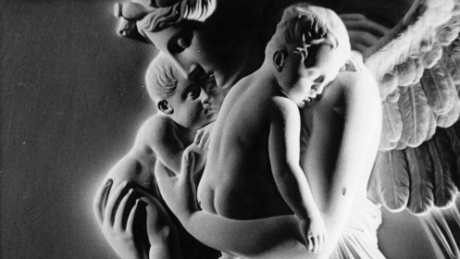
• The A-Z of Carl Dreyer: terrific anthology from Matthew Thrift at BFI about the demanding work of the great Danish director, including his little-known study of the sculptor Thorvaldsen (1949, above).
• Seeing Istanbul again: Orhan Panuk’s translator Maureen Feely writes for The New York Review of Books about the Turkish writer’s vision of the city where he lives.
• Sophia Loren and the Italo-American songbook: apart from being hugely enjoyable, this essay is an object lesson in how to assemble – without commentary – comparatively obscure film extracts to explore an idea, in this case the creation of trans-national identity in ’50s’ cinema; from Bristol PhD candidate Sarah Culhane.
Sometimes there are connections between the three things, oftentimes there are not.
• The wonderfully elusive Chinese novel: a fascinating discussion from The New York Review of Books in which Perry Link takes off from a review of The Plum in the Golden Vase or, Chin P’ing Mei, Vol. 5: The Dissolution to consider wider questions about Chinese literature and translation.
• Alec Soth on photographing “the cloud” in Silicon Valley: it’s more than a year old, but this is a solid SFMOMA video about the wonderful photographer making images of something entirely insubstantial.
Sometimes there are connections between the three things, oftentimes there are not.
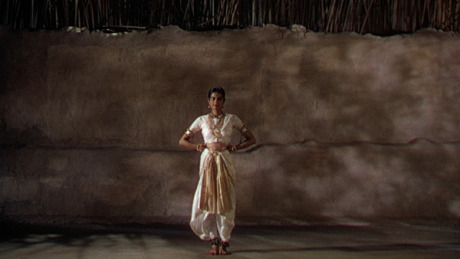
• The River – a new authenticity: a very fine essay by Ian Christie for Criterion on Jean Renoir’s 1951 feature shot in India (above).
• The catastrophe: a rather extraordinary piece by Oliver Sacks in The New Yorker on the late Spalding Gray, who I knew slightly and admired immensely.
• Bruce Springsteen – ‘The River’: from when this song was new – just because…