In the Swan Theatre in Stratford-upon-Avon is a truly splendid Royal Shakespeare Company production of Thomas Dekker’s 1599 play The Shoemaker’s Holiday. Director Phillip Breen, a spirited cast led by David Troughton and the RSC’s costume department have done the text proud, and Dekker’s early ‘city comedy’ emerges as a fascinating text about class and sexual power and the ruins of war. It runs until early March and is well worth the trip; the ‘onstage trailer’ with audience vox pops below gives a small sense of the production’s pleasures. (I should admit that I work as a freelance producer and consultant for the RSC; our next RSC Live from Stratford-upon-Avon cinema broadcast is of Love’s Labour’s Lost next Wednesday, 11 February.)
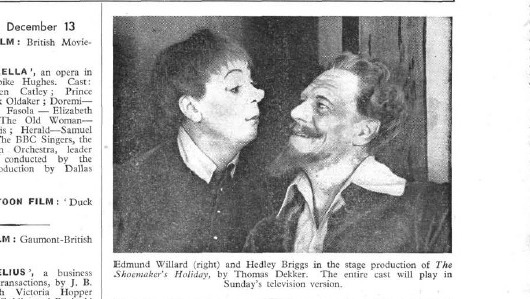
Seeing the production renewed my interest in the early television presentation from Alexandra Palace which was broadcast on the evening of Sunday 11 December 1938. No recording exists, of course (the first plays we have are from 1953), no do there seem to be reviews of the television broadcast, but there are traces of other documentation, including a Radio Times billing with the photograph above. Describing the play as ‘a pleasant comedy of the gentle craft’, Radio Times details that the broadcast was based on Nancy’s Price’s production from the Playhouse Theatre.
Television drama in those early days often adapted stage productions, and The Shoemaker’s Holiday had been running at the Playhouse since the end of October. Announcing the forthcoming attraction on 17 October 1938, The Times noted that ‘a permanent Elizabethan set, with balcony and curtains, will be used, and music of the period will be played.’ The Times also informed its readers that Dekker’s play had received only one professional revival since Jacobean days, and that had been in 1926 at the Old Vic. A week later the paper of record was back-tracking a little, since it acknowledged that there had been only one modern professional production in London, since the play had also been given by the Birmingham Repertory Company in 1922 and was frequently revived by amateur groups.
A week or so after that, on 5 November, the anonymous critic for The Times could only be moderately enthusiastic about the play and production:
the play, as a dramatic unity, just fails to emerge from the museum into life. Partly this is the fault of the story, which tries to poise knockabout comedy between Dick Whittington comedy and Enoch Arden pathos; partly it is no-one’s fault, only the fault of time, which has plunged so much homely verbal humour into obscurity. And yet in patches, recurring again and again, the scenes become heartily and gloriously vital.
There was praise too for the cast, including Harold Warrender and Edmund Willard, but no specific mention of director Nancy Price, a figure who had a fascinating career as an actress and occasional writer.
The Observer, on 6 November, was less enthusiastic:
the production had… good intentions and, at moments, something more… this revival gave us glimpses rather than a steady view of a play that was and still is as English and idiosyncratic as the Lord Mayor’s Show.
‘A.D.’ for The Manchester Guardian, however, was good deal more positive:
It must be that Dekker and his rich and riotous play The Shoemaker’s Holiday are things too lusty for these tenuous times. The Playhouse audience was for at least two-thirds of the way as cold as any congregation… The play’s prodigal bounty of language, its exuberance of simile and imagery, its London flavour, and its oaths that are the delight of bookmen – all these things fell on icy ears… The fault is not that of Miss Nancy Price, who has produced freshly and capably… The fault is not that of the players, who all seem to appreciate both the fun and the poetry of the Elizabethan text. The blame is wholly ours if we cannot take to this gay, witty, full-blooded and often beautiful play for the pitiable reasons that it is either too robust for us or too unfamiliar.
To which, I can only say from the perspective of 2015, hear, hear – although the hugely appreciative audience in the Swan last night seemed to have no such problems.
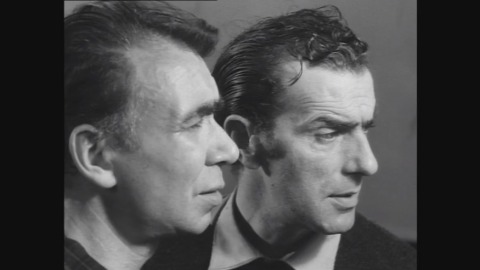
Welcome indeed is the appearance today on BBC Arts Online of Ken Russell’s 11-minute film profile from 1959 of the two Scottish paintersRobert MacBryde (1913-66) and Robert Colquhoun (1914-62). The film, which was Russell’s first about visual artists, was made for the BBC’s arts magazine series Monitor and originally transmitted on 25 October 1959 (for background, see Michael Brooke at BFI ScreenOnline). The documentary is not exactly unknown, but its circulation has been restricted to dedicated researchers in the past 50 years. As a consequence it is an excellent initiative to see it released like in this way (although quite why the film leader has been included I’m not sure). More… please.
Modernist but legible, expressive, energetic, such paintings were what the London art scene, mired in the romanticism of Minton and Graham Sutherland, was waiting for in the 1940s – but the last thing it wanted as abstraction, then pop, ruled a decade later. It is a pleasure to rediscover them now.
Ken Russell would be part of pop’s domination of the art scene in the 1960s, but MacBryde and Colquhoun were among the first painters he encountered when working as a gallery assistant in post-war London. His short film is a quiet and reflective tribute to them, and offers little sense of their bohemian ways and, at the time, ‘deviant’ sexuality. Beginning with a journey into ‘deep’ England, past a parish church and through the hanging fronds of trees, the camera arrives at a Tudor cottage in Suffolk which the two Roberts have apparently rented as a studio for just a pound a week.
Russell takes their paintings seriously, accompanying shots of a range of canvases, with careful moves in and out, by voice-over comments from the artists and by a Debussy arrangement of the music of Erik Satie. The artworks have their own space and place in the film, and Russell – ever the enfant terrible – clearly enjoys the quiet joke when MacBryde defaces and cuts up a page from the BBC’s magazine The Listener to help him make a painting.
Much of the film features the recorded voices of the artists, but at this early stage Russell, or Monitor’s editor Huw Wheldon, believed that a narrating voice was necessary to anchor the images, and here Scottish actor Allan McClelland does the honours. Another notable credit is that of the film editor Allan Tyrer, who would cut many of Russell’s later films including Pop Goes the Easel (1962) as well as supervise the editing of Kenneth Clark’s Civilisation (1969).
One shot particularly leaps out for me, which is a brief image of a cloaked woman walking away from the camera on a seashore. It is included to give a sense of the peasant people of Scotland who made such an impression on Colquhoun during his childhood and who he frequently depicted in his paintings. In the years after making Scottish Painters, Russell would fight Wheldon and others to be allowed to use in his films ‘recon’ or dramatised sequences of artists, eventually triumphing with the technique in Elgar (1962). But here, in however modest a manner, he is already experimenting with the idea.
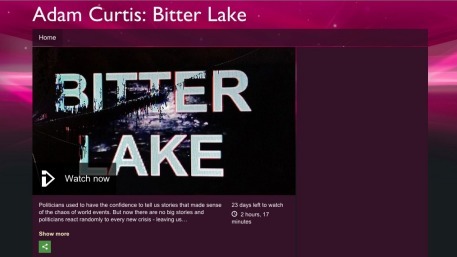
It’s the first day of the second month of the year, and after far too long a break I have some new links to offer. One key event of the week, for all sorts of reasons which I hope to return to, was the release on BBC iPlayer only of Adam Curtis’ new film Bitter Lake (above). The film itself, glorying in its 2 hour 17 minutes length, is here (seemingly just for another 23 days, although why that should be the case is puzzling). But for The Spectator Pakistan correspondent for the GuardianJon Boone offers an interesting riposte describing the film as ‘a Carry On Up the Khyber view of Afghanistan’. For the Guardian itself, however, Emma Graham-Harrison writes that ‘Bitter Lake is a brilliant portrayal of the west’s arrogance in Afghanistan’. For the same media source, Sam Wollaston pretty much agrees: ‘Adam Curtis’s beautiful, gripping film unravels a story of violence, bloodshed and bitter ironies’.
• Nuremberg – Its Lesson for Today: Jan-Christopher Horak at the UCLA Film and Television Archive is fascinating on ‘the mother of all Holocaust documentaries’, made in 1948 by Stuart Schulberg for the U.S. Army.
• Visual education: from earlier in January, Luke McKernan on educational film and video.
• Video essay: Altman TV: so good on Robert Altman’s early television, from Film Comment (a transcript is here):
• American Sniper: Chris Wisniewski’s reflections for Reverse Shot made me think again about Clint Eastwood’s movie: ‘Patriotism and jingoism aren’t the same, and Eastwood’s film is too accomplished and too slippery to warrant blanket dismissal or repudiation.’
• Marshawn Lynch and the future of sports celebrity: Anne Helen Petersen, also for Buzzfeed, asks whether the running back’s refusal to speak to the press is indicative of ‘a new, negotiated mode of sports stardom’.
• I want to howl: who better to review a new biography of Eugene O’Neill than critic and biographer extraordinaire John Lahr, for London Review of Books?
I guess, like anything, theatre is a small, never-ending culture-war. A series of attacks and counter-attacks by artists against each other, all trying to explain the violence and horror, beauty and brilliance of the world to their audiences.
• Arts criticism in the digital age: … after which, further interesting reflections at The Space from Natasha Tripney, founding editor of Exeunt.
• BBC Taster – first week: a major BBC digital initiative, discussed by Adrian Woolard, Head of Connected Studio.
• How John Singer Sargent made a scene: for the Guardian Sarah Churchwell pens a very fine preview of the new National Portrait Gallery exhibition.
• Renzo Piano’s hidden masterpiece: Martin Filler for New York Review of Books on the architect’s construction in Paris for the Fondation Jérôme Seydoux-Pathé.
• The pursuit of beauty: Alec Wilkinson for The New Yorker profiles mathematician Yitang Zhang.
• Latin lives: Anthony Grafton for The Nation is great on the value of the humanities: ‘I have seen the past, and it works.’
• A Few Notes on Our Food Problem:
‘Cinema Pacific and the James Blue Project are pleased to make available this streaming copy of James Blue’s pioneering essay film, which, in spite of the official restrictions prohibiting United States Information Agency films from being released in the United States, was nominated for an Academy Award for Best Documentary Feature in 1968. The film examines, visually and poetically, the efforts by people on three continents to improve agricultural methods and conquer world hunger.’
Reading and viewing (with some listening as well) to ease you into 2015, with the usual apologies for the lack of appropriate thanks to those who recommended some of the following.
• The Wire in HD (updated with video clips): creator David Simon writes thoughtfully, movingly about his ambivalence over the transfer of his modern masterpiece from a SD 4:3 frame to an HD 16:9 one – the examples he includes are revelatory.
• Is television dying?: Ben Lamb at Critical Studies in Television reflects on Christmas TV and what it portends for the future of the medium.
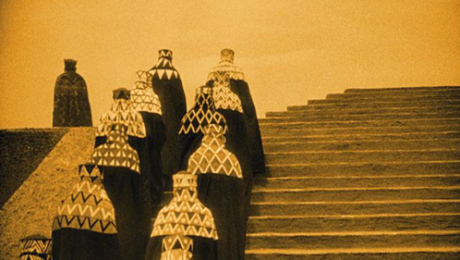
• The ten best films of… 1924: the annual treat from Kristin Thompson rounds up the great works from 90 years ago, including Fritz Lang’s Die Nibelungen: Siegfried (above).
As usual this a selection of articles and more that have engaged me recently; it is presented with my regular apology for not including appropriate thanks to those who alerted me to some of them.
• Worse than a defeat: if you follow only one recommendation this week, make it this angry and important and appalling piece about ‘Britain’s Afghan war’ by James Meek for London Review of Books.
• The messy media ethics behind the Sony hacks: as good a piece as you could hope for from Anne Helen Petersen at Buzzfeed about the legitimacy or not of reading, writing about and studying the hacked Sony e-mails.
• A movie magician: Luke McKernan on the British early filmmaker Walter Booth.
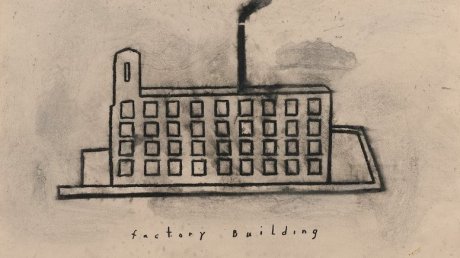
• David Lynch’s bad thoughts: the fine art of the filmmaker, including Factory Building, 2012, a detail of which is above, discussed by J. Hoberman at New York Review of Books.
Under the title ‘Deep reading the Victorians’, Susan E. Cook, Assistant Professor of English at Southern New Hampshire University, has contributed three fascinating articles to the Journal of Victorian Culture Online about the print-vs-digital question and what it means in relation to engaging with 19th-century texts. Each one is well worth reading in full.
Part 1 challenges Nicholas Carr’s arguments in his book The Shallows, in which he worries away at the effects of digital culture on our capacity to read; as Susan Wood suggests in response,
It is easy to see the shift to digital as an epistemic break, but it seems to me that by focusing on this break exclusively we run the risk of flattening out the history of print.
Part 2 reports on an experiment in which the author read a nineteenth-century edition of a nineteenth-century novel that she had not previously read and described the experience. Her chosen text was an undated (but c. 1890) American Arlington Edition of Mrs Henry Wood’s ‘sensation novel’ East Lynne, and she concludes
I don’t doubt Carr’s argument about the cognitive differences between reading print and reading online, but while my own experience reading a nineteenth-century edition was more like reading a contemporary edition than I anticipated, it was not identical to that experience—nor would it be identical were I a nineteenth-century reader, without the same precise vision correction or the benefit of four incandescent bulbs in my reading room I enjoy today. Print is not a static technology but one that changes in response to new technological pressures, new demands from readers, and new market concerns more broadly. The shift to digital was a large shift, but it was not the only shift.
Part 3 describes a further exercise in which the author asked her students in a class on the history of the book ‘to complete a weekly Bleak House reading assignment by a) reading one chapter via our contemporary Penguin Classics edition, b) reading one chapter online or using an e-reader, and c) reading one chapter from one of the three first editions owned by our university.’
She concludes this third post:
Overwhelmingly, the students seemed to prefer reading Bleak House using the format with which they were most comfortable: the contemporary print edition… While this experiment cannot hope to replicate a truly authentic nineteenth-century reading occurrence, it highlights the degree to which the different forms of a book can impact one’s experience of that book. While one student summarizes the respondents’ shared belief that “it is important to have a physical connection with a book (holding a book and turning the pages) in order to have a mental connection with its content,” it is clear that material differences between print editions impact the reading experience greatly and inconsistently. The conditions of deep reading, in other words, seem predicated on comfort, habit, and a complex sense of how one relates to the material text itself.
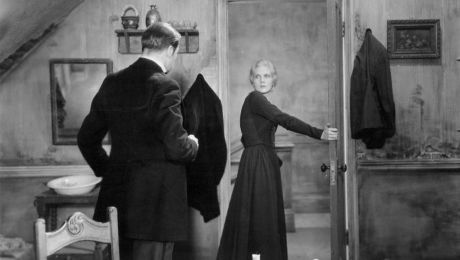
Image: Clive Brook and Anne Harding in the feature film adaptation of Ellen Wood’s novel East Lynne, directed by Frank Lloyd, 1931.
On Sunday at BFI Southbank the estimable programming strand Miss Believed Wiped presented a screening of the ground-breaking 1967 BBC Television satellite broadcast Our World. The strand usually showcases programmes that were once thought lost but have been recently found. Our World, however, was featured because a fine new archival recording had been recently reconstructed and because the programme as a whole, thanks to certain rights restrictions, is very rarely shown. The BBC had preserved Our World as a tele-recording, which was created by filming a screen at the time of transmission. But 50 years ago this process was inferior to 2” video recording, which was what Norwegian television had used to make its copy of the international broadcast. Except that that copy had been dubbed with a local voice-over, so to make what we saw on Sunday the BBC matched its audio to the Norwegian pictures. The result was spectacular, and in a quite specific sense, sublime.
On 25 June 1967 Our World, drawn together by BBC executive Aubrey Singer, set out to link 17 countries around the world in a single live broadcast assembled by crews, ground links and satellite signals. Electronic reports were woven together in London from Australia, Japan, Morocco, western Europe, Canada, the United States and Mexico. Cliff Michelmore anchored the show from BBC Television centre which was transmitted back out around the world. It was a staggering achievement for the comparatively new technology of satellite broadcasting, which had previously linked Europe and the States via Telstar only in 1962 and Britain and Australia for the first time in 1966.
In his fascinating (and very readable) paper ‘The technical history of Eurovision’, which is freely available online, former EBU Senior Engineer Brian Flowers sketches something of the background:
It was an undertaking of incredible complexity, involving control rooms around the world, three geostationary communication satellites (Intelsat I, Intelsat II and ATS-1), over 1.5 million km of cable and ten thousand technicians and programme staff. The programme concept was to link up the world, to demonstrate that we are all part of “our world” – all brothers and sisters. The ground rules for the show included that everything had to be live, and that no politicians or heads of state must be seen.
Four days before the broadcast, five of the participating countries dropped out. The Eastern block countries were protesting at the West’s response to the “Six day War” in the Middle East. But the show went on, with an offer to do it again with them – if ever the Eastern block countries could agree to take part. The audience was spread across 31 countries and totalled between 400 and 700 million people. The live feeds into the programme showed babies being born, sports and arts events, and samples of “cultures” around the globe. At the time it was a technical marvel, and it was in “black and white” television, soon to be replaced by colour television.
“We were trying to make it something which was a program in its own right, that was about something and yet had to carry with it–and this was the problem–all the different nations,” recalls Antony Jay, the writer recruited for the project. “And so we decided to make population growth–which was one of those preoccupations, like global warming is now–a kind of theme of it. We wanted something to try to capture the maximum audience at the beginning, so we thought: Let’s have babies. Typical bit of meretricious television programming, but it gave us a way of getting into it.” The program would begin by attending the births of various children in hospital delivery rooms around the world, then examine the world into which they had arrived. It would consider population growth and the means of supporting people on the planet, and also delve into the worlds of culture and science.
Looked at today the programme has an almost apocalyptic obsession with population growth, with a ticking metronome featured at several points (each representing three new births) and diagrams underlining how little space there will soon be for each of us on the planet. The graphics of the programme, created with screens, projections and models in a huge, wonderfully-lit studio at Television Centre, are one of the glories of the programme, achieving a brilliantly distinctive “look” and facilitating story-telling of great economy. It came as no surprise to see a closing credit to the great television designer Richard Levin.
The content of the programme is for much of the time subservient to the self-reflexive celebration of being able to bring the world together by technology, and certain sections are little more than prosaic reports about the departure of the first tram of the day from a depot in Melbourne, a swimming world record attempt in a pool in Alberta, and an unintentionally hilarious and also rather desperately sad section about life in the modernist utopia of Cumbernauld. But each of these components was done as a live electronic outside broadcast, and reflection on that constantly reinforces a sense of wonder.
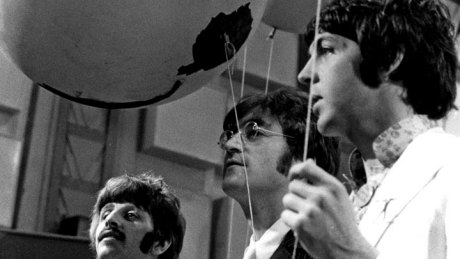
At the same time there are a number of sequences astonishing because of their specific content. The Beatles and George Martin recording All You Need is Love at Abbey Love Illustrated above) is perhaps the best-known, but there is also Wolfgang Wagner rehearsing Lohengrin on the stage at Bayreuth with a full orchestra and a vast chorus. Here too is Franco Zeffirelli and cinematographer Pasqualino de Santis shooting a scene of Romeo and Juliet in a Tuscan church with Leonard Whiting, Olivia Hussey and Milo O’Shea. Leonard Bernstein is in there too, as are Alexander Calder and Joan Miro at the Fondation Maeght in the south of France.
I found it completely absorbing, both for its picture of what 1967 was like around the world and for what I can only call its innocence. Soon after this, with the 1968 Mexico City Olympics and the 1970 World Cup, we would quickly accept live pictures from around the world as entirely natural. We would become blasé about international spectacles made possible by satellite, such as Live Aid in 1985. But here the new sense of wonder evoked by seeing a baby born just then in Japan or a deep space signal picked up at that moment by a radio telescope in Australia was genuinely moving.
What struck me most perhaps was the programme’s fascination with the processes of its own production, and in this as well as other aspects it struck as one of the purest examples of television as ‘technological sublime”. The idea originally comes from Leo Marx and was developed by David E. Nye in his 1996 book from MIT Press American Technological Sublime. Nye quotes the OED definition of the sublime and suggests that this can be applied to the Golden Gate Bridge or the launch of a space shuttle just as much as it can be associated with the Grand Canyon or Niagara Falls:
Of things in Naure and Art, affecting the mind with a sense of overwhelming grandeur or irresistible power; calculated to inspite awe, deep reverence, or lofty emotion by reason of its beauty, vastness or grandeur.
Which is most certainly what, as a product of technology, Our World aspires to, and for my money achieves in a way that precious few television broadcasts do. There is so much more to say about the transmission – and I dearly hope that it can be made more generally available, at least as an object of scholarly study – but here’s a quote from Nye about the sublime which, while it might seem hyperbolic, sees to apply without too much of a stretch to Our World:
One of the most powerful human emotions, when experienced by large groups the sublime can weld society together. In moments of sublimity, human beings temporarily disregard divisions among elements of the community. The sublime tap into fundamental hopes and fears… [I]t is an essentially religious feeling, aroused by the confrontation with impressive objects, such as Niagara Falls, the Grand Canyon, the New York skyline, the Golden Gate Bridge, or the earth-shaking launch of a space shuttle… In a physical world that is increasingly desacralized, the sublime represents a way to reinvest the landscape and the works of men with transcendent significance.
Let’s get this on the table at the top: we believe our 5-disc box-set of the 1960 BBC Television series An Age of Kings, which adapts all eight of Shakespeare’s great History plays, would make an excellent Christmas gift. You can purchase it from us online here, and it is also available from Moviemail, Amazon and other online retailers.
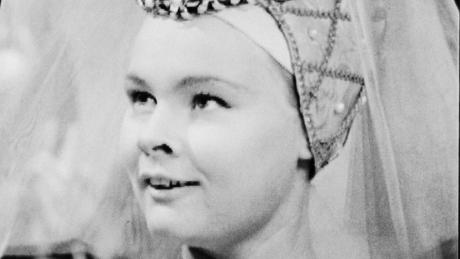
As a holiday treat, and as part of our entreaty to make a purchase, we are releasing highlights from the series to our YouTube channel on each Tuesday and Thursday, and yesterday we presented a scene from Episode 8: Band of Brothers. This is from Act V Scene 2 of Henry V with an implausibly youthful Robert Hardy as the wooing king and Judi Dench as the French princess Katherine. Which seems entirely appropriate given that Dame Judi celebrated her 80th birthday yesterday. Here she is 54 years ago, responding to Henry’s entreaties and being flirty and flighty and haughty and (despite the accent!) captivatingly charming.
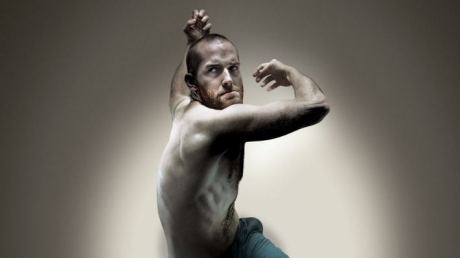
Tonight’s NT Live broadcast of DV8 Physical Theatre’s John was not exactly business as usual. Absent was a live introduction by the bubbly Emma Freud. Instead we were treated to a video message from a serious-looking Nick Hytner telling us that while the subject matter might not be to everyone’s taste (gay sex, drug use, incest, rape and more) what we were about to see was most definitely art. Then we had a voice-over statement from creator Lloyd Newson illustrated with extracts from films and performance footage of previous DV8 shows. Which reminded you, incidentally, that both BBC and Channel 4 have funded truly remarkable DV8 productions for the screen, albeit a decade and more back. But what I thought mostly was different was the distinctive approach to filming this uncompromising combination of dance, movement and verbatim theatre.
I can see what critics mean when they say that the 75-minute piece feels broken-backed, being a first half about the deprivations and degradations of John’s early life and the remainder about the everyday life of a gay sauna. But for me the two elements came together, at is were, most satisfyingly in a closing sequence of considerable power. I found John entirely compelling, and there were moments when I was open-mouthed with admiration at the performances of Hannes Langolf most especially, but also the rest of an extraordinary troupe of dancers. Lloyd Newson’s choreography is at moments astounding, and throughout there is a rare level of invention.
As for the approach of screen director Robin Lough and the camera team, I was struck by how their treatment took the show out of the theatre and into a kind of electronic virtual space. Yes, there was a shot of the Lyttleton auditorium at the top, and we returned there for the curtain calls, but for the duration of the performance we were in an abstracted screen space woven from designer Anna Fleischle’s dazzling revolve and pitch-perfect stage lighting design by Richard Godin. The sense of a physical stage seemed to drop away to leave us with bodies moving restlessly and remorselessly in spaces that changed and morphed and multiplied. I found the effect entrancing.
What the live broadcast achieved (and which the trailer below only faintly suggests) was a kind of screen choreography that dancers and directors have at times conjured up when working on film or with digital recording. Indeed that’s exactly what director David Hinton did with Newson and DV8 for the television films Dead Dreams of Monochrome Men (London Weekend Television, 1990) and Strange Fish (BBC, 1992). But I am not sure I have ever seen this pure kind of screen dance created, as here, on the fly, albeit with endless planning and exceptional execution. Bravo, bravo. I did, however, have one question. With all of that naked and semi-naked male flesh on show, not to mention a fair few cocks, where on earth did they hide the radio mics?