12th October 2014
An idiosyncratic selection of articles and more that have engaged me over the past few days, with the usual apologies for not including appropriate thanks to those who alerted me to some of them.
• Le Giornate del Cinema Muto – Pordenone post no 8: mille grazie to Pamela Hutchinson at Silent London for a delightful series of posts from the silent film festival over the past week; this final one has links to the other seven.
• The Barnsley disaster and the Engine-driver poet: a fascinating fragment of early film history from Luke McKernan.
• The Goddess – the revival of the classic from Chinese cinema’s golden age: a video from BFI about a major film screening this week in the London Film Festival.
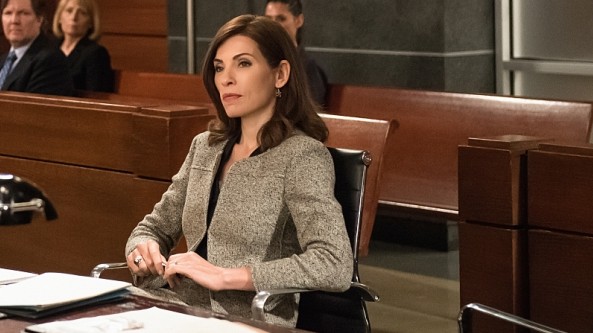
• Shedding her skin: while we wait for Series 6 of The Good Wife with Juliana Margulies (above) – which is simply the best small-screen show of the past five years – here’s a particularly good New Yorker piece on the series and its context from Emily Nussbaum (but with spoilers).
• Find your beach: Zadie Smith is very good on New York, from the New York Review of Books.
• It’s official – AIs are now re-writing history: a weird auto-combination photo story, together with reflections on its implications, from Rob Smith.
• Grindr, dick pics and contemporary art’s new invasions of privacy: interesting article by Sian Cain for Guardian.
• Killing it – lessons in after-hours creativity from pop culture writer turned Gone Girl author Gillian Flynn: pretty much what it says in the headline, from Joe Berkowitz at Fast Create.
• The Woman in the Moon (The Dolphin’s Back) @ The Rose Playhouse, Bankside: Peter Kirwan for The Bardathon on James Wallace’s strong revival of John Lyly’s play.
• Grit & grace: a very fine piece of online branded content about the demands of ballet delivered by The New York Times on behalf of Cole Haan.
• Great beauty – Eugène Green on La Sapienza: Nick James for Sight & Sound talks with the maker of a film I’m longing to see.
• A farewell to Epcot’s Norway ride – how fake experiences shaped my life: Matt Novak at Paleofuture marks the closing of Maelstrom.
• Tetris the movie: can falling bricks really make it big where other video games failed?: Jenna Ng from the University of York at The Conversation.
• How Bill Gates thinks: the Microsoft man talks with author Steven Johnson, from The Atlantic.
• J. xx Drancy 13/8/42: Michael Wood in 2000 from the archives of the London Review of Books on Nobel literature prize-winner Patrick Modiano.
• Karl Miller’s grand style – John Sutherland remembers the late, great editor and academic: from New Statesman.
• The greatest ancient picture gallery: William Dalrymple writes rather wonderfully for the New York Review of Books about the Ajanta caves.
• The top ten fairytales: Marina Warner’s choice, via Guardian – what more do you want?
11th October 2014
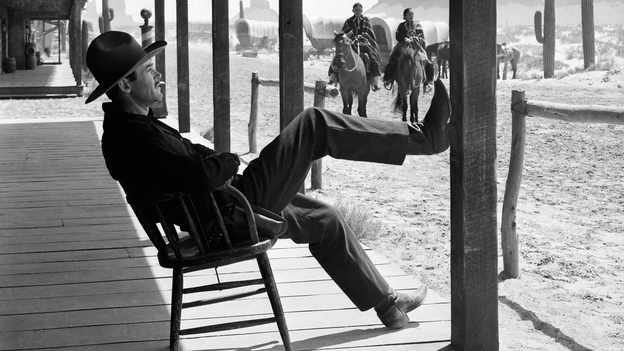
Long ago and far away – in the autumn of 1971, I believe, and in Canterbury – I fell in love. The obscure object of my desire was Cinema, and two inamorata vied for my affections. One was the collective achievement of Jean-Luc Godard, whose films I gorged on in the regional film theatre at the University of Kent. The other was the legacy of John Ford, which was unspooling as I recall in a Sunday night season on BBC2. Jean-Luc’s oeuvre and I have unquestionably had our ups and downs, but I like to believe that I have remained unfailingly faithful to the movies, and most especially the westerns, of Big John. My almost automatic answer to the dinner party question about which single film I would take to a desert island has been The Searchers from 1956, but at this moment I’m not so sure. For I have just seen a glorious, glittering restoration of Ford’s 1946 My Darling Clementine. read more »
8th October 2014

Collective self-portraits from the BBC are always compelling. And that’s exactly what the new video for BBC Music is, even as it features an all-star cast singing the 1966 Beach Boys hit ‘God Only Knows’. There’s already some good analysis online of the three-minute wonder, including a piece by Alexis Petridis for the Guardian. For the same news service, Michael Hann has the background, and there’s more from the BBC here. What particularly interests me is the defiantly retro feel of it all – alongside the remarkable CGI – plus the use of Alexandra Palace and the inclusion of vintage broadcasting kit. Here’s the object of our attention.
read more »
5th October 2014
Below are links to articles and other online offerings that have engaged me in the past few days. I extend my usual apologies to those who have recommended some of these, whether on Twitter or elsewhere, and which I fail to acknowledge.
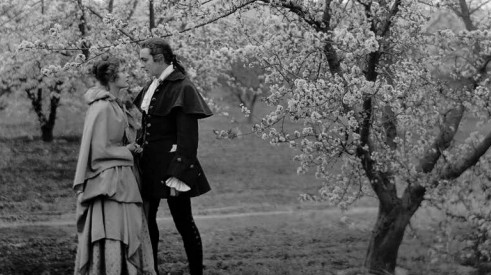
• Le Giornate de cinema muto 33: the link is to the free download of the essential catalogue for the Pordenone silent film festival which began yesterday; the image above is from a featured film, When a Man Loves 1927 with John Barrymore, whose work is being showcased, and Dolores Costello.
• Forty portraits in forty years: The New York Times showcases Nicholas Nixon’s group portraits of the four Brown sisters – he has taken an image of them every year since 1975, and the article includes the latest one; Susan Minot’s accompanying text is pretty good too. Absolutely wonderful.
• Post photography – when artists go wild with cameras – in pictures: a very engaging Guardian gallery.
• Into the unknown: Calvin Tomkins profiles Chris Ofili for The New Yorker.
• Five architects, five state-of-the-art museums: Ellen Gameran for the Wall Street Journal, with some terrific images.
• Post-web technology – what comes next for museums?: by Danny Birchall and Mia Ridge for the Guardian’s Culture Professionals Network; see also Ten R&D projects that are changing arts and culture by Emma Quinn and Althina Balopoulou.
• Digitising the BBC’s archive: there is an embedding option for this interesting short film from BBC Academy, but the graphic surround is SO ugly I thought it more aesthetic simply to provide a link.
• Netflix chief Reed Hastings takes on telcos, cinemas and global expansion: a revealing interview by Christopher Williams for the Telegraph.
• Don’t look down – Russia’s urban daredevils: urbex adventures in Moscow with Maryam Omidi at The Calvert Journal (also via the Guardian, but better in the original).
• Citizen Fan – An Interview with Filmmaker Emmanuelle Wielezynski-Debats (Part One): an introduction and richly interesting interview by Henry Jenkins with the maker of an exceptional new online documentary about fan culture.
• The forgotten story of classic Hollywood’s first Asian-American star: from Buzzfeed, the always wonderfully readable Anne Helen Petersen on Anna-May Wong; AHP’s long-awaited book Scandals of Classic Hollywood was published this week – Time magazine carried a Q&A with her.
• Catastrophic Coltrane: a short New York Review of Books piece by Geoff Dyer illustrated by a performance video and a wonderful photograph.
• Diary: Mary Kay-Wilmers, editor of the London Review of Books, remembers the magazine’s founder, Karl Miller, who died this week.
• David Fincher – and the other way is wrong: an immaculate video essay from Tony Zhou about the work of the filmmaker of the moment.
David Fincher – And the Other Way is Wrong from Tony Zhou on Vimeo.
4th October 2014
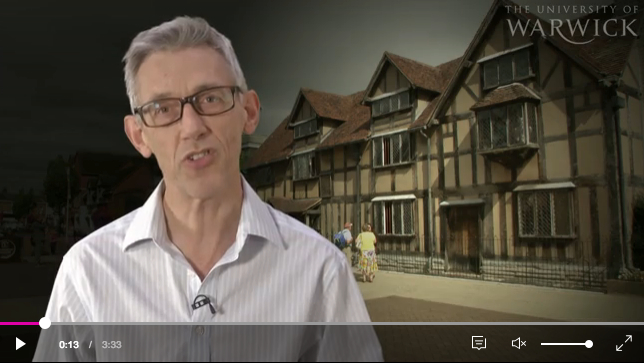
I have come to the end of the first week of my MOOC. Having taken an assessment test and scored 34 from a possible 36 points (and with one of those I dropped being highly questionable), I’m feeling sufficiently pleased to share my experiences. Indeed I think I might chronicle my progress here on occasions across the next nine weeks. For those of you just arrived from Mars, a MOOC is a massive open online course, a relatively new kind of distance learning in which you particpate with lots and lots of other people. My MOOC has been put together by Futurelearn, a private company owned by The Open University, in partnership with The University of Warwick and the Shakespeare Birthplace Trust in Stratford-upon-Avon. The subject is ‘Shakespeare and his world’ and the tutor is the estimable Professor Jonathan Bate, Provost of Worcester College, Oxford, and author of one of the very best books on the Bard, The Genius of Shakespeare. Oh, and it’s completely free – you can sign up here. read more »
3rd October 2014
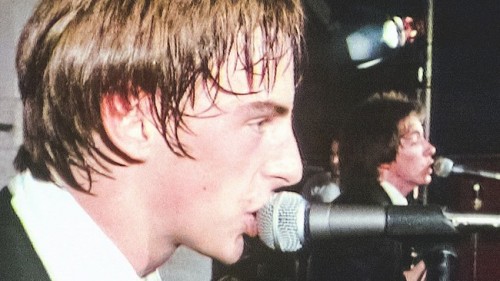
Anarchy in Manchester, a new series produced by Illuminations, starts tonight on Sky Arts 1 HD at 10.30pm. Producer LINDA ZUCK and editor TODD MACDONALD introduce the programmes.
LINDA: In six half-hour programmes, we bring you the very best of So It Goes, Granada Television’s music show presented by the late Tony Wilson of Factory Records and Hacienda fame. We have re-packaged live and uncut punk performance, and dragged it from the archives and into the 21st century – along with some of some of Tony’s most charmingly pretentious asides.
Tonight’s show includes The Buzzcocks, Penetration, The Jam and the very first appearance of the Sex Pistols on TV with ‘Anarchy in the UK’. Future episodes have equally terrific raw performance footage, mostly filmed in pubs and clubs around Manchester. Featured bands include The Clash, The Jam (that’s Paul Weller above), Elvis Costello, The Stranglers, Siouxsie and the Banshees and Iggy Pop.
The Sky Arts trailer is here. Let us know what you think #skyartsanarchy.
Todd has assembled a dazzling .flickr gallery of screen-grabs here. read more »
2nd October 2014
I have been reading with great pleasure the excellent Library of America anthology The American Stage: Writing on Theater from Washington Irving to Tony Kushner. Edited by Laurence Senelick, this features numerous essays, reviews and poems across the past two centuries – and I recommend it warmly. One of the topics that especially fascinates me at present – not least because of my work with RSC Live from Stratford-upon-Avon – is what the specific qualities are of the theatre experience, especially when compared to film and to television.
In a 1955 essay, ‘The American Theater’, penned for Holiday magazine and included in the anthology, Arthur Miller addressed the issue in the following way. I don’t entirely agree with him (and his gender-specific prose grates today) but he expresses his sense of this with elegance and precision and passion:
As the lights go down and the curtain rises, our visitor [to a Broadway theatre] may feel a certain strange tension, an expectancy, and an intense curiosity that he never knew in a theater before. Instead of the enormity of the movie image before which he could sit back and relax, he is confronted by human beings in life-size, and since their voices do not roar out at him from a single point to which his ear may tune in once and relax, he must pay more attention, his eyes must rove over a thirty-foot expanse; he must, in other words, discover. And if there happens to be something real up there, something human, something true, our visitor may come away with a new feeling in his heart, a sense of having been part of something quite extraordinary and even beautiful. Unlike the movies, unlike television, he may feel he has been present at an occasion. For outside this theater, no one in the world heard or saw what he saw this night. I know that, for myself, there is nothing so immediate, so actual, as an excellent performance of an excellent play. I have never known the smell of sweat in a movie house. I have known it in the theater – and they are also air-conditioned. Nor have I known in a movie-house the kind of audience unity that occasionally is created in the theater, an air of oneness among strangers that is possible in only one other gathering place – a church.
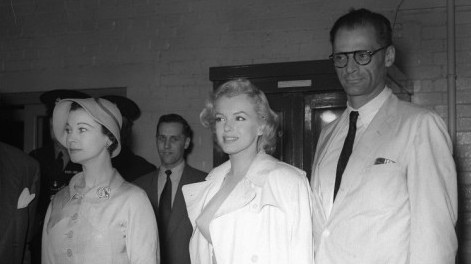
Image: Arthur Miller with his wife Marilyn Monroe and Vivien Leigh, London, July 1955.
1st October 2014
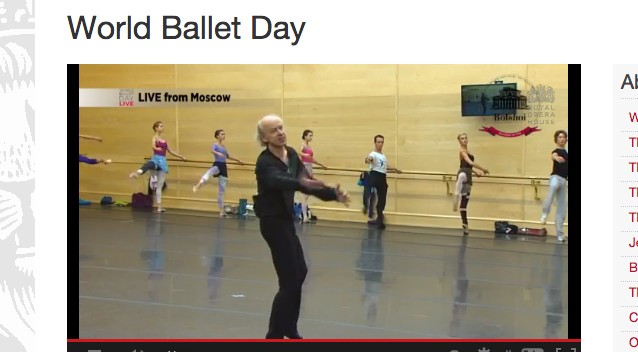
Today is World Ballet Day, a remarkable online collaboration of ballet companies around the world. Since 3am this morning the Royal Ballet’s free Youtube channel has been relaying rehearsal footage, interviews and more from The Australian Ballet and now we’re in Moscow with the Bolshoi (above). The virtual baton is handed to Covent Garden at 11 this morning. I would love to spend all day watching but real life means that I can only drop in and out occasionally, as you’ll see below….
7.20am: We’re in one of the rehearsal rooms of the Bolshoi, and artistic director Sergey Flin is offering a whispered commentary – but in Russian. Although now this is being interpreted and contextualised in voice-over. The images and sound are excellent, and my domestic broadband is only “hanging” very occasionally. There’s immediately an impressive sense of being invited in on a process which is all the more immediate and interesting because it’s not being structured and mediated by the expectations of television.
7.35am: Alongside the video stream there is a lively chat channel with a mix of informed commentary from watchers along with queries and gossip.
7.45am: Some of the dancers are offering brief interview comments between their exercises. The Royal Opera house Youtube page says that around 770 people are watching, although I’m not clear if this is the number viewing through this page (and others are accessing it in other ways) or if this is the total number internationally. At least it will provide a benchmark to see how the figures rise and fall through the day.
8.30am: A rehearsal with just two star dancers now, and some very elegant camerawork which allows us both to see the ballet master and, reflected in a huge mirror behind him, the dancers. Now an interview with principal dancer Svetlana Zhakarova (in Russian again), who we have just watched rehearsing – and she is engagingly out of breath. On then to principal dancer Denis Rodkin.
8.35am: On to a ‘bauprobe’, which I learn is a kind of showing of the full-scale set on the stage. So we get to see what the main house looks like from the stage – and we have (basic) sub-titles here – although at times they obscure vital parts of the image. Bit of an artistic disagreement about whether or not they can have water on the stage. Around 840 watching now.
8.50am: An onstage rehearsal, and the dancers aren’t ready – the choreographer Grigarovich is not happy, and is shouting at the stage. Maybe they prepped this to add a bit of drama, but I don’t think so. It feels very spontaneous – and not quite controlled. The stage rehearsal begins, with orchestra, of A Legend of Love. At times the camera cuts away to the poker-faced choreographer.
8.55am: This is really impressive – remarkable access, a big orchestra, exceptional shots of stage, house, pit. But I *have* to do some other things. Back later, and certainly to catch some of ROH after 11am.
12.35pm Back now with ROH and a rehearsal class. Immaculate sound and pictures – and more than 2,300 watching now. The dancers break and are being interviewed – thoughtful, engaging – I just wish I could spend all day watching.
12.47pm: Oh! Rehearsal run-through of a pas-de-deux from MacMillan’s Manon. Main camera on a small crane so we are above the two (astounding) dancers. Very beautiful.
12.50pm: Somehow it’s made all the more thrilling by being just a reharsal room piano and hearing the comments of the répétiteur watching. Comments too from Director, Royal Ballet Kevin O’Hare. The 2,545 viewers – not to mention me – really are getting a treat. I don’t think anything else I’ve seen – in documentaries or wherever – has got me this close to the rehearsal process of a ballet.
13.08pm Lots of fan love in the chat channel, which is adding its own level of fun. The two dancers, Nela and Federico, are being interviewed now. Federico signs off with a plug for the cinema broadcast of Manon on 16 October. I’m off to book my tickets now.
13.13pm Wayne McGregor now talking about his new collaboration on a piece about Virginia Woolf. “Who was Virginia Woolf?” asks our host. Not sure if the interested audience online really needs that. Followed by terrific montage of extracts from Wayne’s work: Chroma and Infra.
13.21 Composer Jody Talbot in a video package talking us through the composition of the score for Alice. Choreographer Chris Wheeldon in interview too, as well as designer Bob Crowley. Plus dancers Edward Watson and Sarah Lamb. Very nice, elegant film.
13.27 Bit of a sound snafu there as we go into Cassandra rehearsal. Still don’t think we’ve quite got the choreographer on a good mic. But I have to drag myself away and do some other writing. Overall, I am most impressed. Bravo, Royal Ballet!
9.35pm Back for a final session, and the day has moved on to San Francisco Ballet. The local production team has a Steadicam (or equivalent) to film this rehearsal. The standard of camerawork has been really high for everything that I’ve watched. Just over 2,400 viewers at the moment.
9.54pm The rehearsal is for a ballet called Raku, and by seeing the sequence several times you really do get a sense of development and indeed improvement. Interesting interview now with principal dancer Yuan Yuan Tan who has been working with the company for 20 years!
30th September 2014

Click on the title to go to 30 Years of The Turner Prize, a 3-minute film that we put together last week for Tate and the Guardian. It’s also showing alongside the Turner Prize 2014 exhibition which opens at Tate Britain today. From 1993 to 2005 we produced Channel 4’s coverage of the prize and this new short features quite a bit of our archive from those years, with appearances from Damien Hirst, Tracey Emin, Sam Taylor-Johnson, Grayson Perry and others. Enjoy!
29th September 2014
Apologies for our problems with malware over the past ten days or so. Believe me, we are very happy to be back – and we feel confident that we’re free of problems now. So to celebrate here is a list of interesting recent links. As before, I apologise in advance for not crediting the sources of the ones I picked up from others – but do feel free to appropriate any of these.
• Here’s why The New York Times‘ television criticism is so bad: Anne Helen Petersen for Buzzfeed – so good.
• Scandals of Classic Hollywood – the long suicide of Montgomery Clift: meanwhile, here’s a terrific extract courtesy of Vanity Fair from Anne Helen Petersen’s new book.
• Eyes of Hitchcock: a hypnotic short video essay from ::konogawa and Criterion Collection
Eyes of Hitchcock from Criterion Collection on Vimeo. read more »