5th December 2014
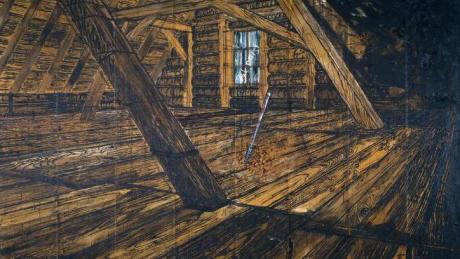
You have just one week to catch the truly remarkable Anselm Kiefer exhibition at the Royal Academy of Arts, which closes on 14 December. In recognition of this we have posted on our YouTube channel a new extract of our 1987 Channel 4 series State of the Art. The extract, which is taken from History, the first episode of the six-part series, features Kiefer’s work set against the German landscape. The full series is available to purchase on DVD, and I wrote in detail about the its production here. Further extracts, which we have recently re-mastered before posting again on YouTube, are online featuring Antony Gormley, Cindy Sherman, Joseph Beuys and Jean-Michel Basquiat together with his friend Andy Warhol. Below I recall the making of the series and of the production’s encounter with Anselm Kiefer.
read more »
27th November 2014
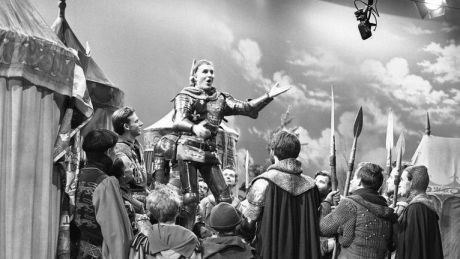
Just exactly one year ago, Illuminations, working with the Screen Plays research project, released a DVD box-set of the BBC’s 15-part series from 1960, An Age of Kings. The series is an extraordinarily ambitious live studio production of all eight of Shakespeare’s History plays, embracing the Bard’s chronicle of England from the troubled reign of Richard II to the downfall of Richard III. You can purchase the 5-disc DVD set here.
The release has been a considerable success – and we would love to follow it with further DVDs of great plays from the BBC archive, although we cannot persuade BBC Worldwide to work out an appropriate relationship for this. To celebrate our modest anniversary, and also to draw your attention to the fine new iteration of our YouTube channel (revamped by Todd Macdonald), we are going to release key scenes from the series on each Tuesday and Thursday between now and Christmas. I will also provide some further background to the series on the blog, together with links to other writings. This is the first, from Henry V and Episode 7, Signs of War, with Robert Hardy as the king.
25th November 2014
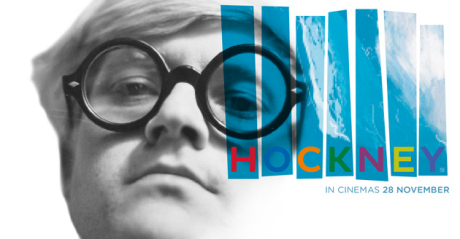
To the Clapham Picturehouse for an evening with David Hockney. First up was Randall Wright’s new film biography of the artist, Hockney, which has been co-produced by the BBC. This was followed, to make it more of a cinema event, by a 35-minute “live and exclusive” visit to Hockney’s LA studio in the company of his friend Charlie Scheips. Judged by the standards of television, this added attraction had aspects of a car-crash.
The satellite feed went down a couple of minutes in and was off for three or four minutes. Sporting a remarkable retro bow-tie, when he was back on screen Charlie couldn’t keep quiet for a second. He seemed to have little sense from moment to moment of where the encounter was going, and he was palpably as nervous as a ferret on a freeway. At one point he and David cued up an extract from the mid-1980s documentary A Day on the Grand Canal with the Emperor of China but getting out of this was messy.
The vision mixer was irritatingly restless and the Steadicam operator became increasingly desperate to find yet another irrelevant floating shot. And most frustrating of all, as Hockney talked interestingly about particular works mentioned by Charlie, there were no images to bring up so that we could see what they were talking about. Television has a way of doing these things to make them look effortless. Yet this wasn’t television, and I got the sense that while this hybrid TV/cinema form is perhaps more demanding technically than the small screen, there are aspects of it that are far more forgiving. read more »
23rd November 2014
Since we have been offline for a month and more, this is a longer (and later)-than-usual selection of articles and more that have engaged me over during that time, with the usual apologies for not including appropriate thanks to those who alerted me to some of them.
• No one wanted to talk about Bill Cosby’s alleged crimes because he made white America feel good about race: strong analysis of the story of the moment by Rebecca Traister for New Republic.
• Bebop/silence – on Hickey & Boggs: Charles Taylor for the LA Review of Books is rather brilliant on the ’70s movie starring Bill Cosby and Robert Culp.
• Nightmare at the Picasso Museum: Guardian Arts has been very strong recently, and one of the treats was Jonathan Jones’ report on the reopening of the artist’s personal collection in Paris.
• Picasso – the view from Florence: more about the master, here from Ingrid D. Rowland for the New York Review of Books on a major show in Italy.
• Being discovered – an interview with Calvin Tomkins: J. C. Gabel for The Paris Review talks with Tomkins about his friendship with Gerald and Sara Murphy, the couple F. Scott Fitzgerald used as the models for Dick and Nicole Diver in Tender is the Night.
• Will Self – are the hyper-rich ruining the new Tate Modern?: not sure I agree with Self’s entire argument for the Guardian, but it’s a fine provocation.
• Eric Fischl: ‘What America wants is artists who are doing very expensive toys’: a very good interview-based profile by Tim Adams for The Observer with the painter whose new works are on show at Victoria Miro.
• Standing naked in front of an audience – Amanda Palmer and a new way to make art: Cory Doctorow for The New Statesman.
• My Darling Clementine – the great beyond: before we went offline I hymned John Ford’s great 1946 western here, and I make no apologies for returning to it with this link to David Jenkins’ new essay for The Criterion Collection.
• What-if movies – forking paths in the drawing room: David Bordwell on (mostly) the 1934 RKO film version of J. B. Priestley’s play Dangerous Corner.
• The hard work of marriage: Zoe Heller on Gone Girl for the New York Review of Books.
• The hidden history of the zoom lens: Nick Hall tells you all you need to know in a video essay distilled from his dissertation:
The Hidden History of the Zoom Lens from Nick Hall on Vimeo.
• The veils of collaboration: a dense, lengthy but fascinating not-quite-a-journal-article about the writing of early modern plays by Holger Syme for his blog dispositio.
• It’s best not to make him angry: a terrific review for Michael Boyd’s Brooklyn staging of Christopher Marlowe’s Tamberlaine, by Ben Brantley for The New York Times.
• At the Donmar: Jacqueline Rose for London Review of Books on Phyllida Lloyd’s all-female production of a compiled Henry IV.
• Bertolt Brecht’s Marie-Antoinettism: for The New Republic Anthony Daniels reviews Stephen Parker’s mammoth new biography.
• The new Jacob Bronowski archive: Erica Wagner for the Financial Times goes to Cambridge with Lisa Jardine to see the papers of her father [requires registration].
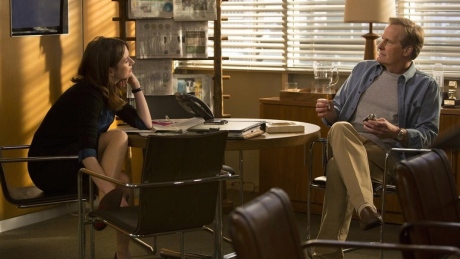
• Dumb and Gummer – The Newsroom: Run: to her great surprise Libby Hill for The AV Club loves S3 E2 of Aaron Sorkin’s series (which is running on Sky Atlantic, and is illustrated above)…
• The Newsroom may be the most entertaining show on television:… and Richard Lawson for Vanity Fair agrees – ‘I come to praise The Newsroom and, sadly, to bury it.’
• The cult of Connie Britton: the Nashville star considered by Anne Helen Petersen for Buzzfeed.
• Science has great news for people who read actual books: Rachel Grate at Arts.Mic on the e-books versus paper debate, with the strong suggestion that paper wins every time.
• The future of the culture wars is here, and it’s Gamergate: Gamergate had mostly passed me by, but this piece by Kyle Wagner at Deadspin is a good place to catch up.
• Revenue streams: John Seabrook writes for The New Yorker about Spotify.
• The creepy new wave of the internet: Sue Halpern for The York Review of Books.
• Silicon Valley and journalism – make up or break up?: an essential lecture by Emily Bell, Director at the TOW Center for Digital Journalism at Columbia Journalism School.
• Labelling BBC Online’s archived websites: Neil McIntosh for the BBC Internet blog.
• Labour vanishes: a deeply depressing but bracing read by Ross McKibbin for London Review of Books.
• Out of print: if it’s still online, below is Julia Marchese’s documentary about the famous Los Angeles movie theatre, and about the end of 35mm, is well worth watching; see also David Bordwell, Ode to the New Beverley, and a downbeat coda, but you need also to read the background from Julia Marchese, I will not be censored. Out Of Print from John T. Woods on Vimeo.
20th November 2014
It’s been a hugely frustrating month and more. One night, entirely unprovoked by us, our web site apparently started ‘attacking’ other sites. Our developers quite rightly felt that the only thing to do was to take a large part of the site offline. We have spent the last month sorting out what went wrong, moving across to another digital agency, Origin Media (a process which was underway in any case), and working with them to restore all of our content. Which is the stage we’re at today, and which in itself feels like a small triumph.
At the same time, we have been re-vamping our YouTube channel, and you can see where we are with that here. Our plan now is to have a regular release of new content related to our productions and our DVD releases, and I will be posting about that in the coming days. For the moment, though, we are happy simply to back benignly online
17th October 2014
To Stratford-upon-Avon Picturehouse for a live broadcast of the Royal Ballet’s Manon, choreographed by Kenneth MacMillan. Very splendid it was too, with Marianela Nuñez and Federico Bonelli as the principals, and with screen director Ross MacGibbon providing a master-class in how to translate a fiendishly complex three-act ballet to the cinema. This post is intended to highlight the work of one of MacGibbon’s distinguished predecessors as a screen interpreter of dance, Margaret Dale, but let me note here that I am also fascinated by MacMillan. Jann Parry’s richly interesting 2009 biography Different Drummer: The Life of Kenneth MacMillan vividly portrays a conflicted man and a brilliant artist. And my interest in the relay was also piqued by seeing Marianela and Federico rehearse a pas de deux during the recent World Ballet Day online. The Royal Opera House have made this clip available on their terrific YouTube channel, and I embed it here simply because it is technically astounding and achingly beautiful.
read more »
12th October 2014
An idiosyncratic selection of articles and more that have engaged me over the past few days, with the usual apologies for not including appropriate thanks to those who alerted me to some of them.
• Le Giornate del Cinema Muto – Pordenone post no 8: mille grazie to Pamela Hutchinson at Silent London for a delightful series of posts from the silent film festival over the past week; this final one has links to the other seven.
• The Barnsley disaster and the Engine-driver poet: a fascinating fragment of early film history from Luke McKernan.
• The Goddess – the revival of the classic from Chinese cinema’s golden age: a video from BFI about a major film screening this week in the London Film Festival.
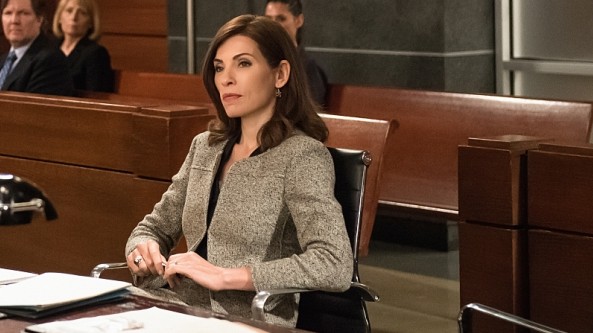
• Shedding her skin: while we wait for Series 6 of The Good Wife with Juliana Margulies (above) – which is simply the best small-screen show of the past five years – here’s a particularly good New Yorker piece on the series and its context from Emily Nussbaum (but with spoilers).
• Find your beach: Zadie Smith is very good on New York, from the New York Review of Books.
• It’s official – AIs are now re-writing history: a weird auto-combination photo story, together with reflections on its implications, from Rob Smith.
• Grindr, dick pics and contemporary art’s new invasions of privacy: interesting article by Sian Cain for Guardian.
• Killing it – lessons in after-hours creativity from pop culture writer turned Gone Girl author Gillian Flynn: pretty much what it says in the headline, from Joe Berkowitz at Fast Create.
• The Woman in the Moon (The Dolphin’s Back) @ The Rose Playhouse, Bankside: Peter Kirwan for The Bardathon on James Wallace’s strong revival of John Lyly’s play.
• Grit & grace: a very fine piece of online branded content about the demands of ballet delivered by The New York Times on behalf of Cole Haan.
• Great beauty – Eugène Green on La Sapienza: Nick James for Sight & Sound talks with the maker of a film I’m longing to see.
• A farewell to Epcot’s Norway ride – how fake experiences shaped my life: Matt Novak at Paleofuture marks the closing of Maelstrom.
• Tetris the movie: can falling bricks really make it big where other video games failed?: Jenna Ng from the University of York at The Conversation.
• How Bill Gates thinks: the Microsoft man talks with author Steven Johnson, from The Atlantic.
• J. xx Drancy 13/8/42: Michael Wood in 2000 from the archives of the London Review of Books on Nobel literature prize-winner Patrick Modiano.
• Karl Miller’s grand style – John Sutherland remembers the late, great editor and academic: from New Statesman.
• The greatest ancient picture gallery: William Dalrymple writes rather wonderfully for the New York Review of Books about the Ajanta caves.
• The top ten fairytales: Marina Warner’s choice, via Guardian – what more do you want?
11th October 2014
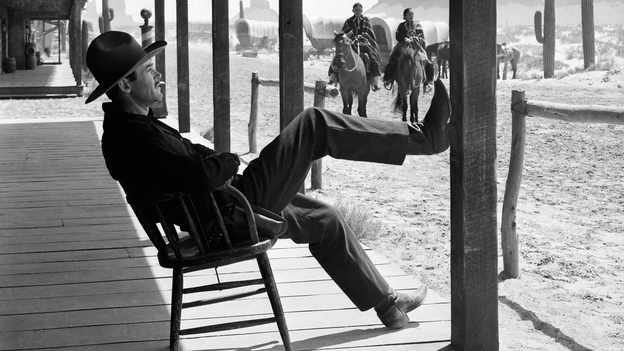
Long ago and far away – in the autumn of 1971, I believe, and in Canterbury – I fell in love. The obscure object of my desire was Cinema, and two inamorata vied for my affections. One was the collective achievement of Jean-Luc Godard, whose films I gorged on in the regional film theatre at the University of Kent. The other was the legacy of John Ford, which was unspooling as I recall in a Sunday night season on BBC2. Jean-Luc’s oeuvre and I have unquestionably had our ups and downs, but I like to believe that I have remained unfailingly faithful to the movies, and most especially the westerns, of Big John. My almost automatic answer to the dinner party question about which single film I would take to a desert island has been The Searchers from 1956, but at this moment I’m not so sure. For I have just seen a glorious, glittering restoration of Ford’s 1946 My Darling Clementine. read more »
8th October 2014
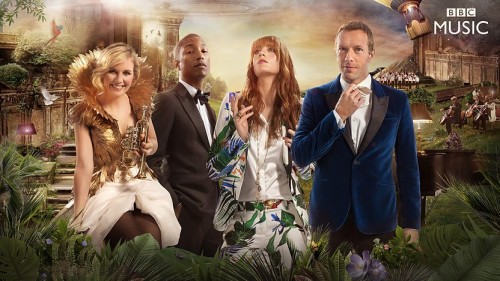
Collective self-portraits from the BBC are always compelling. And that’s exactly what the new video for BBC Music is, even as it features an all-star cast singing the 1966 Beach Boys hit ‘God Only Knows’. There’s already some good analysis online of the three-minute wonder, including a piece by Alexis Petridis for the Guardian. For the same news service, Michael Hann has the background, and there’s more from the BBC here. What particularly interests me is the defiantly retro feel of it all – alongside the remarkable CGI – plus the use of Alexandra Palace and the inclusion of vintage broadcasting kit. Here’s the object of our attention.
read more »
5th October 2014
Below are links to articles and other online offerings that have engaged me in the past few days. I extend my usual apologies to those who have recommended some of these, whether on Twitter or elsewhere, and which I fail to acknowledge.
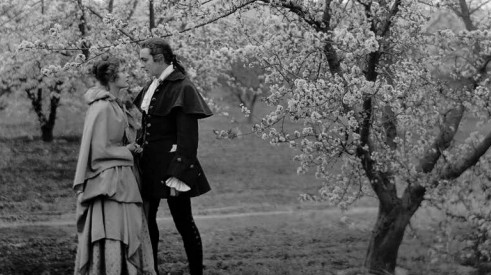
• Le Giornate de cinema muto 33: the link is to the free download of the essential catalogue for the Pordenone silent film festival which began yesterday; the image above is from a featured film, When a Man Loves 1927 with John Barrymore, whose work is being showcased, and Dolores Costello.
• Forty portraits in forty years: The New York Times showcases Nicholas Nixon’s group portraits of the four Brown sisters – he has taken an image of them every year since 1975, and the article includes the latest one; Susan Minot’s accompanying text is pretty good too. Absolutely wonderful.
• Post photography – when artists go wild with cameras – in pictures: a very engaging Guardian gallery.
• Into the unknown: Calvin Tomkins profiles Chris Ofili for The New Yorker.
• Five architects, five state-of-the-art museums: Ellen Gameran for the Wall Street Journal, with some terrific images.
• Post-web technology – what comes next for museums?: by Danny Birchall and Mia Ridge for the Guardian’s Culture Professionals Network; see also Ten R&D projects that are changing arts and culture by Emma Quinn and Althina Balopoulou.
• Digitising the BBC’s archive: there is an embedding option for this interesting short film from BBC Academy, but the graphic surround is SO ugly I thought it more aesthetic simply to provide a link.
• Netflix chief Reed Hastings takes on telcos, cinemas and global expansion: a revealing interview by Christopher Williams for the Telegraph.
• Don’t look down – Russia’s urban daredevils: urbex adventures in Moscow with Maryam Omidi at The Calvert Journal (also via the Guardian, but better in the original).
• Citizen Fan – An Interview with Filmmaker Emmanuelle Wielezynski-Debats (Part One): an introduction and richly interesting interview by Henry Jenkins with the maker of an exceptional new online documentary about fan culture.
• The forgotten story of classic Hollywood’s first Asian-American star: from Buzzfeed, the always wonderfully readable Anne Helen Petersen on Anna-May Wong; AHP’s long-awaited book Scandals of Classic Hollywood was published this week – Time magazine carried a Q&A with her.
• Catastrophic Coltrane: a short New York Review of Books piece by Geoff Dyer illustrated by a performance video and a wonderful photograph.
• Diary: Mary Kay-Wilmers, editor of the London Review of Books, remembers the magazine’s founder, Karl Miller, who died this week.
• David Fincher – and the other way is wrong: an immaculate video essay from Tony Zhou about the work of the filmmaker of the moment.
David Fincher – And the Other Way is Wrong from Tony Zhou on Vimeo.