John Wyver writes: another selection of links, many gratefully harvested from my Twitter follows, to articles and videos that have felt significant over the past week.
• Full-length version of Portland State’s national anthem duet: the accompanying text says, ‘While filming the national anthem for Portland State University’s virtual commencement ceremonies on the South Park Blocks in downtown Portland, a stranger asked if they could sing with PSU graduate Madisen Hallberg.’
You also need to know, as a Youtube contributor writes: ‘His name is Emmanuel Henreid. He’s a well known & respected, Classically trained Singer, Dancer, Actor, & Pianist. He currently sings for the Portland Opera Co, Maui Opera Co, St. Mary’s Cathedral, Gospel Choir Kingdom Sound, & teaches students around the Globe.’ I found the — socially distanced — duet very moving.
Today, I thought I might mark the occasion by noting a handful of screen productions that have come to light since the book was published and that I would most certainly have included had I come across them during my research. One of the joys of a project like this, of course, is the continuing process of discovery of new slices of an adaptation history, and I feel certain that there is more to emerge.
I cherish especially his work with Peter Hall for the Royal Shakespeare Company in the early 1960s, and most particularly his Gloucester / Richard III in The Wars of the Roses trilogy. Hall and John Barton adapted the Henry VI plays and Richard III into three dramas that were first seen in Stratford-upon-Avon in 1963, and revived the following year before being recorded for BBC Television and broadcast at Easter 1965.
Here’s a brief moment from the series, demonstrating the charismatic clarity and immediacy and intelligence and sheer joy of Ian Holm’s performance. This is taken from the third part of the trilogy, from Richard III act 1, scene 2, at the conclusion of the scene in which Richard seduces the grieving Lady Anne (played by Janet Suzman).
John Wyver writes: another collection of links to stuff that I have found interesting, enlightening and challenging over the past week, much of it gleaned from my Twitter feed and starting with a remarkable online essay-cum-exhibition and a screen dance work that each stood head and shoulders about anything else I saw or read.
• Sources of self-regard: from the New York Times, a glorious, powerful collection of ‘self-portraits by Black photographers reflecting on America’, accompanied by statements and an essay from Deborah Willis:
The impressive range of images featured here overturn the notion of self-portraits as mirrored reflections of the body; they become more reflexive as each photographer engages with the issues of the time. They make an imagined existence legible, establish a sense of being known and transform moments of the past. They explore probing stories about the self, even as they deconstruct and reflect on how the last four months have changed and will continue to shape our world — as we struggle through a global pandemic, unemployment, health disparity and protests focusing on ending police brutality in black neighborhoods. These self-portraits fuse together uncertainty, loneliness, dislocation, joy and discovery, and the results make for deeply insightful storytelling.
• Choreography under lockdown: a New Yorker round-up by Jennifer Homans of responses by dancers to the lockdown, which especially highlights this brilliant 5-minute film ‘choreographed, designed, directed, performed, and shot (on an iPad)’ by Jamar Roberts (above, and see also A dance about the state of emergency we’re in by Brian Seibert for the New York Times):
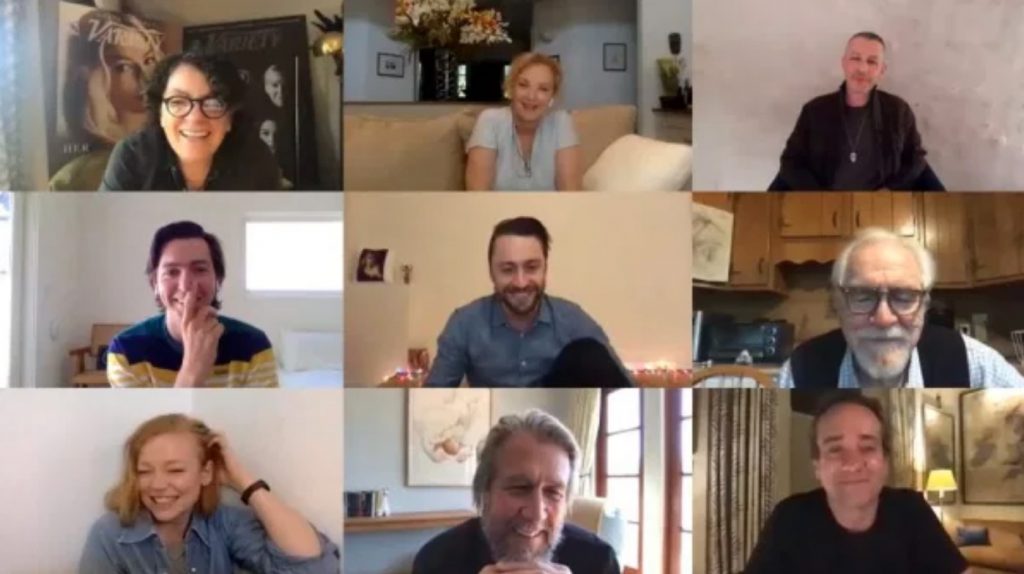
John Wyver writes: another pot-pourri of links to stuff that has engaged and interested me over the past week, including the exceptional virtual roundtable organised by Variety with the cast of Succession – more on that below the fold. More urgent reflections on the the past and the present need to take the lead…
• Toppled statue glorified slavery: for the New York Times, strong, clear, unarguable from Gurminder K Bhambra, Professor of Postcolonial and Decolonial Studies in the School of Global Studies, University of Sussex.
• The new age of autarky: historian David Edgerton as valuable as always, for New Statesman.
• The unpresident and the unredeemed promise: Fintan O’Toole as great as ever for the New York Review of Books – from the following he spins a dazzling analysis of the present and of possible futures:
The US has engaged in many armed conflicts, but three of them have never ended: the Civil War, the Vietnam War, and the so-called war on terror. Their toxic residues flow from different directions into the current breakdown of the American polity.
John Wyver writes: These are some of the things that have engaged me over the past extraordinary, historic week. The selection starts with four essential analyses, and with a powerful video made by actors who have worked with the RSC in recent years. Above, the Planet Labs image from an orbiting satellite of the centre of Washington DC with the glorious two-blocks-long mural ordered by Mayor Bowser on the street leading up to the White House.
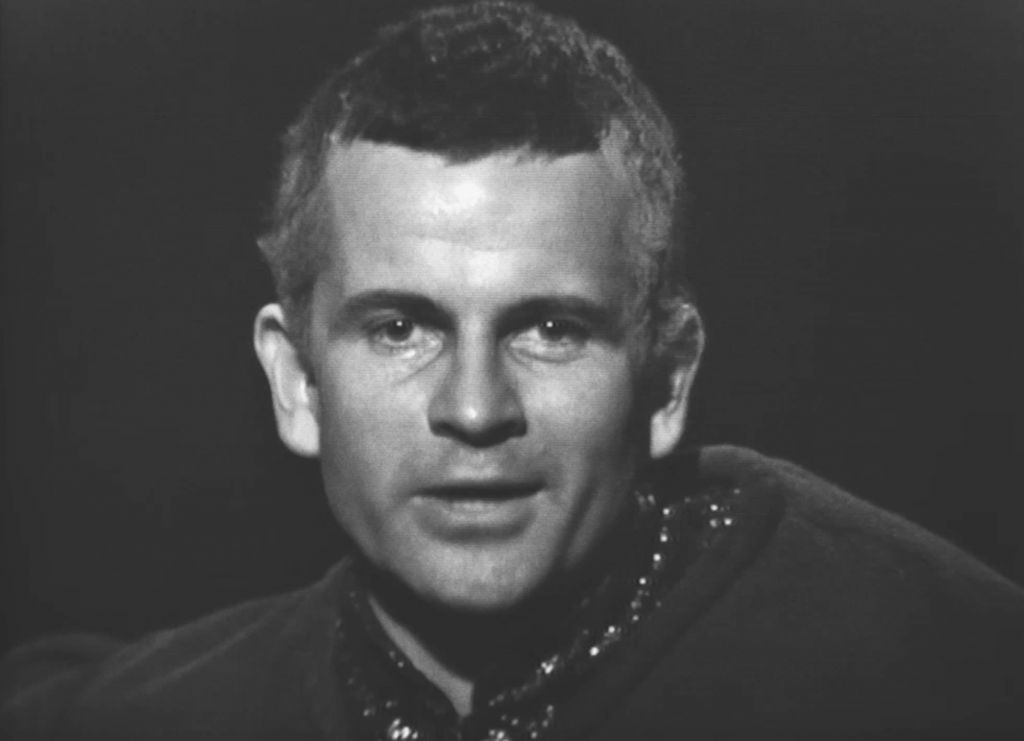
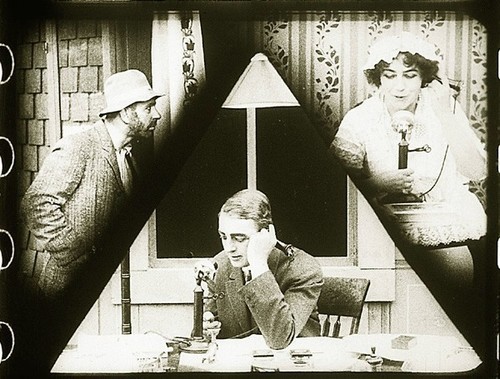
John Wyver writes: Following on from my two earlier posts, here and here, this one develops my tentative thoughts about screen performance in lockdown and the prevalence – and seeming appropriateness — of split-screen styles for this moment. I introduced the argument in the first post and developed it further in the second, which looked more specifically at feature films, narrative and split-screen styles. Here, I want to muse more about split-screen and television today, and to get to that by looking at some engaging examples of historical split-screen performance, including in music videos, and by considering a sequence from the first broadcast of the CBS current affairs series See It Now in 1951, from which the above screen grab is taken.
First, here’s ‘Once Upon a Time’ from MGM’s It’s Always Fair Weather (1955), with Gene Kelly, Dan Dailey and choreographer Michael Kidd. The direction of film is credited to Kelly and Stanley Donen.
As a very good Dissolve roundtable explores, the tri-part split-screen, which is also employed elsewhere in the film, expresses brilliantly the separate but parallel lives of three former soldiers trying to adjust to the harsh climate of post-war America. But the sequence is also a response to the what was then perceived as the threat of television to the movies — as is the film’s more explicit satirical approach to the new medium. The big guns of CinemaScope and Eastmancolor spectacle aid the special effects split-screening to demonstrate exactly what the low-res, mostly monochrome domestic medium can never hope to deliver.
That was then, and now of course, as is shown by this recent delightful split-screen dance from Broadway stars Katheryne Penny and Nathan Lucrezio , posted a few days ago to Facebook, you can shoot and edit this at home, and distribute it freely to hand-held screens around the world.
John Wyver writes: In the first post in this series I suggested that the lockdown has prompted the proliferation of the performance of music, dance and drama in split-screen media spaces. The prominence of work that employs what, following the scholar Lev Manovich, we can call ‘spatial montage’ (that is, juxtaposed shots in the same frame, rather than in a sequence) suggests – perhaps – a distinctive challenge to the dominant screen language of performance.
The overwhelmingly familiar language, which is common across screen stories of many kinds, privileges single frame shots and employs them to construct, through techniques like continuity editing, convincing suggestions of real world spaces. (I’m aware that here and elsewhere my own language lacks appropriate analytical rigour; that may come if I get to write up these jottings in a more formal way.)
What I want to do in this post is to highlight some examples of split-screen story-telling in film history and to reference elements of reading that I’m finding useful in thinking about all this. A key source for me is a 2009 paper by Jim Bizzocchi, ‘The fragmented frame: the poetics of the split-screen’, a draft of which is available via the link. Additional reading can be accessed via a decade-old post, ‘Split screen studies’ on the invaluable-as-ever Film Studies for Free resource created by Catherine Grant. The post was compiled by Catherine Grant to complement her elegant (and early) video essay exploring the narrative and psychological dimensions of a split-screen sequence near the start of Darren Aronofsky’s Requiem for a Dream (2000) – and this is well worth (re-)visiting now.
John Wyver writes: Two months or so into lockdown I wonder if, along with so much else, we are seeing a fundamental shift in the screen language of our moving image media. So do I have your attention now?
I am struck by how quickly so much online performance, entertainment and drama has moved away from forms in which single screen images are predominant and on-screen space is constructed through sequential editing of supposedly contiguous shots. Instead, we are seeing the blossoming of innovative screen spaces with multiple images from separate real world or abstract environments proliferating within single frames.
As I’ll go on to explore in what I intend to be a series of posts, key influences here are our enforced use in professional and personal contexts of Zoom and the like, as well as the mainstreaming of super-smart Tik Tok videos. Another contributing factor, of course, are the constraints on conventional media production. Out of this nexus of challenges and opportunities is emerging what we might think of as the screen language of lockdown.
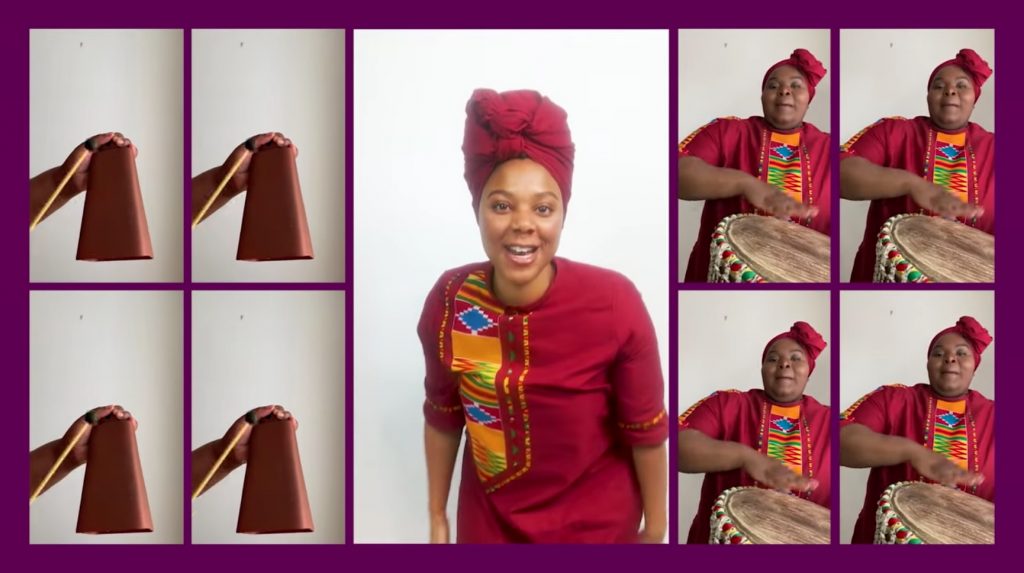
This past weekend saw the premiere of Illuminations’ modest contribution to this language with Unicorn Theatre’s Anansi the Spider Re-spun, episode 1: Brother Anansi and Brother Snake, a screengrab from which is above. Over the past weeks we have been working with the Unicorn’s artistic director Justin Audibert and his brilliant creative team to adapt for the screen the Unicorn’s hit show for 3-8 year olds. Our own Todd MacDonald collaborated as editor and technical director, and as yesterday’s 5-star review from Samuel Nicholls at A Younger Theatre recognised, the result is simply ‘an unbeatably fun and fresh experience’.
John Wyver writes: another list of links from lockdown, with my thanks once more to those on my Twitter timeline who have prompted many of them. These are some of the articles and videos and more that I have enjoyed and been engaged by over the past week.
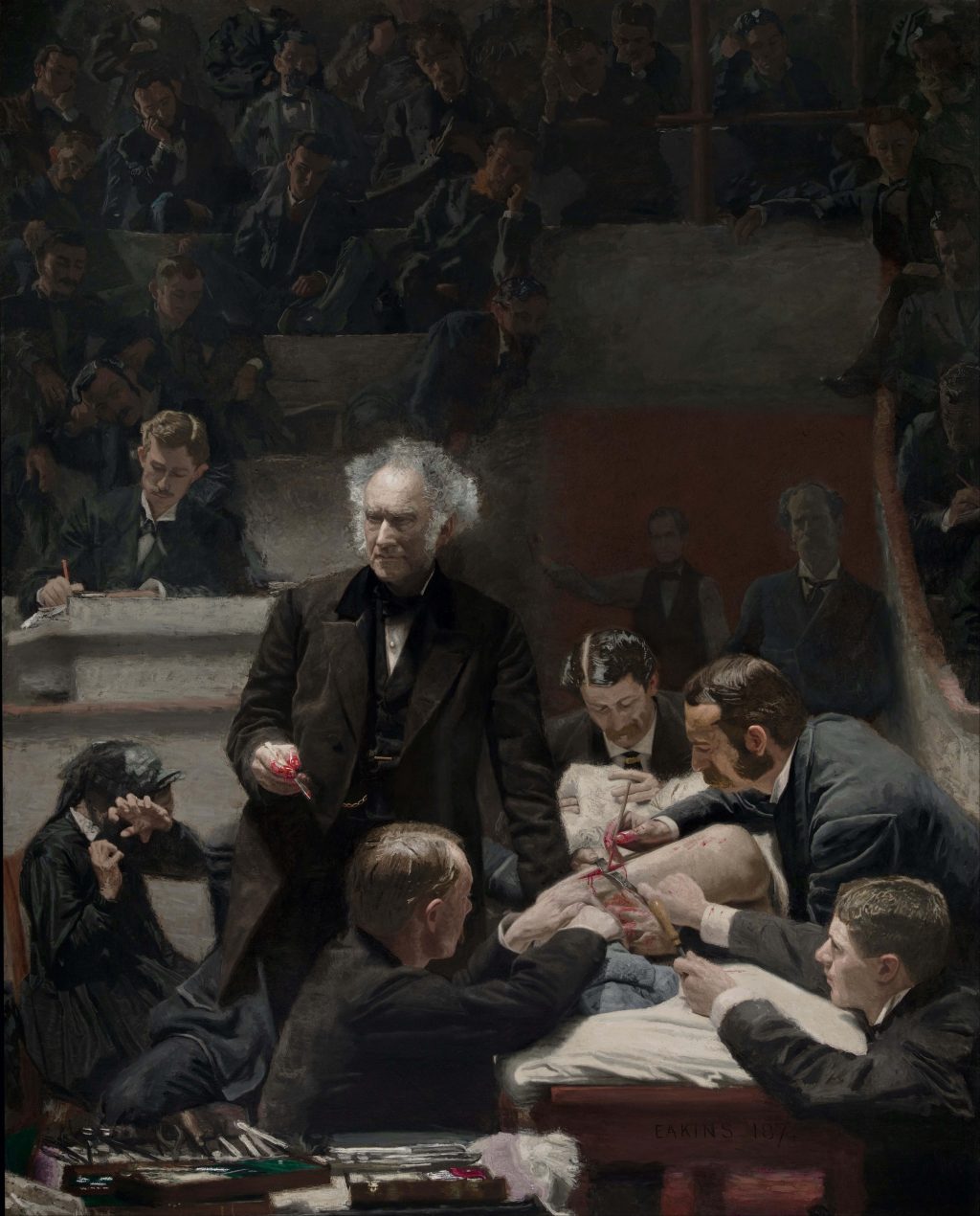
• Taking lessons from a bloody masterpiece: I was very taken by this New York Times interactive essay by Jason Farago and producers Gabriel Gianordoli and Alicia DeSantis – combining commentary with an innovative exploration of Thomas Eakins’ great 1875 painting ‘The Gross Clinic’ (Philadelphia Museum of Art, detail above, full painting below), it offers both stimulating ideas and a revelatory form of online close looking.