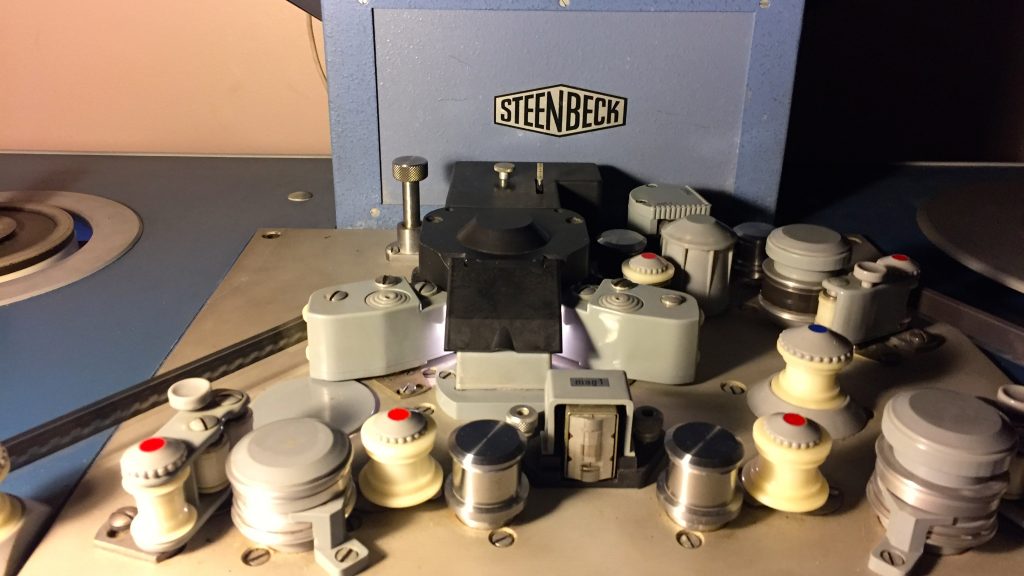
I have had a hugely enjoyable morning viewing a 16mm combined optical print on a 4 plate Steenbeck flat bed. The substance of what I watched must wait for a future post, since here I want simply to celebrate the pleasure provided by the wonderful Steenbeck. A time there was when these editing tables were ubiquitous, and of course I recognise that my jouissance came with a a double shot of nostalgia. Such, however, is the age profile of those making television today, that I wager the majority of people in production now have no sense whatever of what I’m talking about. Certainly most of them will not have had the satisfactions of lacing up a print, locking sprocket holes onto the triangular teeth, hearing the nylon rollers click crisply into place, and easing the speed controller into ‘forward’ so as to prompt the hum of the spinning prism and, finally, to see a sequence of tiny still images spring into life. read more »
My weekly offering of links to articles and videos that I have found interesting or stimulating over the past seven days. The US election continues to prompt much exceptional written journalism, and I lead with several pieces related to this. Thanks, as always, to those who have pointed me towards some of them, via Twitter and in other ways, and apologies for the absence of appropriate name-checks.
• How Trump took hate groups mainstream: very fine Mother Jones journalism by Sarah Posner and David Neivert about the candidate’s connection with far-right extremists.
These photos expose the artifice and the political veneer, holding up the process and candidates to an unprecedented level of inspection, critique, and in some cases, a reciprocal dose of hostility. Here are seven photos that, if not for the unusual tone and atmosphere of this campaign, may not have been published.
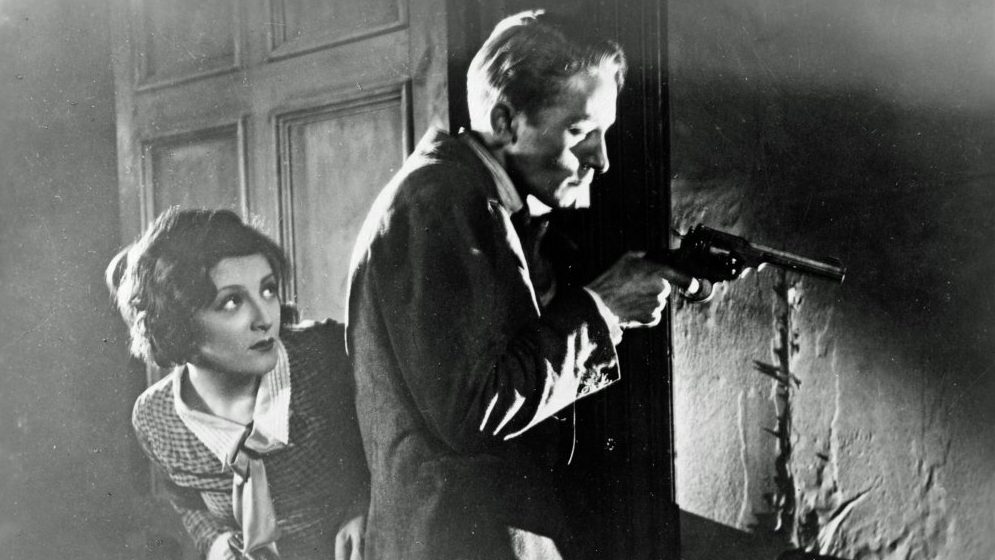
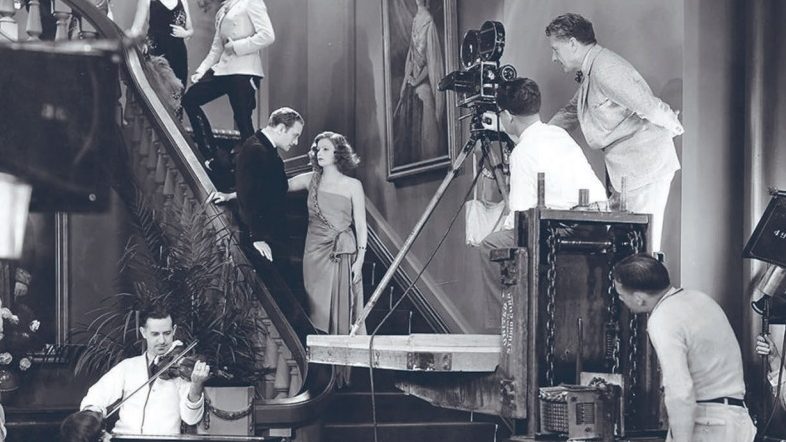
To BFI Southbank for the London Film Festival’s Archive Gala screening of The Informer. Produced in 1929 during the transitional period when the industry was changing from silent film to sound, this intense tale of love, friendship and betrayal was made both with crude dialogue and – with subtly different shots – without. But as BFI curator Bryony Dixon demonstrated with extracts beforehand, the sound recording at the time was crude and the accents of a European cast uncertain. Nor, as this triumphant screening with a newly commissioned score demonstrated, does the film really require speech. A few inter-titles help the story along but The Informer is supremely and gorgeously visual – as well as being a rattling good yarn. read more »
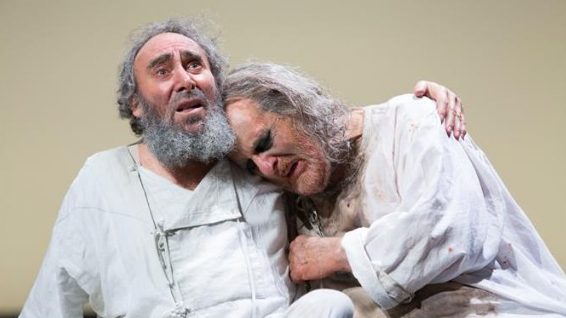
Tonight RSC Live from Stratford-upon-Avon broadcasts Gregory Doran’s production of King Lear with Antony Sher in the title role. If we can achieve something of what we got in the second camera rehearsal yesterday, then I think it will be very special – go here to find cinemas near you that are screening it.
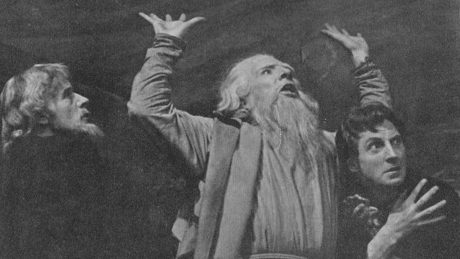
Working on this production made me curious about the first full-length British screen version of the play, which was the live transmission by BBC Television in 1948. Sadly, we have no archive copy of this broadcast and nor do there seem to have been any reviews, but there are a few written and photographic traces, which I have started to gather here. read more »
On Wednesday this week RSC Live from Stratford-upon-Avon broadcasts Gregory Doran’s production of King Lear to cinemas across Britain. As preparation for this, my work as producer has meant that I’ve watched the staging half a dozen times now – and on each occasion it seems to me richer and deeper and more moving. Antony Sher plays the king and gives, to my mind, a fiercely intelligent, subtly complex performance that I feel privileged to be seeing at close quarters. Complementing him is an exceptional cast including David Troughton, Antony Byrne, Paapa Essiedu and Natalie Simpson. And the production is strikingly visual too, with Niki Turner’s vivid, often sumptuous design and Tim Mitchell’s accomplished lighting. If you can book a ticket for Wednesday I don’t think you’ll regret it.
We’re opening the broadcast with a brief montage of photographs of distinguished actors who have played Lear at Stratford, beginning with John Gielgud in 1950. And as background to all of this I have been reading Jonathan Croall’s terrific recent book for The Arden Shakespeare, Performing King Lear: From Gielgud to Russell Beale. (I should note I’m also working on a book for Arden.) read more »
I wish, I wish I had been in Pordenone for the 35th edition of that northern Italian town’s Silent Film Festival. I have been on several occasions in the past, and the event’s intense week of screenings combined with Italian food and wine is simply glorious. But I had the RSC cinema broadcasts of Cymbeline and King Lear to look after, and so I could only follow it from afar. Which is something that Pordenone facilitates by publishing online not only its daily schedule but also its excellent, scholarly catalogue (from the cover of which the detail above of a production still from The Mysterious Lady is taken). read more »
I missed a links post last Sunday and other entries over the past fortnight have been only sporadic. I can only plead busy-ness in the preparation for the RSC Live from Stratford-upon-Avon broadcasts of Cymbeline, ten days ago, and King Lear, next Wednesday (and of which more tomorrow). Here, however, is the weekly offering of links to articles and videos that I have found interesting or stimulating over the past seven days. Thanks, as always, to those who have pointed me towards some of them, via Twitter and in other ways, and apologies for the absence of appropriate name-checks.
• The protective state: British politics is so awful at present that we have a profound responsibility to undertake some deep analysis; fortunately there are writers who can help, including Will Davies here in an exceptional post for Goldsmiths’ Political Economy Research Centre…
• Idiots: Dan Mersh’s message to America from us Brits – ‘we’re the classy Judi Dench-y ones and you’re the subhuman fuckwits who think that a mentally unstable bankruptcy addict is somehow going to be “strong on trade”.’
Tonight it’s the Last Night of the Proms for me. I know most people celebrated this oddly English and – especially in the current climate – deeply contradictory occasion a month ago. But for me Saturday 8 October is the ‘Last Night’. That’s because, for the second year in a row, I have been listening in order to every minute of every Prom using the wonderful BBC iPlayer Radio app. Which has allowed me to access and download every Prom since the unscheduled ‘La Marseillaise’ on 15 July and then listen at my leisure. I have found this to be a quintessentially informative, educational and entertaining experience. Thank you, BBC! read more »
Perhaps I’ve mentioned that I am writing a book about screen adaptations of Royal Shakespeare Company productions? I’m currently in the middle of researching and drafting the first of six chapters, which is intended both to introduce the key ideas of the volume and to explore media versions of productions from the Stratford Memorial Theatre before 1960. That was the year that Peter Hall created the RSC out of a company that had a history going back to 1879.
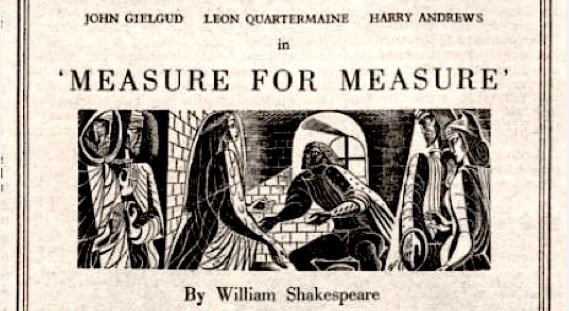
Before 1960 there were both film and television versions of Stratford productions, although the dominant adaptation medium was radio. Radio, I recognise, doesn’t entirely align with ‘screen’, but even so wireless versions of interwar and post-war Stratford stagings feel like they should be part of my story. We have no recordings of most of these, but there is at least one very remarkable – and I think all-but-unknown – archival survivor. Today I heard, some 67 years after it was broadcast, a recording of Peter Brook’s ground-breaking 1950 Stratford production of Measure for Measure with John Gielgud and Barbara Jefford. read more »